Show Caption
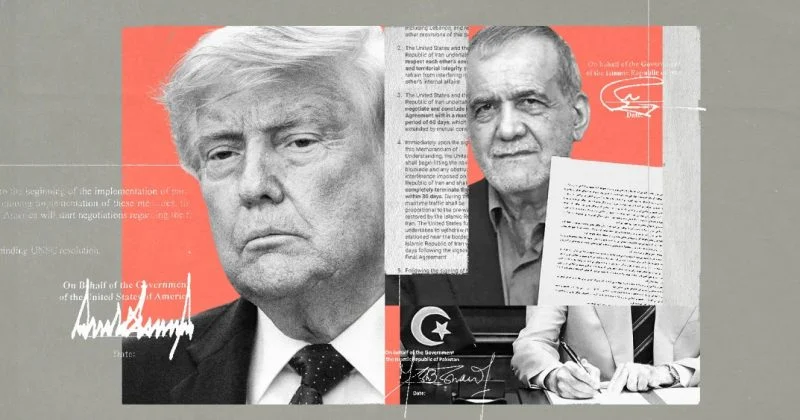
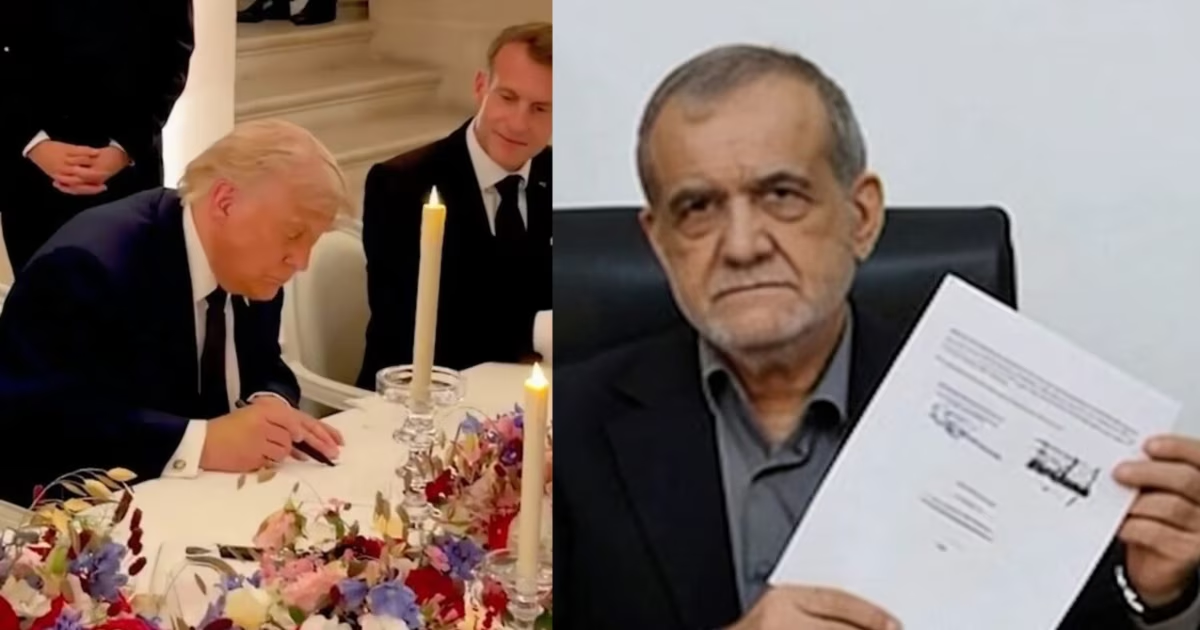
The deal President Donald Trump struck with Iran this week is the United States' second attempt this century to prevent the Middle Eastern country from developing a nuclear weapon.Trump and Iranian President Masoud Pezeshkian signed the preliminary deal, known as a memorandum of understanding, to end fighting between the countries on June 17, almost four months after the United States and Israel first launched joint strikes on Iran to eliminate its nuclear capabilities.The MOU says Iran commits to refrain from procuring or developing nuclear weapons in exchange for sanctions relief and a $300 billion reconstruction plan. Both sides agree to reopen the Strait of Hormuz.In 2015, then-President Barack Obama’s administration negotiated the Joint Comprehensive Plan of Action (JCPOA), commonly known as the Iran nuclear deal, which was signed by Iran, the United States, China, France, Germany, Russia and the United Kingdom.The agreement imposed limits on Iran's nuclear program to prevent it from developing nuclear weapons. In exchange, Iran received phased relief from international economic sanctions.Trump withdrew from the JCPOA agreement in 2018, during his first term as president. The United States began reimposing "maximum pressure" sanctions, targeting Iran's critical energy, petrochemical and financial sectors.So how does Trump’s 14-point MOU differ from Obama’s deal?While it is difficult to compare a memo with a completed agreement, here are some top-line differences:Relief and reconstruction moneyTrump's deal commits the United States to providing sanctions relief and $300 billion for reconstruction and economic development of Iran with regional partners. It also commits to terminating all types of sanctions, including on Iran's oil and petrochemical exports as well as the U.N. Security Council resolutions.The MOU also states that the United States will grant any required licenses, waivers and permissions needed for financial transactions related to the fund. The mechanism for the implementation of this plan will be part of the final deal, to be reached within 60 days. Obama's deal did not include a reconstruction fund but had sanctions relief and transferred $1.7 billion in cash to settle a decades-old arbitration claim between the United States and Iran. Strait of HormuzUnder the MOU, Iran has agreed to reopen the Strait of Hormuz, which carried about 20% of the world's oil supply before the war. The country's blockade has throttled traffic through the channel, driving up fuel prices and threatening the global economy.The United States, which erected its own retaliatory naval blockade, agrees in the MOU to completely remove it within 30 days, along with "any disturbances or impediments against the Islamic Republic of Iran."Iran, in turn, agrees to bring the traffic of vessels to levels before the war.The Strait of Hormuz wasn't part of the 2015 agreement because it was not closed then.Nuclear weaponsThe 2015 agreement signed by Obama said “that under no circumstances will Iran ever seek, develop or acquire any nuclear weapons.” Iran also committed to open its facilities to extensive international inspections in exchange for the sanctions relief and unfreezing of its foreign assets.The agreement aimed to limit Iran’s nuclear program but not shut it down entirely. It permitted the country to keep a small amount of monitored low-enriched uranium, but constrained and restricted Iran’s ability to obtain a nuclear weapon. It also required Iran to keep its uranium enrichment levels at 3.67%, significantly below the 90% enrichment level needed to create a bomb.The agreement had "sunset clauses" – key dates when limits on Iran's capabilities would expire, enabling the country to resume or increase production.Trump's MOU, similar to the earlier agreement, says Iran “shall not procure or develop nuclear weapons.” It does not, however, include details such as whether or when Iran will be allowed to enrich uranium. The Trump administration is aiming instead for permanent restrictions.Swapna Venugopal Ramaswamy is a White House correspondent for USA TODAY. You can follow her on X @SwapnaVenugopal