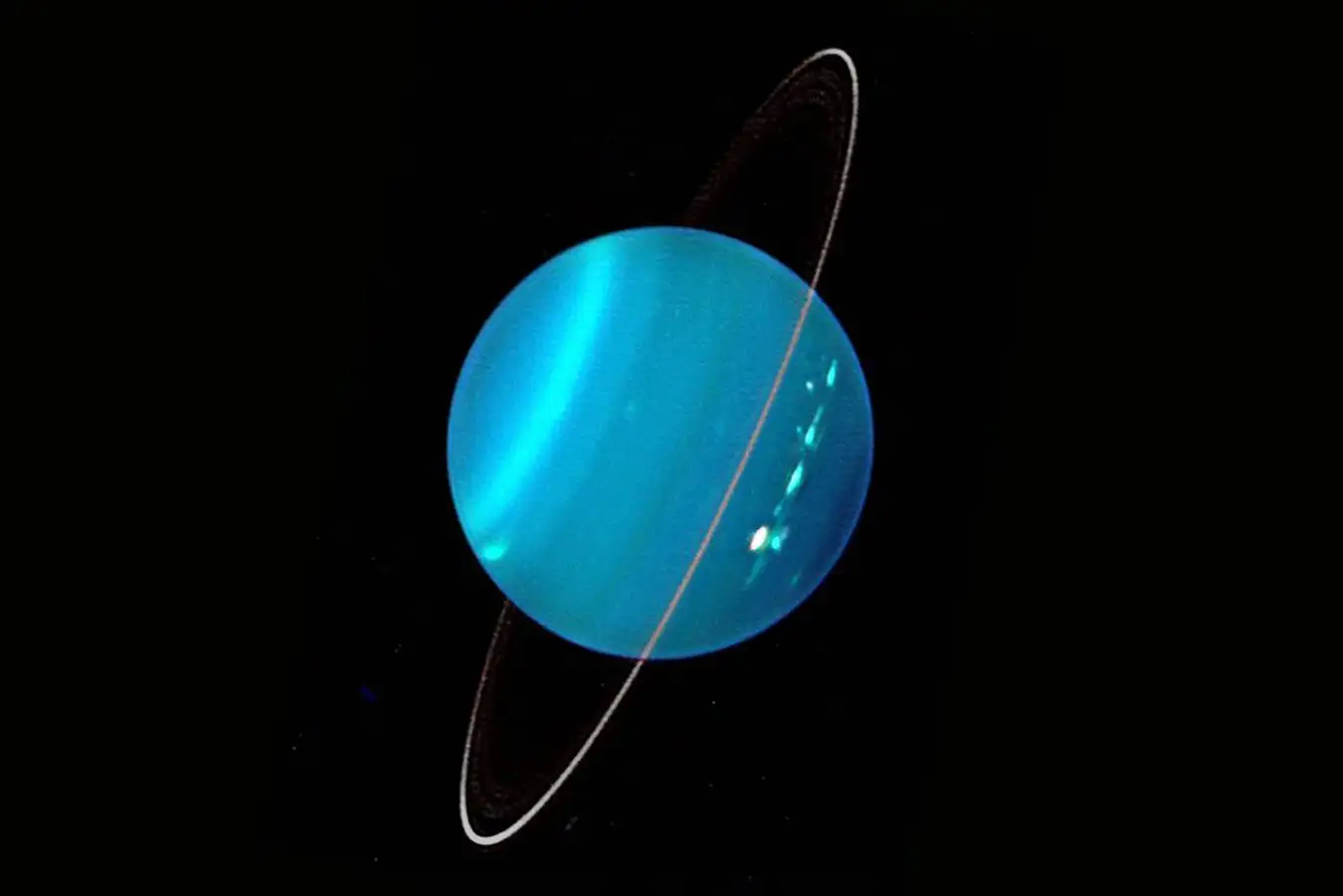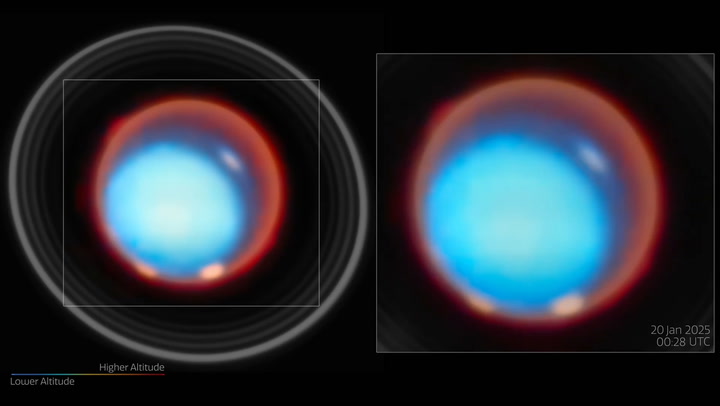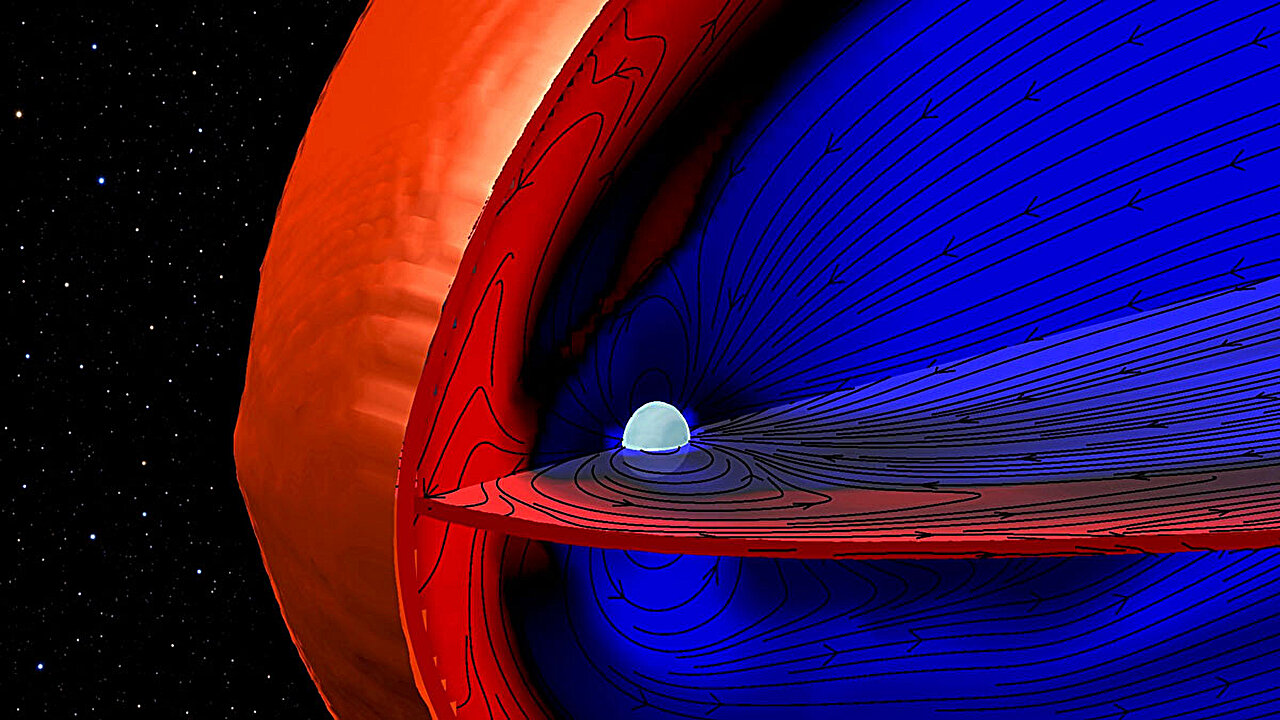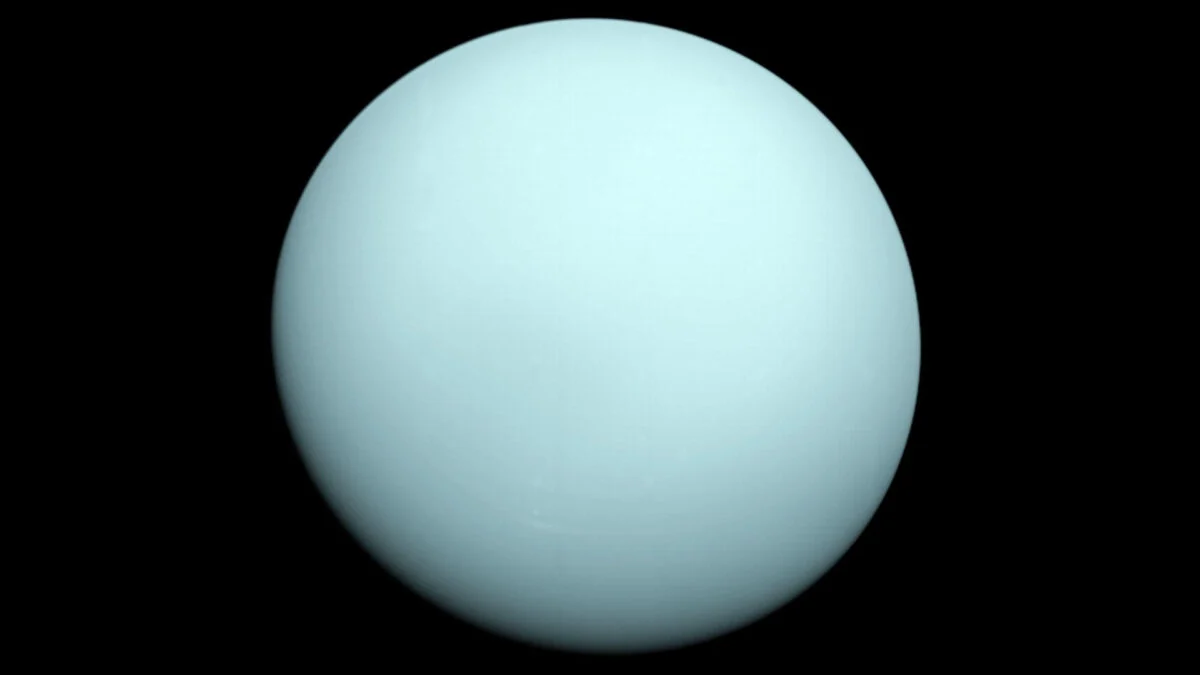
Uranus appears beyond the horizon of its moon Miranda in this illustration. If detectable, high-energy neutral particles produced near Uranus could help scientists decipher the structure and dynamics of the icy planet’s magnetosphere. Credit: NASA’s Goddard Space Flight Center Conceptual Image Lab
Sending a spacecraft to the underexplored planet Uranus is at the top of many planetary scientists' wish lists. But which spacecraft-mounted instruments would be most useful for answering questions about the mysterious ice giant?
Several missions to other parts of the solar system have included an instrument that detects energetic neutral atoms (ENAs) zipping through space. An ENA is created when a fast-moving, positively charged ion collides with a neutral particle and "steals" an electron. The now-neutral atom maintains its high energy, and because it is no longer charged, it escapes the influence of a magnetic field and flies onward in a straight line—perhaps right into a spacecraft-mounted ENA detector.
By measuring the numbers, directions and energies of ENAs produced in a magnetic system, scientists can create three-dimensional images that illuminate that system's structure and dynamics. ENA imaging previously deepened understanding of the space environments surrounding Earth, Mars, Saturn and the sun and highlighted interaction mechanisms occurring at the edge of our solar system.