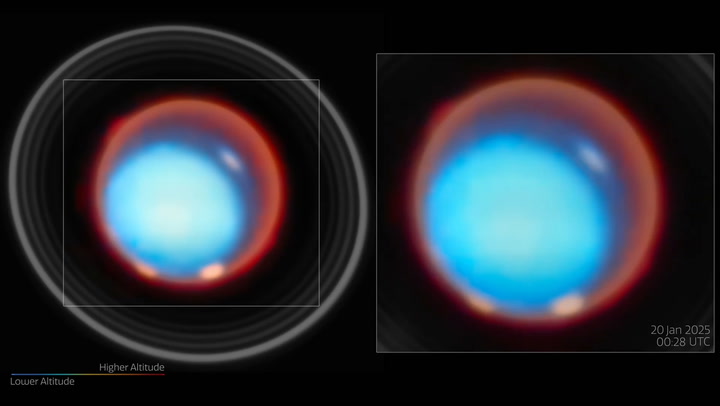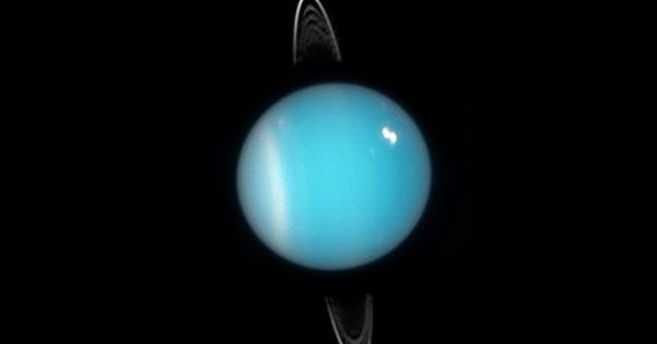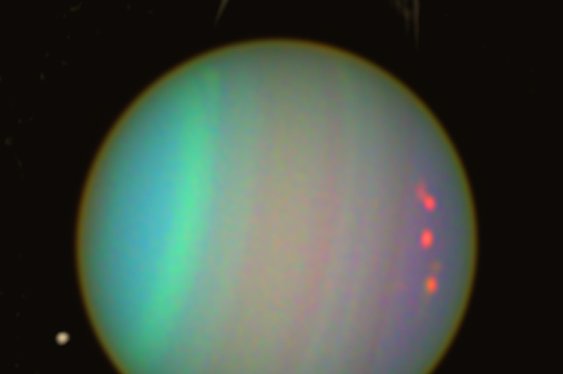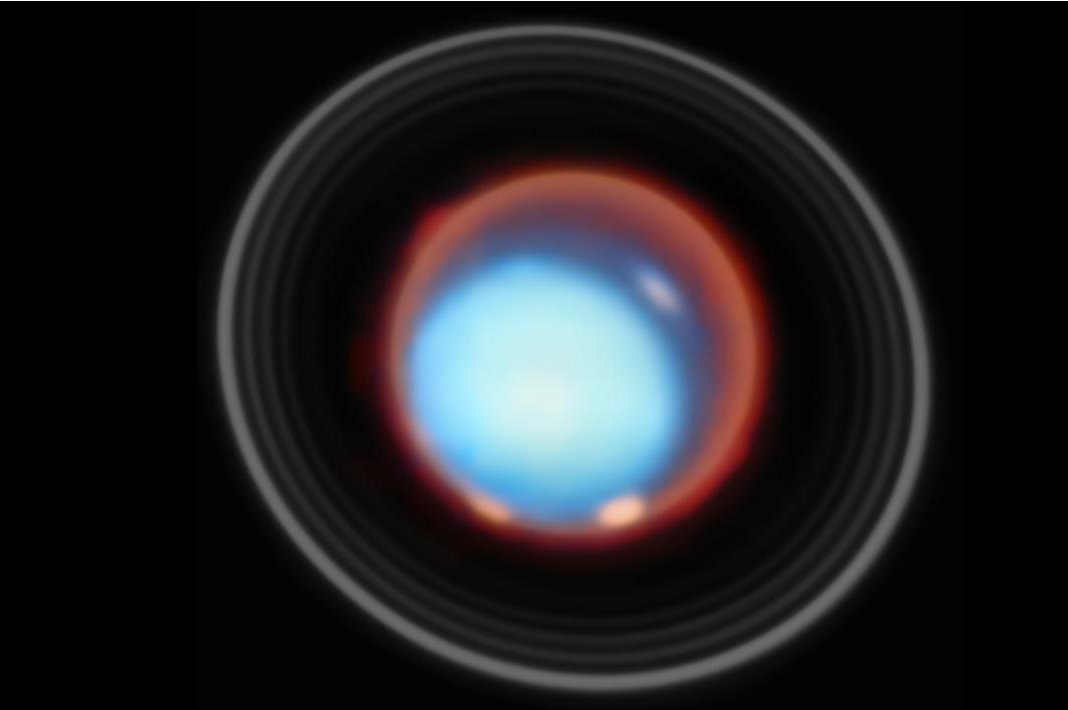
NASA's James Webb Space Telescope has captured the first vertical view of Uranus's upper atmosphere, delivering an unprecedented look at the planet's ionosphere and auroral structures.
The new observations, released by NASA on Tuesday, show how temperature and charged particles vary with height above the ice giant's cloud tops, offering fresh insight into one of the least understood worlds in the solar system.
For decades, Uranus has remained enigmatic to scientists. Its upper atmosphere, composed mostly of hydrogen and helium and extending thousands of miles above the cloud layer, has been challenging to study since the only spacecraft to fly by the planet, Voyager 2 in 1986, provided limited data, according to the European Space Agency. Webb's Near-Infrared Spectrograph (NIRSpec) changed that by observing the planet over nearly a full rotation.
A collage of 3D images of Uranus showing the vertical structure of the planet's upper atmosphere taken by the James Webb Space Telescope's NIRSpec instrument. Image courtesy ESA/Webb, NASA, CSA, STScI, P. Tiranti, H. Melin, M. Zamani
The resulting three-dimensional map reveals how temperatures peak between roughly 1,800 to 2,500 miles above the cloud tops, while the density of electrically charged ions is highest around 621 miles. These vertical profiles give astronomers a clearer picture of how energy moves through the upper atmosphere and interacts with the magnetic field.