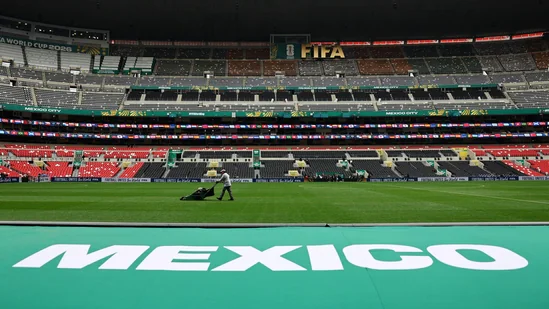
It’s often said that bigger means better. This year’s FIFA World Cup may put that to the test.By almost any metric, the 2026 tournament is the largest ever: the most host countries; the longest distances between stadiums; the most players, teams, and matches; and then there’s the eye-watering ticket prices.The scale is a logistical nightmare for fans, teams, and host cities. Held across three countries— Canada, Mexico, and the US—48 teams (up from the usual 32) will navigate 16 host cities separated by thousands of miles and four distinct time zones.With FIFA expanding the tournament to defend soccer’s dominance over a host of growing contender sports, fans and teams alike should get used to the upscaling, experts tell WIRED Middle East. Going forward, only the richest or largest nations will ever be able to host a tournament alone.Ticket Prices and Average SpendThe sky-high prices to attend games in this year’s tournament have drawn global attention. FIFA has been accused of pricing normal people out of soccer by implementing exorbitant rates for all but the least desirable seats.Flights and HotelsIndustry data suggests that hotel rooms in host cities across Canada, the US, and Mexico are also surging in price.“Average attendance cost in the US host cities is running north of $5,000 a head, before you’ve factored in flights between venues,” says Christos Anagnostopoulos, an assistant professor in sports management at Hamad Bin Khalifa University in Qatar.An average visitor is expected to spend around $5,400 in the US—far above the $720-$2,500 visitors to Qatar spent in 2022.Transport at this year’s tournament is fundamentally different from that of the one-city tournament in Qatar, or in Russia in 2018, which provided free public transportation and an additional 500 trains to help people get around.This year, because of the vast distances, the only option for fans and teams is flights, which airlines have been adding to accommodate potential World Cup travelers.“Teams and fans now must factor in flights, not metro rides, and the carbon and cost implications are real,” Anagnostopoulos says.The need to book flights, not trains or taxis, may also be decreasing demand for hotels simply because the travel costs are too high for some people. “US hotels are already reporting bookings below expectations,” Anagnostopoulos says. “Scale doesn’t guarantee the crowds will show up.”SecurityFor organizers and host cities, the scale of the tournament demands a massive investment in security, including against threats that would have barely crossed the minds of previous hosts.The US federal government has issued $625 million in grants for host cities to address security issues. On top of that, the Department of Homeland Security has made over $200 million worth of grants available to states to buy anti-drone technology, with the US State Department highlighting hostile actors’ increasing access to drones and other technology.In Canada, federal authorities have issued around $104 million worth of grants to host cities Vancouver and Toronto. That brings total public grants in Canada and the US alone to nearly $1 billion—likely just a fraction of the real costs of securing the tournament.The size of the tournament, and the fact that it crosses borders, has pushed the price tag higher.“Qatar 2022 benefited from a highly compact geography, with venues operating within a relatively unified environment. The 2026 World Cup will involve multiple cities, jurisdictions, agencies, and technology ecosystems across the United States, Canada, and Mexico,” says Leo Levit, chair of Onvif, a membership body focused on standardization of physical security products.“The challenge is not simply the number of systems involved, but whether those systems can exchange information efficiently,” he adds.The Future of the World CupThe numbers tell a story of a tournament straining under its own ambition. It’s not yet clear whether these investments will pay off in terms of tickets bought and advertising slots sold. Why, then, is FIFA pursuing growth at all costs?According to Simon Chadwick, professor of sport and geopolitical economy at the international SKEMA Business School, the reason may be growing competition from other sports.“What [FIFA president Gianni] Infantino is trying to do is to ensure that football remains robust, relevant, prominent and that it doesn’t begin losing market share—to the NBA, which is in China, India, Africa, and the Gulf region; to the NFL, which is making moves on Europe; and to Formula One, which has grown hugely in popularity, particularly in North America,” Chadwick says.Adding more teams to the tournament means that more space for players and fans is required, but it also means more viewers and tickets sold. FIFA is forecasting 6 billion engagements across TV, streaming, and digital platforms this year, up from last tournament’s 5 billion. Over 5 million people will attend in person, compared with Qatar’s 3.4 million.But protecting soccer’s global primacy comes with a trade-off: It looks increasingly likely that only a select few economies will ever be able to host the tournament alone. The World Cup is now “too big for most nations,” Anagnostopoulos says, explaining that the tournament has even outgrown France, Germany, Russia, or England.“From here, you either have to be enormously rich—China, Saudi Arabia—and willing to build a host nation from scratch—India—or you have to share the load across borders,” he says. “The days of a single traditional football nation hosting alone are probably numbered.”This article originally appeared on WIRED Middle East.
This World Cup, Bigger Might Not Really Be Better
The biggest World Cup ever is pushing fans, players, and host cities to their limits—and experts say this is only the beginning.
880 words~4 min read