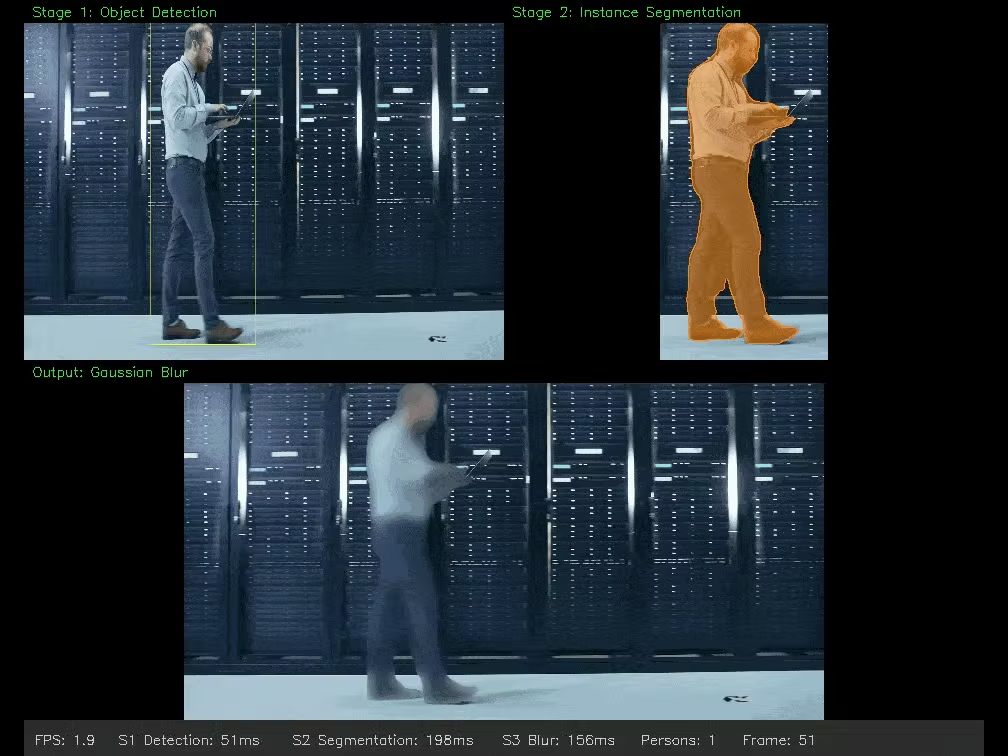
Things used in this project Story IntroductionComputer vision tasks sit on a ladder of increasing detail. Image classification gives a single label for a whole frame. Object detection draws a bounding box around each object. Instance segmentation goes one step further and outlines every object pixel by pixel, producing a separate mask for each instance. That extra precision is what lets you lift a single person cleanly out of a scene, trace an irregular part on a conveyor, or measure an object's true shape instead of a rectangle around it.Edge Impulse ships classification and object detection as built-in learning blocks, but not instance segmentation. This guide adds it by combining two techniques:Model cascading chains two models so each does what it is best at. A small, fast detector runs first, and a heavier segmentation model runs only when the detector finds something worth segmenting. Each model stays simple to train and deploy, and you spend compute where it matters.BYOM Freeform ("Bring Your Own Model") lets you upload any ONNX model to Edge Impulse and have the runtime hand back its raw output tensors untouched. This is the escape hatch for deploying architectures Edge Impulse does not parse natively, such as YOLO-seg, where you do the post-processing yourself.To keep it concrete, we build a person-blur privacy application: Stage 1 detects people, Stage 2 segments each one, and the app blurs them using their pixel-accurate masks so the person is hidden while the background stays sharp, which is hard to achieve with bounding boxes alone. The whole pipeline runs through the Edge Impulse Linux runtime on a Qualcomm QCS6490, and because it is built on .eim files, the same code runs on any Edge Impulse Linux target.
Instance Segmentation on Edge Impulse with BYOM Freeform
Build a vision pipeline that detects people, segments each one with a pixel-accurate mask, and blurs them for privacy By Samuel Alexander.
2,505 words~11 min read