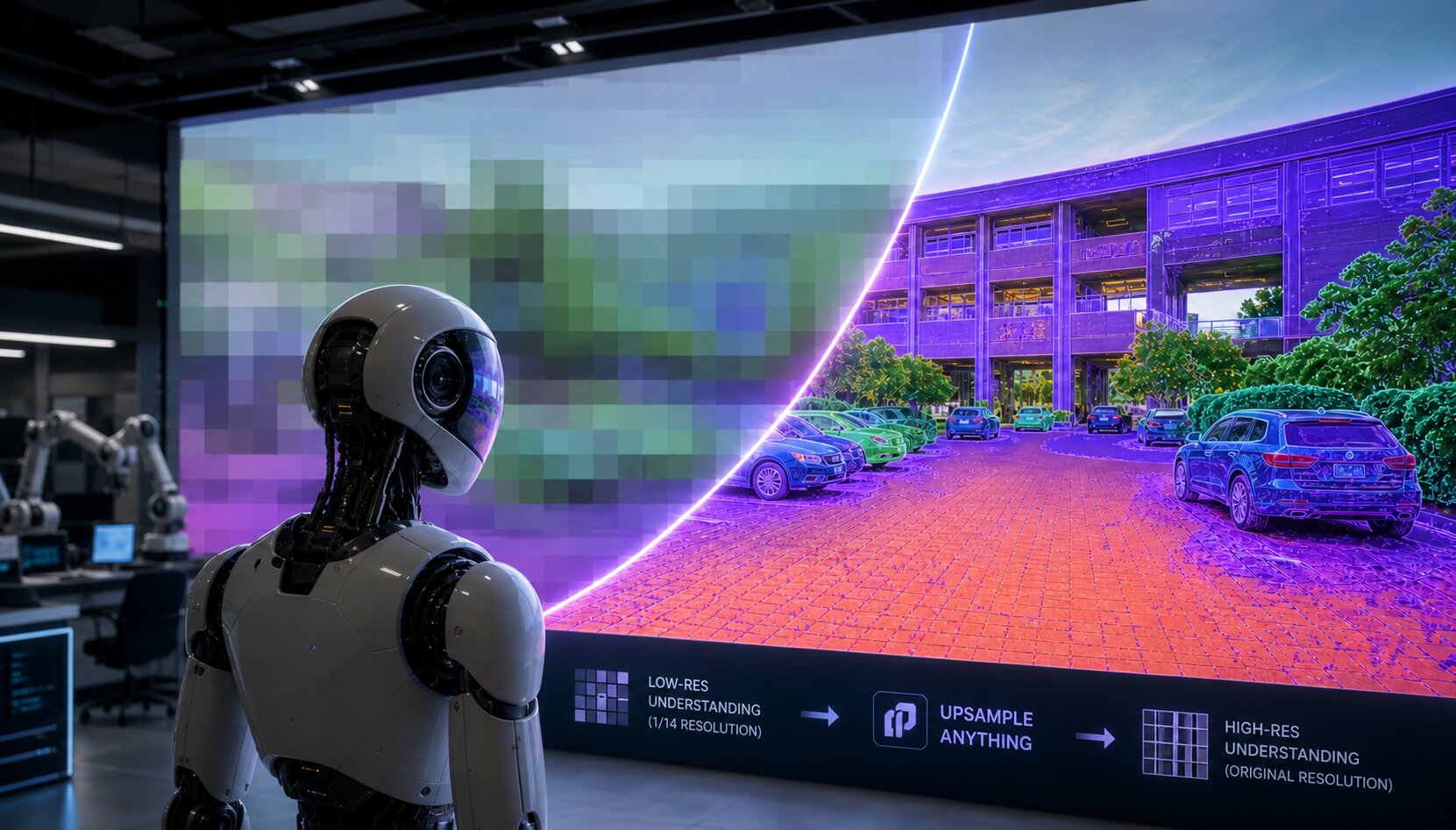
Comparison image illustrating the performance gap with conventional methods (AI-generated). Conventional vision foundation models understand a scene by converting the input image into low-resolution features at a small patch level (left). Upsample Anything restores these low-resolution features to the original resolution level, enabling the AI to comprehend the scene's structure and boundaries with significantly higher precision (right). Credit: KAIST
From facial recognition on smartphones to humanoid robots, computer vision technology, which serves as the eyes of artificial intelligence (AI), is widely used in daily life. A joint research team from KAIST and international institutions has developed a technology that allows AI to see the world more clearly with minimal memory, increasing GPU (Graphics Processing Unit) memory efficiency by up to 16 times. The achievement is seen as a core technology that could accelerate the era of humanoid robots and on-device AI.
A research team led by Professor Changick Kim from the School of Electrical Engineering, in joint research with researchers from MIT and Microsoft in the United States, developed "Upsample Anything," a universal technology that can enhance the visual performance of AI even with limited GPU memory.