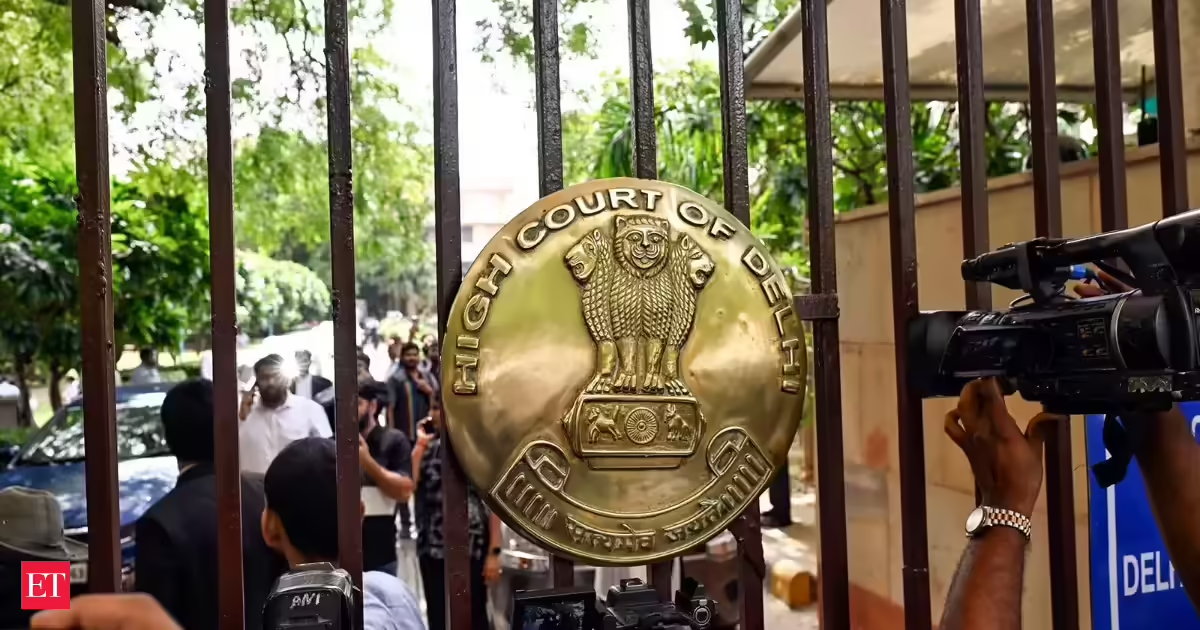
The Counsel representing Centre on Thursday told the Delhi High Court that the ban on Telegram was very much justifiable because lakhs of students are impacted, and it was not a permanent blocking of the app, but just for a few days, till the NEET-UG 2026 re-examination.The Centre vehemently argued before the High Court that Telegram has all the potential of getting misused by miscreants.Justice Tejas Karia has reserved the verdict after hearing extensive arguments from Senior Advocate Dhruv Mehta, appearing for Telegram, and Attorney General R Venkataramani and Solicitor General Tushar Mehta who represented the Centre. The judge also asked the counsel for both parties to file their written submissions, if any, by late evening Thursday.The Ministry of Electronics and Information Technology (MeitY), acting on recommendations of the National Testing Agency (NTA), issued a direction under Section 69A of the Information Technology Act, 2000, restricting access to the Telegram platform in India till June 22, covering the day of the NEET (UG) 2026 re-examination and its immediate aftermath.MeitY in its submission said that it had been receiving several complaints about misuse of Telegram as a platform. The first such complaint came from the NTA which was dated May 21, 2026.Meanwhile, the Court also questioned the Centre’s decision to temporarily restrict access to Telegram, saying how the rights of over 150 million users of the messaging app can be curtailed just because a few of them are taking up the test.“How can we stop the rights of 150 million people just because one set of citizens are appearing in examinations...The question is, can you block somebody else’s rights to protect someone else’s rights? The law has been laid down in the Anuradha Bhasin case (judgement),” the bench asked.The law officer said that the apex court judgement in the Anuradha Bhasin case does not prohibit blocking.Solicitor General (SG) Tushar Mehta who represented the Centre referred to the technical aspects of the messaging app and said that a single Telegram account can create up to 40 bots.“I will just give an example. In Telegram, one account user can create 40 bots. While in case of WhatsApp, it’s one bot per user. They have multiplicity encouraging architecture and then the bots can further multiply,” he said.He argued bots are machines and they can further multiply and as per the report, Telegram can offer bot infrastructure which can disseminate information in bulk. This feature is unique as it permits creation of sophisticated networks with minimal human oversight.Justifying the decision, Mehta said the government does not have this problem with other intermediaries. “This platform operates through the cloud. Even if they block it and someone does mischief, law enforcement agencies cannot reach the actual user,” he said.The SG also mentioned that the report indicated that Telegram is frequently used for terrorist activities and that law enforcement agencies face challenges due to this architectural design in various jurisdictions.Published on June 18, 2026
Ban on Telegram was very much justifiable, Centre’s Counsel to Delhi High Court
Centre's Counsel defends Telegram ban in Delhi High Court, citing misuse concerns as NEET re-examination approaches.
486 words~2 min read