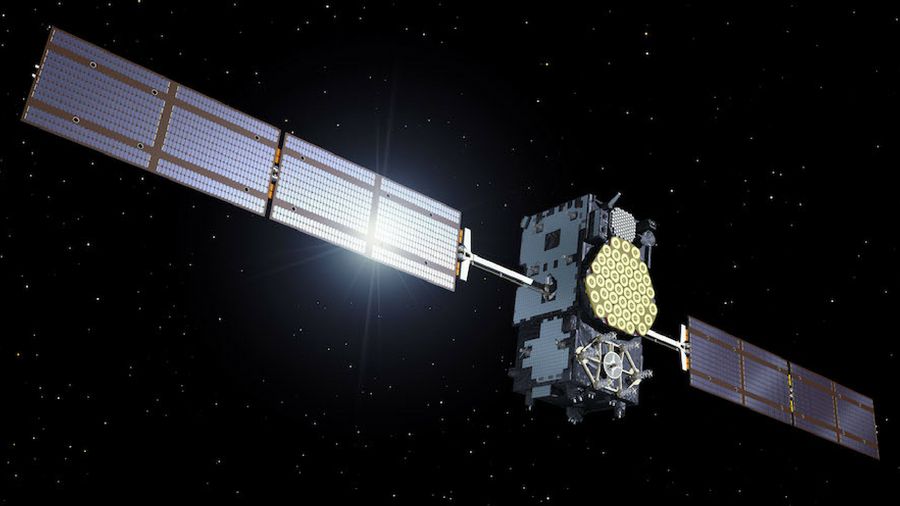
Artist's illustration of a U.S. GPS satellite, an increasingly frequent target for jamming, in orbit around Earth.
(Image credit: Lockheed Martin and U.S. Space Force)
An experimental satellite has mapped the scale of GPS jamming across Europe and the Middle East from space for the first time.The data surprised the team behind the project and indicated that satellites orbiting far from Earth aren't the only ones that experience degradation of their positioning, navigation and timing (PNT) signals, which could affect their performance and the safety of their operations.The new measurements were made by Pulsar-0, the first satellite of the novel Pulsar navigation constellation developed by California-based Xona Space Systems. The experimental satellite orbits 310 miles (500 kilometers) above Earth, testing Xona's technology before the company begins deploying its navigation constellation of 300 spacecraft in low Earth orbit (LEO) later this year.The purpose of the Pulsar constellation is to provide a more resilient PNT service compared to the United State's GPS network and other global navigation satellite systems (GNSS), such as Europe's Galileo or China's Beidou. The PNT signals distributed by GNSS satellites underpin many systems that our civilization relies on in everyday life, including the operation of power grids, finance operations and oil drilling.But because GNSS satellites orbit quite far from Earth — at altitudes abve 12,000 miles (19,000 km) — the signal that ground-based receivers detect is weak and can be easily jammed.GNSS jamming (the overpowering of GNSS signals with noise) and spoofing (which involves overriding the original signals with false ones carrying incorrect coordinates), have become almost a global emergency over the past five years.For example, Russian jammers have been disrupting GNSS signals along Russia's western borders, officially to protect the country from Ukrainian drone attacks. Every month, this interference affects tens of thousands of flights that cruise over the region. The warring parties in the Middle East, too, use jamming and spoofing to deflect drone attacks and hide the positions of illegal ships at sea.