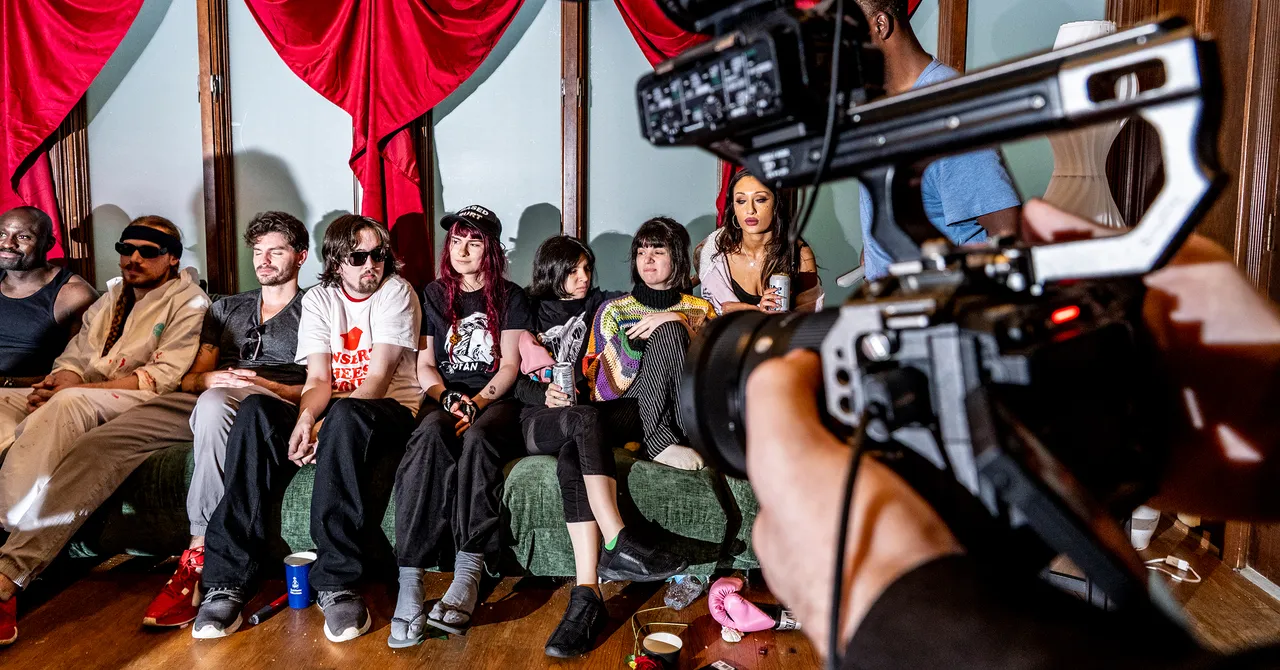
Jun 17, 2026 6:00 AMIt’s like Big Brother without any limits, or broadcast standards. WIRED goes on location—and on camera—with the cult hit.PHOTOGRAPH: Mark Peterson/Redux PicturesOn March 16, 2026, at 5:45 pm in a leafy suburb of Atlanta called Sandy Springs, police pound on the door of a neglected French Country–style mansion, rifles at the ready, bodycams rolling. Minutes earlier, a distress call came from someone claiming to be hiding from a gunman in the mansion's downstairs bathroom. The dispatcher heard a gunshot ring out in the distance, then the line disconnected. “Open the door!” an officer yells. A calm young man with a mullet and woolly eyebrows steps out, hands raised. The police ask him who else is in the house. “Just my friends,” he replies, as seven other young people, men and women, silently file out behind him, less evidently relaxed. They remain outside while two officers search the house.Inside the mansion there are no immediate signs of a massacre, but the decor alone arouses suspicion. All of the windows are frosted over, so only a chilly light leaks in. The place is a mess, and the walls are adorned with lurid, seemingly AI-generated art: a frowning baby holding an assault rifle, a rubber ducky bobbing in a mug of what looks like black coffee, a lidless and levitating eyeball crying into a martini glass. The rooms are painted primary colors, grass green and cherry red, like a kindergarten class. A vape dangles from a doorframe by a chain, suspended at mouth level. The pantry is practically empty. The bedroom is a dormitory featuring seven identical twin beds.No one is hiding in the bathroom. The call, it seems, was a prank. The police return to the driveway and ask, “What is it that you guys are doing here?”“We’re just livestreaming,” says a man in a camo hat named Matt.“OK,” one officer says. “You guys don’t have any firearms or anything inside the house?”There are guns in the house, Matt says, for self-defense. Fans of their livestream can be obsessive, he explains, and tend to have perverse ideas about jokes. The distress call, for example, complete with gunshot sound effects. The officer asks to see their weapons, and they go downstairs. The room is cluttered with ergonomic swivel chairs, desks strewn with takeout containers and energy drinks, two flatscreen TVs, and a dozen computer monitors. It’s a control room of some kind.On one desk, beside the keyboard, lies a handgun. On another, a rifle rests under a tangle of cables. The officer picks up each and turns them over in his hands. He recommends that they “have them locked up,” as leaving weapons out can sometimes go poorly. Then he takes a last look around and notices that the monitors display live feeds of every upstairs room. The kitchen, the dining room, the bedroom. “You all got everything on camera,” he says, stating the obvious, probably considering whether there’s anything inherently dubious about that. Surveilled sleeping, frosted windows, guns, mullets. The producers had cut the video feed when the police showed up, but the officers themselves were recording through their bodycams. So this is livestreaming?“OK,” the officer says, finally. “No issues with that.”Outside, the inhabitants thank the Sandy Springs PD for their service. “Of course,” the officers reply, “good luck with y’all’s stream!” They begin to drive away, and one by one the streamers file back inside, into the Fishtank.Vance, Fishtank cameraman and former contestant.PHOTOGRAPH: Mark Peterson/Redux PicturesPerhaps the easiest way to describe Fishtank Live is as a reality show. It features real people living together in a real house, bickering and mingling, with the promise to viewers that they will see unrehearsed, authentic human behavior. In many respects, it’s identical to Big Brother or its precursors, MTV’s The Real World and the Dutch show Nummer 28. In other key ways, which become obvious within moments of watching the show, it’s much stranger.Fishtank takes place in what its producers call a “fully monitored smart house”: a suburban home rigged up with dozens of CCTV cameras, microphones, and speakers. Each season, between six and 10 contestants—or “fish”—move into the home and battle for supremacy. They face off in elimination challenges and attempt to irritate each other into quitting. Last one remaining wins. The rules are simple: no phones, no weed, extremely little privacy. Only the bathrooms, and a closet or two, are off camera.PHOTOGRAPH: Mark Peterson/Redux PicturesSo far, still in the realm of Bravo. But Fishtank is live and unedited, and it runs 24/7 for weeks straight; it’s for audiences who grew up on Twitch and expect to participate in—rather than just consume—the material. About half of that time the contestants are sleeping or eating. Fans watch for hours each day and pay to interact with the cast in various ways. An ad for the show reads: “You live in the walls. You control the action.” Viewers can vote on popularity-based challenges, send gifts or advantages to the cast, or type messages that blare through the speakers in real time, like a comments section sprung to life. These messages are uncensored and composed, largely, of obscenities, slurs, and insults, anything to get under the cast’s skin. They often succeed, and the contestants’ antics—if you can call them that—dwarf the most startling behavior MTV, TLC, and Netflix have collectively cooked up over decades. Contestants have been known to strip naked, pour cups of piss on one another, scream slurs, and fistfight. They have smoked crack or meth (viewers couldn’t quite tell which), masturbated, attempted to smear feces on each other, worn blackface, and run directly into plate glass doors. Producers—who run the show from the basement, where they also sleep amid scattered guns—often come upstairs and join the chaos. Like the masterminds behind many reality shows, they seem to revel in psychologically tormenting their subjects. They also, occasionally, strap on boxing gloves and beat the shit out of them for real.The violence and degeneracy of Fishtank is hard to exaggerate, which seems to be by design. It may well be the most extreme reality show in history. It’s been drummed out of four neighborhoods in three states after neighbors complained about possible zoning law violations. It’s viewable on its own website and on the freewheeling streaming platform Kick.You’ve likely never heard of Fishtank and may be tempted to brush it off as fringe—an unwell collective of sadists, masochists, and exhibitionists throwing simultaneous tantrums on a remote frontier of the internet. That may be true, but the show is drawing nearer to the mainstream with each passing day. With more than 500,000 people regularly watching the most recent seasons, producers claim the show is worth more than $30 million; their budget is less than a million. The show has been landing increasing numbers of corporate sponsors, including Sticker Mule and Backyard Butchers. Bam Margera, from Jackass, hosted the latest season, and Joe Rogan noted on his podcast that the show, while shocking, differs from conventional reality TV only in degree, not in kind. “Isn’t it funny,” he mused, “The Real World is OK because they’re only mildly mentally ill?”Fishtank is the OnlyFans of reality TV, a kind of uncensored, subscription-based, interactive voyeurism. It’s part of an emerging content ecosystem that tech writer Ryan Broderick calls “Chudtech,” interactive sites that monetize humiliation. Maybe that’s the future—a proliferation of bespoke, 24/7 reality shows on which we all simultaneously and separately star, trading our privacy and dignity for cash to pay rent.For some people, and so I ventured into their world of alternate-reality TV to find out what might be in store for the rest of us. I spent weeks watching Fishtank. I spoke to fans, former contestants, and its producers. And then I stepped into the Fishtank myself.From the point of view of contestants, a season of Fishtank begins the same way many reality shows do. Staggered for dramatic effect, they enter the house one by one, suitcases in tow. They greet each other, choose a bed, and unpack. They poke around the rooms, taking in their new home.For viewers, the experience is less standard. Rather than meet the cast over a minute or two in the form of a bouncy montage (“Ten strangers, picked to live in a house …”), they watch it unfold in real time, over many hours, during which little occurs. There is no music to color the action or punctuate a moment, or editing to foreshadow conflict. With those flourishes stripped away, all that remains is the eerie allure of watching someone who knows they are being watched but doesn’t know by whom.Surveillance is the point. The Fishtank website is designed to mimic an array of CCTV feeds. Navigating it, you feel like a loss-prevention officer at a department store or a prison guard. The house is divided up room by room into a grid that covers most of the homepage. You can enlarge the view of any room by selecting it, then toggle between rooms by clicking on doorways or hallways. This makes it easy to pursue contestants as they navigate the house. Often, action is occurring in different rooms simultaneously, and so the viewers, in a sense, edit the show themselves by choosing which feed to watch. For this reason, and because viewers tune in at different times of day as their schedules permit, no two viewers ever have the same experience watching the show.PHOTOGRAPH: Mark Peterson/Redux PicturesIn traditional reality TV, at least a few cast members always come in swinging—talking shit, making fast friends or enemies, singing, dancing, having an immediate breakdown. Which is to be expected, since they’re selected for strong personalities: the bubbly one, the brainy one, the cocky one, the schemer. They are meant to have storylines, to be conventionally attractive and offer some sense of aspirational viewing. Fishtank’s cast, meanwhile, is almost always composed of very young, shy loners who don’t have much going on in their lives. They live with their parents and work minimum-wage jobs, if they’re employed at all. Many are self-described NEETs—“not in education, employment, or training.” They spend a lot of time online, which is how they discovered Fishtank to begin with, and they have usually never applied to be on a reality show before. Most have never been on camera.When NEETs gather in a room, sparks don’t exactly fly. On the first day of a Fishtank season, there’s a lot of hand-wringing and timid banter. Not the most riveting stuff, but that’s where the producers come in. After the fish mingle sheepishly for a few hours, the host arrives. For the first four seasons of the show, this figure was the show's cocreator, the comedian Sam Hyde. Standing around 6'5", Hyde looks something like a GMO Trotsky—patchy mustache-goatee combo and circular glasses beneath a bulging forehead—and has an intimidating presence and a dark, confrontational sense of humor. He’s best known for his Adult Swim sketch show World Peace, which was canceled in 2016 after, among other things, Hyde appeared in blackface. Since then he has operated mostly outside of the mainstream, posting sketches and podcasts on his website and YouTube.Fishtank creator Sam Hyde poses for a portrait in December 2016.PHOTOGRAPH: Ian Thomas Jansen-Lonnquist/Getty ImagesOn Fishtank season one, day one, Hyde’s arrival was signaled by a blood-red light that suddenly cloaked the living room, where the fish were gathered. He entered wearing a blue suit, shouted, “Hey, new friends! How’s everybody doing?” and was met by a smattering of mousy hellos. He sighed, evidently disappointed, and asked the cast to gather round for a pep talk. “This opportunity?” he said, “It’s whatever you make of it. I don’t care … You can sit here and pick your fucking nose. I would recommend, though, that when I say, ‘How you doing, Fishtankers?’ we get a modicum of enthusiasm, OK?” He left and entered again. This time, he was met with claps and whoops.Producing mainstream reality TV is the art of playing big egos off one another—focusing an energy that’s already in the room—and of platforming eager entertainers. Fishtank is the reverse, an exercise in turning shut-ins into performers willing to do just about anything.That takes some coaching, but the alien, oppressive environment of the Tank also seems to naturally loosen the cast up over time, breaking down their sense of decency. The speakers, which pipe in messages typed by fans day and night, play a key role. Viewers criticize contestants’ clothes, voices, weight, social skills, and speech patterns. They bombard them with accusations and slurs. They taunt them as they try to fall asleep. They dig into their pasts, dredging up anything perceived to be embarrassing, tragic, or allegedly criminal.At any given time the audience will select, organically and via some mysterious calculus, one cast member to pile onto. In the early days of season five, the unlucky fish was a young woman named Victoria: “Icky Vicky.” “You dress like a junkie.” “Fat. You’re fat. You’re a huge pigster. Kill yourself.” “Nasty beat bitch.” Victoria laughed it off for a few hours, but by the evening she broke down. The next morning, after a sleepless night, she hid from the cameras by sitting motionless with a sweater thrown over her head. By day seven, she quit the show.Each season, about half of the cast taps out before they’re eliminated, and so the daily challenges serve more to break down the fish mentally than to raise or lower their standing in the house. In the early days of a season, the challenges are typically tedious—the Rice Challenge: Count the number of jasmine rice grains strewn on the floor and mixed with brown basmati rice. Then they turn bizarre—the Mommy-Baby Challenge: Half of the cast pretends to be mothers, the other half infants. Then confessional—the Most Traumatic Life Story Challenge: Tell your saddest story. Then gross—The Shit Your Pants Challenge: self-explanatory. Then mean—the Dress-Down Challenge: Contestants stand eye to eye and rip into one another. And, finally, sadistic—the Hurt Burt Challenge: Take turns punching and slapping a guy named Burt.Often a contest will be framed as an elimination challenge, then ruled inconsequential afterward if a fan favorite loses. In this way, the producers run the show as a kind of rigged popularity contest, a fact viewers acknowledge but don’t seem to mind. The last fish to quit the show or to be eliminated wins. The prize is $50K—not a fortune, but enough to motivate someone desperate.PHOTOGRAPH: Mark Peterson/Redux PicturesOften the house is badly damaged in the heat of competition. As the furniture falls apart and the drywall disintegrates and the garbage piles up, the cast steadily grows disinhibited. They do anything they can to entertain the viewers, who applaud or rebuke their efforts in real time. They let slurs fly, strip, scream, attack each other, and generally regress to some pre-socialized state of nature. Every season it’s the same. A spell settles over them, from which they rarely stir. An exception: On the 21st day of the most recent season, during a skirmish involving mops, brooms, and thrown piss, one fish named Bashir paused amid the fray and yelled, “What is the point of this?”“It’s entertaining!” a producer called back.“The Wire,” Bashir replied, “is more intellectual. You don't watch The Wire for people throwing shit.”The producer glared at him. “OK, well, you’re not on the fucking Wire.”To make sense of Fishtank’s tasteless, deliberately appalling ethic, it helps to know a bit more about its creator. Sam Hyde grew up in Connecticut and graduated from the Rhode Island School of Design in 2007 with a degree in filmmaking. After college, he began producing sketches and prank videos under the moniker “Million Dollar Extreme,” positioning himself as a kind of right-wing Andy Kaufman. A beloved bit among fans: He once performed standup in Brooklyn and pivoted mid-set to “speak from the heart,” which meant reading aloud from prepared notes which framed homosexuality as deviant, antisocial behavior. Most of the audience walked out, which was, of course, the goal.In a more elaborate prank, Hyde secured a speaker slot at a TEDx conference at Drexel University in 2013 by posing as a globe-trotting documentarian and delivered a talk titled “2070 Paradigm Shift.” He asked the audience to pat themselves on the back for saving the world. They obliged. Then he offered a list of predictions for the next 50 years: “Sea floor farming … Sea beets. Sea yams.” Facebook will be in charge of birth certificates. Race riots. “Trash economy. You use cubes of trash as money. Everybody becomes rich.” In closing, he led the audience in another pat on the back.After landing his show on Adult Swim in 2016, Hyde found a wider audience but also drew backlash. Hyde believed that rival forces inside Adult Swim, including Tim Heidecker of Tim and Eric, were responsible for the show’s cancellation. He called in to Heidecker’s podcast and accused him of conspiracy. Heidecker denied any involvement and suggested Hyde shake off the setback. This wasn’t just a bump in the road, Hyde fired back, “I’m blacklisted.” Exasperated, and seemingly eager to end the call, Heidecker encouraged Hyde to strike out on his own with the rabid fanbase he’d amassed.“Why do you need Adult Swim?” he asked. “Why do you need anybody? You have an army, dude!”Hyde took Heidecker’s advice. He retreated into independence, producing more sketches and posting them to YouTube, where his subscribers grew. Then, in 2018, his show was banned from YouTube, too, and he began posting content to his own website. His fans found him, and his relationship with them grew deeper and stranger the farther he drifted into exile. They were disaffected, aggrieved, angry, young, and mostly white. Unemployed, or underemployed, and very online. Perhaps analogizing Hyde’s professional cancellation to their own social alienation, they began to see him as a role model.In 2023, Hyde devised Fishtank as a parody of reality TV. Originally, he wanted to call the show Hell House. He hosted the first four seasons but then told his producers he wanted to focus on other projects. He didn’t respond to my interview requests except to say, “Feel free to fabricate quotes.” Was he sick of his creation, or hoping to distance himself from it, legally? Streaming humiliation can go very wrong; last summer, a French streamer died during an “extreme challenge” during which he streamed for nearly 300 hours straight and was woken up at least once with a bucket of water. But while accusations of misconduct against Fishtank have been lodged online, and noise complaints have followed the production from house to house, nothing has been filed with police or taken to court, and no one, as far as we know, has been grievously injured. But still, Hyde moved on. He’s been producing videos on YouTube, where, no longer banned, he has accrued nearly a million subscribers between two channels.The current showrunner of Fishtank is a onetime rapper who goes by Jet Neptune. Twenty-eight years old, Neptune grew up in Georgia and joined Hyde’s team a few years ago, pre Fishtank, as a video editor. He speaks with an easygoing, baritone drawl; has a round face, bushy eyebrows, a mullet; and typically wears a thick chain over a polo or oversize T-shirt. While Hyde’s cult popularity launched the show, it’s Neptune’s efforts behind the scenes, in the basement, that have kept it afloat for five seasons.Jet Neptune at the control board.
Interactive. Violent. Gross. Inside Fishtank, the Unhinged Future of Reality TV
It’s like Big Brother without any limits, or broadcast standards. WIRED goes on location—and on camera—with the cult hit.
8,338 words~38 min read