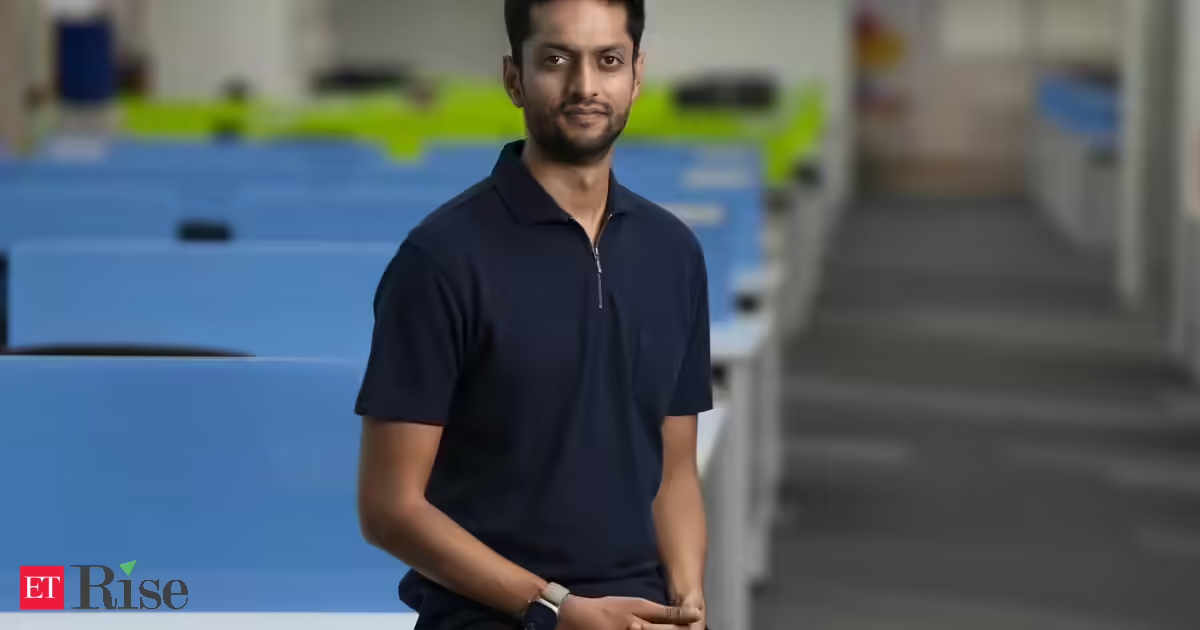
The MSME sector is vital to India's economic expansion, accounting for almost a third of its GDP and providing jobs for millions in various sectors. In today's digital, regulated, and competitive business environment, technology is evolving beyond mere compliance. It's now a key factor in boosting efficiency, fostering growth, and building resilience. In a conversation with ET Digital, Tejas Goenka, the Managing Director of Tally Solutions, talks about the evolving technological requirements of MSMEs, the growth of interconnected business systems, the impact of AI and automation, and how software developed in India is gaining traction globally. Edited excerpts:The Economic Times (ET): India’s MSME sector is undergoing rapid digital transformation. From Tally’s vantage point, what are the biggest shifts you are seeing in the way small businesses manage accounting, compliance, payments, and operations today?Tejas Goenka (TG): Over the last few years, the relationship MSMEs have with technology has fundamentally changed. Earlier, technology was largely seen as a tool for accounting and compliance. In many cases, one of the first motivations for adopting software was the ability to generate a professional, GST-compliant invoice that inspired confidence among customers, suppliers, and partners. It wasn't just about compliance; it was about appearing more credible and business-ready.Today, business owners increasingly view technology as a growth enabler that helps them make faster decisions, improve efficiency, and run their businesses with greater confidence.One of the biggest shifts we're seeing is the demand for real-time visibility into cash flow, receivables, inventory, and overall business performance. At the same time, businesses expect accounting, payments, banking, and compliance workflows to work together seamlessly, reducing manual effort and operational friction.We see this evolution firsthand through initiatives like Tally MSME Honours, where we engage with thousands of entrepreneurs across the country. A common thread across these businesses is their growing ambition and willingness to adopt technology that helps them operate smarter and grow faster.At the same time, MSMEs continue to value simplicity; they want technology that adapts to the way they work, making business operations easier rather than more complex. That's where we see the future heading: technology becoming more intelligent, connected, and effortless to use.ET: Tally today supports more than 2.5 million businesses globally. How has the company’s business grown over the last few years in terms of customers, revenues, and market reach, and what have been the key drivers behind that growth?TG: Our growth over the last few years reflects two parallel shifts: businesses digitising faster than ever before, and our continued focus on building technology that evolves with the changing realities of MSMEs.Today, Tally supports over 2.7 million businesses globally, with nearly 7.5 million users across markets. What's encouraging is that this growth has been driven not just by new businesses adopting technology, but also by existing customers expanding how they use technology as their businesses grow.India's formalisation and digitisation journey has certainly been a catalyst, from GST and e-invoicing to digital payments. But equally important is the shift in what business owners expect from software today. They no longer want standalone tools; they want connected experiences that simplify operations and provide greater visibility into their business. Our investments in capabilities such as Connected GST, Connected Banking, TallyPrime Cloud Access, and now AI-powered assistance through TallyIra are a reflection of that shift.We're also seeing strong momentum across international markets. Regions such as Africa, the Middle East, Bangladesh, and Southeast Asia share many similarities with India's SME ecosystem, and the experience of building for India's dynamic and diverse business environment has positioned us well to serve these markets too. From a business perspective as well, we've seen consistent growth, with operating revenue increasing from Rs 558.4 crore in FY23 to approximately Rs 710 crore in FY25.ET: MSMEs have always been at the core of Tally’s customer base. What percentage of your business today comes from MSMEs, and how are the needs of small businesses evolving compared to five years ago?TG: SMEs have always been at the heart of Tally's journey, and today they account for more than 95% of our customer base globally.What has changed significantly over the last five years is both the appetite for technology and the expectations from it. SMEs today are far more open to adopting digital tools, automation, and AI than ever before. However, adoption remains challenging because small businesses don't operate through perfectly structured processes. They are often owner-driven, balancing formal systems with informal workflows, relationships, and constantly changing business realities.As a result, the conversation is no longer about whether businesses should adopt technology, but whether the technology genuinely understands and adapts to the way they work. Business owners are looking for solutions that save time, simplify complexity, provide greater visibility, and help them make better decisions without disrupting their existing ways of operating.At the same time, some expectations remain unchanged. SMEs continue to value simplicity, reliability, affordability, and trust above everything else. For us, that reinforces a core belief: technology should adapt to the business owner, not require the business owner to adapt to the technology.ET: What are the primary factors driving the adoption of Tally’s solutions today? Is demand being led more by regulatory requirements such as GST and e-invoicing, or by businesses seeking greater operational efficiency and growth?TG: Regulatory reforms such as GST, e-invoicing, and e-way bills were undoubtedly major catalysts for technology adoption among MSMEs. For many small businesses, one of the earliest drivers was the need to generate professional, trustworthy GST-compliant invoices that inspired confidence among customers, suppliers, and partners. Compliance often became the first step towards digitisation.What is interesting, however, is how that journey evolves. Once businesses adopt technology, they quickly begin to see benefits beyond compliance, which is better visibility into operations, improved efficiency, faster decision-making, and greater control over the business.In many ways, compliance opened the door, but productivity and growth are now driving continued adoption. This is also reflected in how we're evolving TallyPrime, with connected capabilities and AI-powered assistance that help businesses automate routine tasks and interact with their business data more intuitively. The trend is clear: MSMEs are increasingly looking for technology that helps them operate smarter while remaining simple and easy to use.ET: Compliance requirements are becoming increasingly complex with developments such as GST 2.0 and the Digital Personal Data Protection (DPDP) framework. How are MSMEs adapting to these changes, and what role can technology play in reducing the compliance burden?TG: MSMEs today are far more comfortable with digital systems than they were a few years ago, having successfully adapted to major shifts such as GST, e-invoicing, and e-way bills. However, compliance remains particularly challenging for small businesses because they often operate through a mix of formal processes and informal workflows.A business owner may be managing inventory, collections, vendor relationships, and compliance simultaneously, often with incomplete information and limited resources. As compliance requirements expand beyond taxation into areas such as data privacy and governance, the challenge is not simply understanding the regulations but incorporating them into already complex day-to-day operations.This is where technology plays a critical role. Business owners shouldn't have to think about compliance as a separate activity. Instead, compliance should be built into the workflows they already use-whether that's invoicing, accounting, banking, or record-keeping. The right technology can help surface exceptions, reduce errors, maintain audit trails, and provide confidence that critical requirements are being met.At Tally, we believe compliance should be a natural outcome of running a business efficiently. The goal is not just to help businesses meet regulatory requirements, but to reduce uncertainty and give owners greater confidence and control over their operations.ET: There is growing interest in connected business ecosystems where accounting, banking, payments, inventory management, taxation, and financing work together seamlessly. How is Tally positioning itself in this evolving landscape, and what opportunities do you see from initiatives such as ONDC and embedded finance?TG: We strongly believe the future of business software is connected, not fragmented. Business owners don't think in terms of separate functions like accounting, banking, compliance, payments, or inventory; they simply want their business to run smoothly.That's why we're focused on building connected experiences that bring critical business workflows together. Capabilities such as Connected GST, Connected Banking, and TallyPrime Cloud Access are helping businesses move beyond standalone processes towards a more unified view of their operations.For SMEs, the real value lies in reducing friction. When business data flows seamlessly across workflows, owners spend less time reconciling information, switching between systems, or managing exceptions, and more time making decisions and growing their business. Ultimately, our vision is simple: technology should connect the different parts of a business in a way that gives owners greater visibility, control, and confidence, without adding complexity.ET: A large number of Indian MSMEs, especially family-run and traditional businesses, are still cautious about adopting new technology. How do you make digital adoption simpler and more accessible, and what does the concept of ‘invisible technology’ mean in practice?TG: For many small business owners, hesitation around technology isn't about a lack of interest. In fact, most SMEs are actively looking for ways to save time, reduce errors, and run their businesses more efficiently. The challenge is that small businesses often operate through a mix of formal processes, personal relationships, and practical workarounds that don't always fit neatly into structured systems.That's where our philosophy of "invisible technology" comes in. We believe technology should adapt to the way businesses naturally operate, rather than forcing business owners to change how they work. It should quietly simplify tasks, surface the right information at the right time, and help owners make better decisions while keeping them firmly in control.This thinking shapes how we build TallyPrime and newer capabilities like TallyIra. The objective isn't to make businesses learn new technology; it's to make technology feel natural, intuitive, and genuinely useful in everyday operations. Ultimately, adoption happens when technology reduces effort and uncertainty, while strengthening the business owner's confidence and judgment. That's what invisible technology means in practice.ET: Tally has expanded beyond India into markets such as Kenya, Indonesia, the UAE, and Saudi Arabia. What lessons from India’s MSME ecosystem are proving relevant globally, and what does this tell us about the export potential of India-built SaaS products?TG: One of the biggest lessons from India is that small businesses are often far more complex than they appear. Unlike large enterprises, SMEs typically operate through a combination of structured processes, informal workflows, relationships, and owner-led decision-making. While the specifics vary across markets, we've found that this reality is remarkably consistent in countries such as Kenya, Indonesia, the UAE, Saudi Arabia, Bangladesh, and Nepal.Building for Indian SMEs has taught us how to create technology that works in environments where business information is often fragmented, processes are constantly evolving, and owners need clarity without losing control. Those lessons travel well because they address a fundamental challenge shared by small businesses globally.More broadly, it highlights the growing potential of India-built software products. Indian companies have become very good at solving complex business problems in highly dynamic environments while keeping solutions practical, accessible, and easy to adopt. That combination is increasingly resonating across emerging markets around the world.
India’s MSMEs are no longer digitising for compliance alone: Tally’s Tejas Goenka
As MSMEs accelerate their digital transformation journey, technology is becoming central to growth, efficiency, and resilience. Tejas Goenka shares how AI, connected ecosystems, and India-built software are reshaping the future of small business management.
1,842 words~8 min read