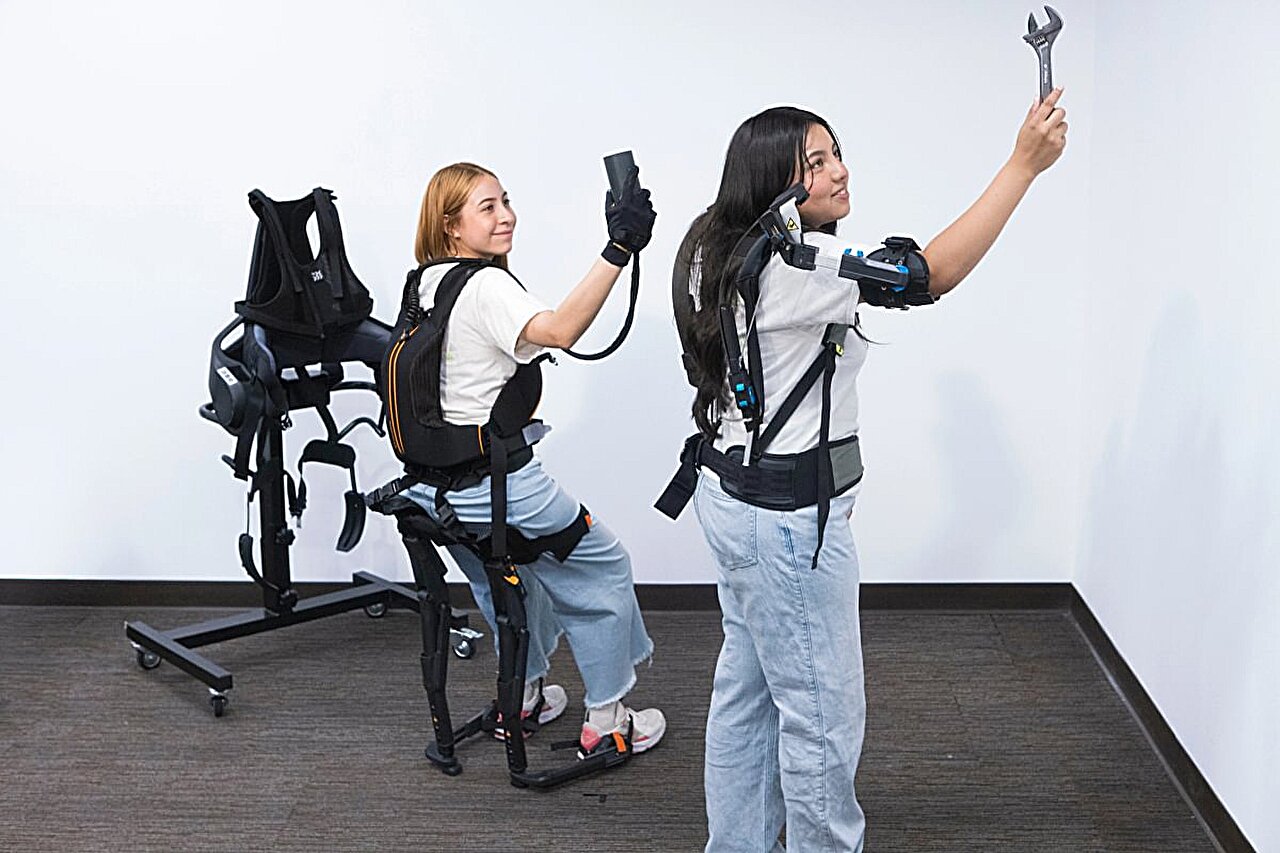
UTEP student Juliana Guevara Mendoza, left, wears a grip strength support device (Ironhand) and the sit-stand support exoskeleton (Chairless Chair), while Jessica Sanchez-Balandran works with a shoulder support exoskeleton (Skelex). Credit: The University of Texas at El Paso
Wearable exoskeletons can help reduce physical strain in the workplace and protect employees from injury, but the technology has yet to achieve widespread adoption. A new study published in PLOS One by engineers at The University of Texas at El Paso may explain why: The technology is still too complex and cumbersome for everyday use.
"Our research suggests that a critical factor influencing exoskeleton success may be largely overlooked: how easy they are to assemble, put on and take off," said UTEP's Arunkumar Pennathur, Ph.D., who led the study. "The exoskeletons that win in the workplace may not be the most sophisticated ones, but the ones a worker can actually get on quickly and correctly."
Pennathur is an associate professor in the Department of Industrial, Manufacturing and System Engineering who leads a UTEP lab focused on human performance and behavior. One of its goals is to help workers in high-strain industries like health care, manufacturing and construction.