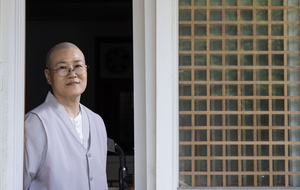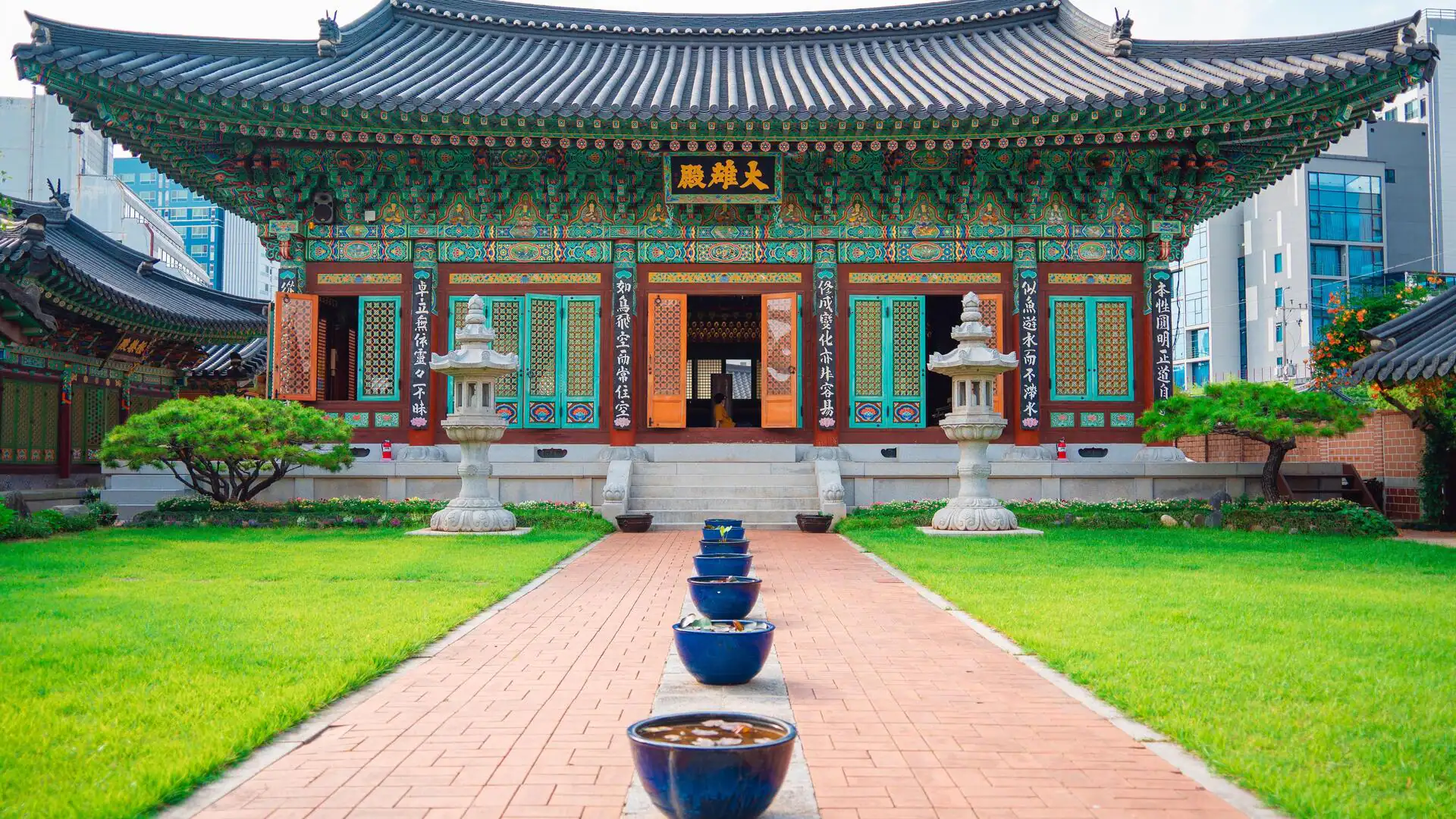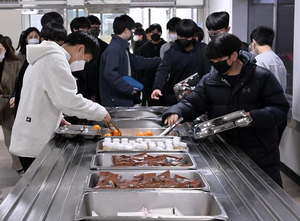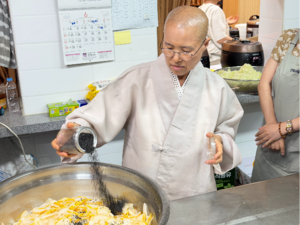
Temple food master Ven. Seonjae is making banchan with Korean melon at Yeonhwasa in Seoul on Tuesday. (Hong Yoo/The Korea Herald) 'Culinary Class Wars' monk Ven. Seonjae cooks students free temple lunchCheongnyeon Bapsim, run by the Korean Buddhist Foundation for Social Welfare, offers university students free lunches of healthy temple food, meant to nourish the body and mind as much as to ease their meal costs.The name joins the word for youth with "bapsim," the energy a person draws from a bowl of rice.Before the 100 students ate at Yeonhwasa on Tuesday, Ven. Seonjae put the idea to them herself."A grain of rice endures a cold spring, a hot summer and the cold winds of autumn before passing through a farmer's hands. I hope you eat thinking of food as something that heals and comforts the body and mind," she said.The temple food master, who reached the Top 6 in the second season of Netflix's "Culinary Class Wars," cooked the program's final lunch of the semester. None of the students paid a won. University students from nearby schools are eating free temple food at Yeonhwasa made by Ven. Seonjae on Tuesday. (Hong Yoo/The Korea Herald) The program began in 2024 with 560 participants and rose to 1,959 students last year. This semester, it ran at Yeonhwasa, Gaeunsa and Sangdoseonwon in Seoul, with Yeonhwasa serving 100 students each Tuesday.Tuesday's menu included yeonipbap, or lotus leaf rice, and the carrot noodles Ven. Seonjae cooked on the show."I also made seasoned cabbage and black sesame banchan because it is easy to digest, and the dubujorim, a simmered tofu dish, because students tend to be short on protein. For dessert, there is hwachae. Students these days only know Western desserts, so I wanted to show them what a Korean dessert can be," Ven. Seonjae said. A plate of 11 temple food dishes made by Ven. Seonjae (Hong Yoo/The Korea Herald) Ven. Myojang, the abbot of Yeonhwasa, said the idea took shape after a Kyung Hee University professor mentioned that his students were skimping on lunch to save money.He doubted young people would take to vegetarian temple cooking, until one student's response after a free meal stayed with him."The student said it tasted like their mom's cooking. At home, mothers make a lot of namul dishes, the kind restaurants rarely bother with, and temples make them all the time. Because it is offering food, that care is already there," Ven. Myojang said.Ven. Doryun, executive director of the foundation, said the program was moving beyond Seoul, with temples in Cheongju, North Chungcheong Province, and Busan in talks to begin in the fall semester. Ven. Seonjae (right) serves temple food to university students at Yeonhwasa in Seoul on Tuesday. (Hong Yoo/The Korea Herald) With first-semester finals underway, students filed in with exam materials in hand. Organizers had wondered whether the exam period would thin the turnout, but the kitchen soon filled."I usually end up eating at convenience stores or having ramyeon, so a free, nutritious meal like this means a lot," said Na Hyun-ji, also a media studies student at Kyung Hee who is from Changwon, South Gyeongsang Province, and lives alone in Seoul.That is the everyday eating Ven. Seonjae set out to interrupt, hoping young people used to instant, intensely seasoned food would understand why good food matters and see the nature behind it."Good food comes from nature. Eating well means choosing seasonal foods that do not harm life. In Buddhism, food is not just for me. It is connected to the life of nature, and nature has to be well for me to be well," she said.
More than a meal: Temple food feeds students in body and mind
Cheongnyeon Bapsim, run by the Korean Buddhist Foundation for Social Welfare, offers university students free lunches of healthy temple food, meant to nourish t
603 words~3 min read