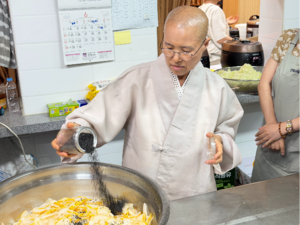
The Ven. Hyebeom talks about temple food philosophy of gratitude and discipline while making yeonipbap ahead of Buddha's birthday Temple food expert the Ven. Hyebeom poses for a photo during an interview with The Korea Herald at Suwolam in Seoul on May 14. (Im Se-jun/The Korea Herald) The Ven. Hyebeom pressed her fingertips into a mound of soaked glutinous rice, opening small holes for steam to pass through, then settled a cloth over the bamboo steamer. Buddha's Birthday is on Sunday, and she was preparing the lotus leaf rice often served in Korea's Buddhist temples."We're making yeonipbap because it's May, Buddha's Birthday is here, and it's one of the most representative Buddhist dishes," she told The Korea Herald. The Ven. Hyebeom of Suwolam in Seongbuk-dong, Seoul, was named a Grade 1 expert of Korean temple food by the Cultural Corps of Korean Buddhism this year, one of only 12 Grade 1 experts in Korea.The dish looks plain once tied off, a small parcel of seasoned rice studded with chestnuts, jujubes and beans, wrapped in a dried lotus leaf. The labor is in the layering. Glutinous and short-grain rice, mixed in an eight-to-two ratio, soaks for about six hours in summer or overnight in winter. The grains are steamed once, seasoned with salt water and steamed again with their additions, then steamed a third time inside the lotus leaves."The ingredients aren't fixed to yeonipbap. Whatever grains, beans or vegetables are in season can go in. Chestnuts and jujubes are common, sometimes ginkgo nuts as well," Hyebeom said.She prefers to eat yeonipbap with a doenjang soup or stew and salty banchan like pickled plums, or dried radish in winter. Temple food expert the Ven. Hyebeom cooks lotus leaf rice at Suwolam in Seoul on May 14. (Im Se-jun/The Korea Herald) A cuisine defined by what it leaves outKorean temple cooking is shaped as much by absence as by ingredient. Monks do not use the five pungent vegetables, known collectively as osinchae, which are garlic, green onion, Korean chives, wild chives and mureut (Chinese squill). The prohibition, Hyebeom said, is more practical than doctrinal."They're not harmful foods. When monks live together in groups to study, these ingredients release strong outward smells that can become unpleasant when some have eaten them and others haven't," she said.The deeper reason has to do with the body and the practice. The five vegetables are believed to boost energy, which can interfere with seated meditation. There is also a folk story of a farmer who once offered his garlic field to monks, only to find the field left with nothing. The farmer complained to Buddha, who responded by prohibiting his disciples from eating garlic ever again."What's difficult is that without osinchae, the original flavor of each ingredient has to come through," she said.That focus on the ingredient itself runs through her seasonal cooking. In spring, the staples are mugwort and shepherd's purse, made into fritters, rice cakes and soups. The young shoots of dureup follow, and chamnamul is at its peak now.In summer, her restorative is kongguksu, cold noodle soup in a broth of ground black or yellow soybeans. When senior monks or guests visit, she upgrades it to jatguksu, made with pine nuts, which are much more expensive at around 80,000 won per kilogram these days. Temple food expert the Ven. Hyebeom talks to The Korea Herald at Suwolam in Seoul on May 14. (Im Se-jun/The Korea Herald) A path that began at age 3Hyebeom was raised in a temple from age 3, ordained at 23 and graduated from Unmunsa Buddhist College in Gangwon Province. New ordinands spend their first year as postulants in the gongyanggan, the temple kitchen, learning to handle ingredients. In her third year at the college, she was assigned a three-month rotation to prepare banchan for the senior nuns.If asked for the most memorable temple food she has ever eaten, she returns to her first year at Unmunsa, to a kimchijjim made in a cast-iron cauldron by the wood-fired stove, aged kimchi braised slowly with a generous pour of perilla oil and a spoonful of doenjang."That kimchijjim is different from anything we make at home. The taste is hard to describe," she said.She later taught temple food in Chungju, North Chungcheong Province, then earned her certifications through the Cultural Corps of Korean Buddhism. She served as a resident instructor at the Korean Temple Food Culture Center for two years.In 2021, she founded the Mindfood Cooperative to share temple food more widely and for service work. The group prepares monthly lunch boxes for older residents in Seongbuk-gu and runs an annual temple food festival in the district.Most of the people who take her cooking sessions are not Buddhist, and about half or more are Catholic or Protestant."They come in nervous because they may have never met a monk before, and a monk teaching cooking makes them more so. But temple food isn't a flashy cuisine. By the time they finish the class and leave, they're smiling," she said.Her work abroad has changed her approach. At K-Food Festa at the Korean Cultural Center in Tokyo earlier this year, she prepared yeonipbap and a tomato water kimchi seasoned with lemon and grated pear in place of sugar or vinegar. The kimchi drew the strongest response."They were surprised we'd use ingredients they already had at home, like tomato and lemon," she said. "The natural sourness from lemon and the sweetness from pear felt fresh to them, not like commercial seasonings."She has come to think more carefully about what foreign visitors can actually eat."I used to teach the temple food I liked. Now I think more about which dishes people who aren't used to this can enjoy," she said.Food as medicine for practiceThe temple meal is preceded by a contemplation that frames eating as preparation for practice rather than enjoyment."It takes the wind, the air and the soil for the ingredients we use to make food to get to our kitchen tables. We give thanks for that, and we eat it not just for pleasure but as medicine for the work we have to do," Hyebeom said."Our work is to preserve the clean, traditional food we have, while still meeting the present.”
'We eat not just for pleasure but for spiritual practice'
The Ven. Hyebeom pressed her fingertips into a mound of soaked glutinous rice, opening small holes for steam to pass through, then settled a cloth over the bamb
1,035 words~5 min read