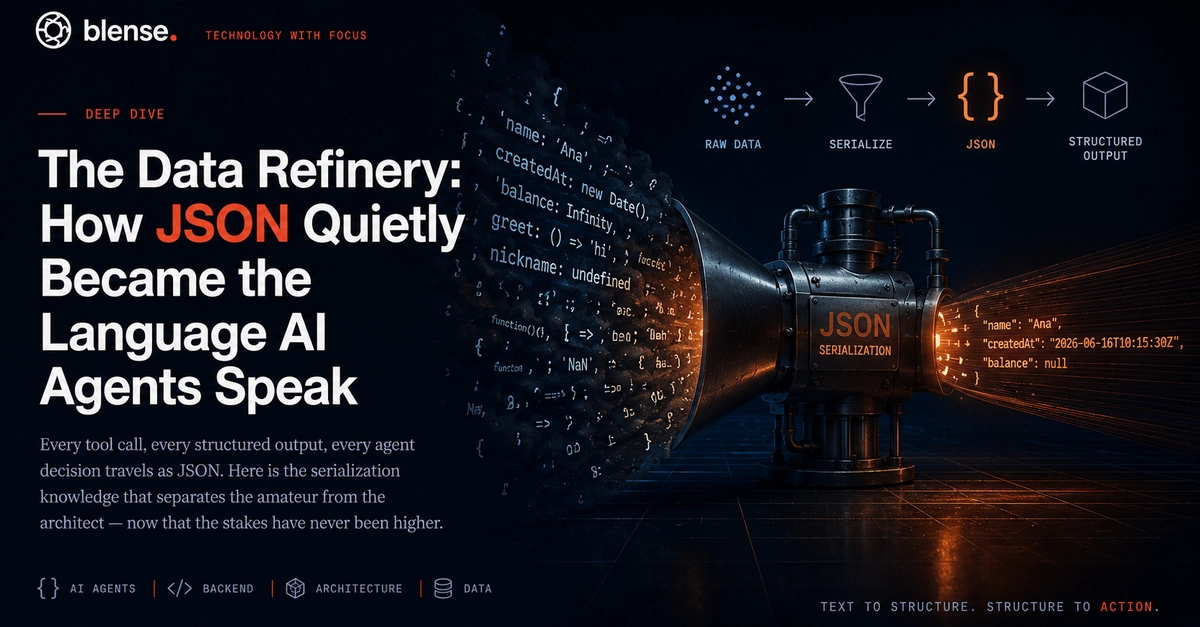
Every tool call, every structured output, every agent decision travels as JSON. Here is the serialization knowledge that separates the amateur from the architect — now that the stakes have never been higher.
A developer ships an AI agent on a Friday. In the demo it's flawless: the model reads a request, calls a tool, returns a clean answer the app renders perfectly.
A week later, production dashboards are full of garbage. A date is showing up as raw text. A field that was definitely there is silently gone. Under one big payload, the whole server froze for two seconds. And here's the maddening part — nothing threw an error. The model returned JSON. The code parsed it. Everything "worked."
The bug wasn't in the model, and it wasn't in the parser. It lived in the narrow gap between text and data — the place every JSON value has to cross twice. That gap is serialization, and in 2026 it has quietly become one of the most important things a JavaScript engineer can actually understand.
Why now? Because the most important conversations in modern software aren't between humans anymore. They're between models and machines — an LLM deciding which tool to call, a server answering, an agent chaining ten steps together. And every one of those conversations happens in the same format: JSON.