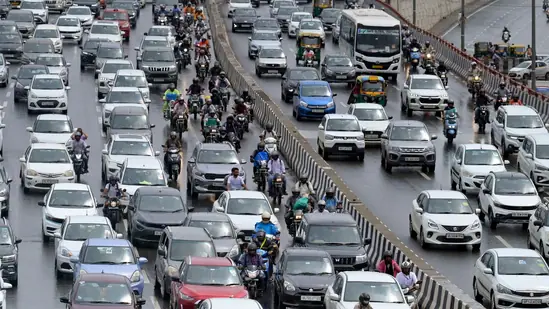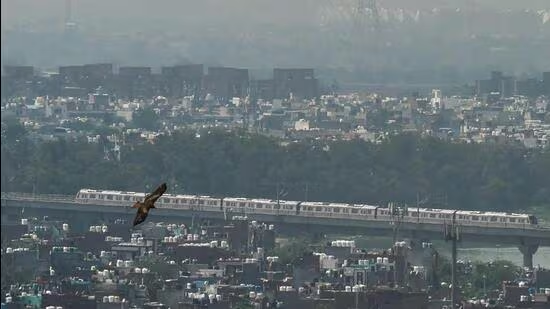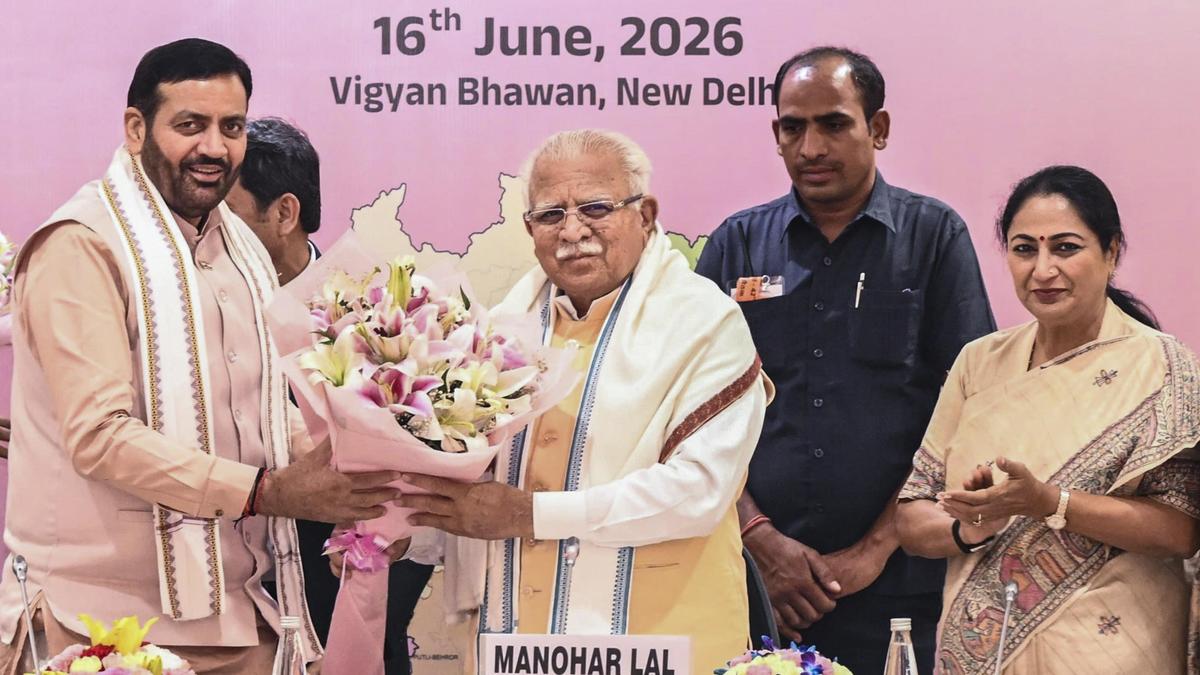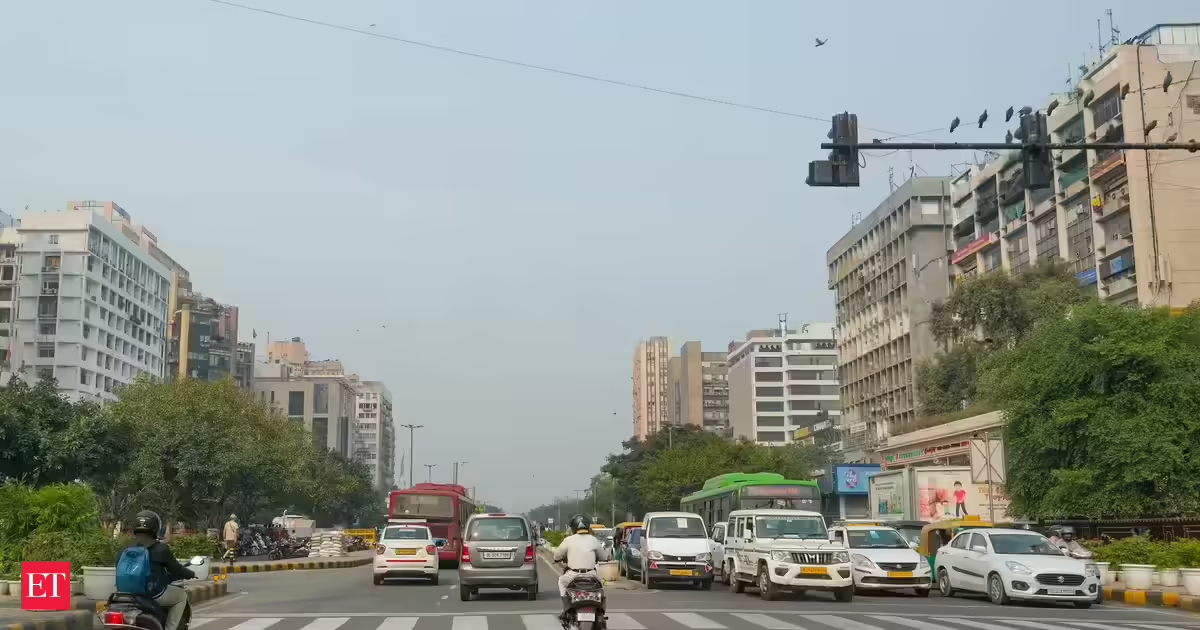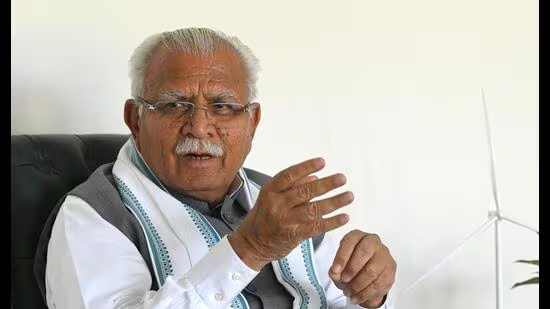
The National Capital Region Planning Board (NCRPB) has decided against altering the boundaries of the region, and instead plans to divide into three zones as part of a new framework for environmental regulations under the long-pending Regional Plan 2041, which was cleared for approval on Tuesday at a high-level meeting. This has implications for peripheral areas of the region where restrictions, such as those imposed for pollution control, will be scaled back or no longer be implemented.Speaking after the meeting at Vigyan Bhawan, chairperson and Union housing and urban affairs minister Manohar Lal Khattar said, “The entire area that was previously fixed will remain as it is. There will be no change.” (Hindustan Times)Speaking after the meeting at Vigyan Bhawan, chairperson and Union housing and urban affairs minister Manohar Lal Khattar said, despite demands from some states for additions and deletions, “The entire area that was previously fixed will remain as it is. There will be no change.”Haryana for the last few years has been advocating the removal of certain districts such as Karnal, Jind, Mahendragarh, Bhiwani, and Charkhi Dadri outside of the NCR zone, citing longer distance from Delhi and inability to pursue state specific industrial policy and skirt construction ban due to Commission for Air Quality Management (CAQM) guidelines, particularly during winter months when air pollution spikes in cities like Delhi, Gurugram, and Noida during the winter months.The restrictions, which used to come into effect in far away areas where they were “not required”, will now “be applied zonally to three types of areas,” said the minister.Under the framework, NCR will be divided into three zones, with the core area located within the Kundli-Ghaziabad-Palwal (KGP) and Kundli-Manesar-Palwal (KMP) expressway network, while the remaining districts will be divided into two additional categories. To be sure, it was not immediately clear which restrictions would be relaxed and at what locations.“This has been done so that districts located farther away do not face the same difficulties as those closer to the core NCR area,” Khattar added.CAQM refused to comment on the matter.The RP-2041, due since 2021, will guide development across the 55,000 sq km region spread over 32 districts.At the meeting on Tuesday, Khattar said consensus had been reached on all aspects of the plan. “Only a few changes remain to be incorporated in the document and the plan will be finally declared within two months,” he said.Haryana chief minister Nayab Singh Saini, Delhi CM Rekha Gupta, Uttar Pradesh urban development minister Arvind Kumar Sharma, and Rajasthan urban development minister Jhabar Singh Kharra were present in the meeting.To finalise the plan, a sub-committee comprising senior officials from the Union government and the NCR state governments has been constituted. It will submit its final report to the board by August 15.Among issues on the table, the NCRPB deliberated on the construction of two more regional expressways to be developed as “growth corridors and opportunity areas” for balanced development of NCR, in addition to the Eastern and Western Peripheral Expressways.The first one is expected to connect Panipat, Shamli, Meerut, Hapur, Khurja, Hodal, Rewari, Jhajjar, and Rohtak. The second one is expected to connect Karnal, Muzzafarnagar, Aligarh, Mathura, Deeg, and Alwar, among others. A plan to construct an orbital railway in Uttar Pradesh as the one already approved in Haryana is also expected to get the nod from the board.The board also discussed the vehicle replacement programme, called the Parivartan Scheme, as part of efforts to tackle air pollution in the region approved by the Union Cabinet. Khattar said vehicular emissions account for nearly 40% of pollution in the NCR and that the scheme would promote a shift towards BS-VI-compliant vehicles.The programme will initially be voluntary with states notifying and implementing it on their own. According to officials, Delhi informed the board that it plans to accelerate the phasing out of polluting and end-of-life vehicles as part of its clean-air strategy, while other NCR states are expected to formulate their own implementation roadmaps after notifying the scheme.The meeting also reviewed long-term water management strategies, with a particular focus on wastewater recycling and groundwater recharge. Khattar said NCR cities must prioritise treatment and reuse of wastewater. “\It should not run out; it should be processed and reused,” he said.He also stressed the need to improve rainwater harvesting and groundwater recharge so that groundwater reserves can be used when required.
‘No change in NCR boundary; 3-zone system for green curbs’
The NCRPB retains current boundaries, dividing the region into three zones to update environmental regulations and address pollution management. | Latest News Delhi
724 words~3 min read