1. China is bracing for a wave of retired batteries as the government strengthens oversight of its recycling industry. [para. 1] In April, the Ministry of Industry and Information Technology (MIIT) launched a nationwide crackdown on illegal battery recycling operations, following new rules requiring EV makers and battery manufacturers to collect end-of-life power cells. [para. 2] The regulatory push comes as China faces a surge in retired clean energy products, with the wave of EV batteries expected to arrive years ahead of similar surges in solar panels and wind turbine components. [para. 3]2. The stakes involve cleaning up the industry and realizing a future market worth hundreds of billions of yuan, though the business is currently largely losing money. [para. 4] China's power battery sector boomed in the early 2020s; with a typical service life of five to eight years, many batteries are now nearing retirement. [para. 6] In 2025, retirements grew more than 30% to 400,000 tons, according to MIIT data, and volumes are expected to double by 2027-2028. [para. 7] Retired power battery volumes are projected to reach 3.5 million tons by 2030, making battery recycling a market worth over 100 billion yuan ($14.8 billion), per Frost & Sullivan. [para. 8]3. The retirement wave extends beyond batteries: solar panel retirements are projected to surge after 2030, reaching 20 million tons by 2040, with recovery value expected to grow to 7.7 billion yuan by 2030 and 110 billion yuan by 2040. [para. 10] Annual retired wind power capacity is expected to reach about 10 gigawatts by 2030, generating recyclable materials worth 24 billion yuan, according to industry associations. [para. 11]4. The rush of recyclables underscores problems regulators aim to fix: the domestic recycling industry has seen a flood of new entrants, many slashing prices or paying premiums for limited retired equipment. [para. 14] Unlicensed operators have proliferated, undercutting compliant recyclers through improper dismantling and disposal. [para. 15] As of August 2025, China had over 180,000 battery-recycling companies, with more than 60% established within the previous three years. [para. 15] The industry is fragmented, with less than 30% of retired power batteries collected through formal channels. [para. 16]5. Weak economics further complicate the picture: profitability hinges on lithium prices, but the metal's plunge has weakened recycling incentives. [para. 17] As a result, "the entire industry is basically losing money," according to a battery recycling company executive. [para. 18] Similar problems exist in aluminum recycling, with intense competition and thin margins due to low investment costs and weak downstream demand from the automotive and property sectors. [para. 19][para. 20]6. Several industry participants said the sector is closely watching regulators: China lacks a licensing system for hazardous waste treatment, making enforcement difficult. [para. 21] Recycled materials are priced based on market supply and demand, failing to capture premiums for environmental benefits. [para. 22] Whether a recycling boom emerges by 2030 depends on stable feedstock supplies, effective pricing mechanisms, and policy incentives such as subsidies. [para. 23]AI generated, for reference only
In Depth: As Retired Battery Wave Approaches, China Moves to Clean Up Recycling
A flood of new entrants chasing a still-scarce supply of spent power cells has left the industry fragmented and largely unprofitable
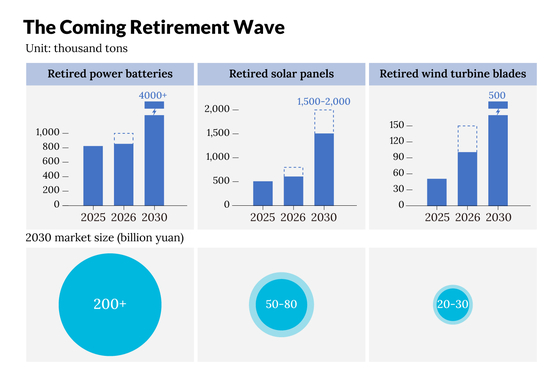
498 words~2 min read