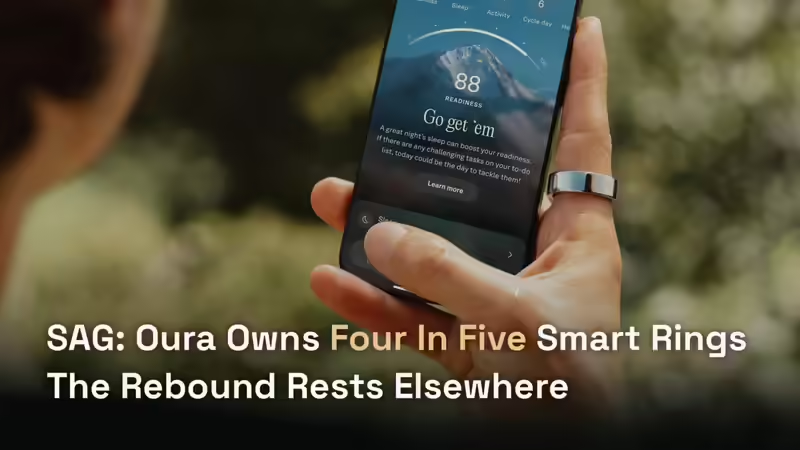
Smart Analytics Global put a number on the smart ring market last week, in a Wearable 360 note from founder and principal Linda Sui, and the number that matters sits a long way from the headline. Growth of 3 per cent year on year for the first quarter of 2026 reads as a stumble. The figure underneath it reads as a moat: Oura, the Finnish maker of the Oura Ring 4, held roughly 79 per cent of global smart ring shipments, on SAG's count. Four rings in every five carry one brand.A category the wearables business still files under "emerging" already has a sovereign. The 3 per cent wobble belongs to two names, both of them everyone-else — a Samsung between product cycles, and an Ultrahuman shut out of its biggest market by a patent ban. SAG's promised double-digit rebound asks the field to do what the field has so far missed: take share off the leader.Key TakeawaysOura held about 79 per cent of global smart ring shipments in Q1 2026, on Smart Analytics Global's count, holding a near-monopoly in a category that ships roughly 6 million units a year.Global shipments grew just 3 per cent year on year, a stall SAG attributes to lower Samsung Galaxy Ring volumes ahead of a refresh and to Ultrahuman's US ban after its patent loss to Oura.SAG forecasts close to 6 million units in 2026 (up 39 per cent) and over 7 million in 2027 (up 31 per cent), riding on an Oura Ring 5, a next-generation Samsung Galaxy Ring, and fresh launches from challengers.North America accounts for about 69 per cent of shipments; SAG flags India as an emerging market on its culture of ring-wearing.The India angle runs through Ultrahuman, the Bengaluru maker of the Ring Air (around Rs 24,000), banned from the US in October 2025 and now suing Oura in the Delhi High Court.A draw with one seed that mattersRead SAG's vendor split and the smart ring business looks less like a market and more like a tournament with a single seed worth watching. Oura sits at 79 per cent. The rest contest the qualifiers' bracket — "Others" at 15 per cent, RingConn and Ultrahuman level-pegging near 3 per cent apiece, on SAG's chart. SAG ranks RingConn the leading independent challenger, the best of the players seeded outside the top one.VendorQ1 2026 share (per cent)Oura~79Others~15Ultrahuman~3RingConn~3Oura defends its position the way a top seed protects a ranking — on court and in chambers. Tom Hale's company filed an International Trade Commission complaint in March 2024 against Ultrahuman and RingConn over US Patent 11,868,178, the one covering the Oura Ring's internal layout. The ITC agreed. From 21 October 2025, exclusion and cease-and-desist orders barred both challengers' rings from US import and sale. RingConn, based in China, took the settlement — a multi-year licence, royalties to Oura, a clear path to keep selling. Ultrahuman chose the longer rally.Where the 3 per cent wentTwo absences explain the soft quarter. Samsung throttled Galaxy Ring shipments ahead of a next-generation model, the lull every product takes before a refresh. Ultrahuman, knocked out of the US in October, lost the market that had supplied close to half its users. SAG reads both as passing. The reasoning holds for Samsung, whose refresh is a question of timing. For Ultrahuman the wound runs deeper, and that thread is the most interesting thing in the data.Can a 3 per cent quarter become a 39 per cent year?Only if the back half of the innings scores fast. SAG forecasts the market close to 6 million units in 2026, up 39 per cent, then past 7 million in 2027, up 31 per cent — a steep climb from a watchful opening. The quarter just gone was a maiden over: tight, wickets intact, the big hitting still to come.YearUnitsGrowth (per cent)2026 (forecast)~6 million+392027 (forecast)>7 million+31Sui reads the stall as a pause rather than a peak. The market "experienced a temporary slowdown in Q1 2026, but the underlying fundamentals remain very healthy," she said, with growth set to accelerate as new products reach shelves; she expects Oura to "maintain its leadership position" while Samsung grows into a larger contributor. The scoring depends on three deliveries landing. An Oura Ring 5 reaching wider retail. A next-generation Samsung Galaxy Ring — Samsung walking back to the crease in 2027, by SAG's reckoning, after a season padded up in the pavilion. And fresh bats from RingConn, Ultrahuman, Femometer and the rest. Hold the forecast against the share table and the tension shows: a double-digit rebound needs the tail-enders to bat like openers.Why are smart rings moving into shops?Because you cannot guess a ring size through a screen. SAG's channel tracking puts vendor-owned online stores at the largest share of smart ring sales, ahead of big-box chains such as Best Buy and e-tailers including Amazon, with mobile operators a minor channel. The model is shifting toward physical shelves. Sui names this among the trends she tracks most closely — a move "toward offline retail, where consumers can experience products firsthand and receive immediate sizing assistance," she said. A phone fits any hand; a ring fits one finger, and the wrong size means a sizing kit posted out, a wait, and a second parcel before the product even arrives. Try-on settles in a minute what post settles in a week. Indian buyers take the ring once they handle it in a shop, Mohit Kumar of Ultrahuman told Business Standard, while online sales lag. The sizing problem and the trust problem are the same problem, solved at a counter.Bengaluru's ring in two courtroomsIndia enters this market from two directions at once — as a buyer and as a combatant. The combatant is Ultrahuman, founded in Bengaluru in 2019 by Mohit Kumar and Vatsal Singhal, both alumni of the food-delivery startup Runnr that Zomato later bought. Its Ring Air, around Rs 24,000, built the business; the United States supplied close to 45 per cent of its roughly 700,000 daily users until the October ban closed that door. Ultrahuman answered on three fronts: a Delhi High Court suit accusing Oura's Ring 4 of copying its design, a US patent-office review of Oura's patent, and a redesigned Ring Pro — fifteen days of battery, a new internal architecture built to clear Oura's claim — submitted to US Customs for entry. The company reports an annualised run rate near $150 million, so the fight is for survival as much as pride.As a buyer, India is where SAG sees room to run, on a plain cultural fact: Indians already wear rings, as jewellery and as ornament, so a ring on the finger fits a habit the country already keeps. The price ladder is filling out.RingIndia price (Rs)NoteOura Ring 4from 28,900Rs 599/month membershipSamsung Galaxy Ring~20,000subscription-freeUltrahuman Ring Air~24,000Bengaluru-built brandNoise / boAt / Gabit11,000–15,000budget tierOura plays the premium end — titanium, a Rs 599 monthly membership, and a sleep-data pitch it backed with an "India: The State of Sleep 2026" report claiming Indian users average six hours twenty-eight minutes a night. Samsung's Galaxy Ring undercuts it and skips the subscription. Beneath them sits a price-sensitive tier — Noise, boAt, Gabit — selling rings near Rs 12,000 to buyers who want a step count, a sleep score, and a one-time price. Gabit carries its own Zomato pedigree: founder Gaurav Gupta spent six years building the food-delivery company's business before leaving in 2021 to start the health-and-wellness brand, and a second former Zomato co-founder, Mohit Gupta, backed its seed round. Two of India's smart-ring names, Ultrahuman and Gabit, trace to the same Gurugram food-delivery floor.Strip away the forecast's confidence and one dependency remains. Every line of SAG's rebound runs through products yet to ship at scale and a challenger bench stuck at 3 per cent — while the company already selling four rings in five spends as much energy in courtrooms as in laboratories. A market with a single dominant seller and a litigation habit can grow its total and still answer to one address in Oulu. The rebound, if it comes, arrives on Oura's terms.Frequently askedWho leads the smart ring market in 2026?Oura leads by a wide margin. Smart Analytics Global put the Finnish company at about 79 per cent of global smart ring shipments in Q1 2026, with RingConn and Ultrahuman near 3 per cent each and the rest of the field sharing the remainder.Why did smart ring growth slow to 3 per cent?Two factors, on SAG's reading: Samsung trimmed Galaxy Ring shipments ahead of a next-generation refresh, and Ultrahuman lost its US sales after an October 2025 import ban stemming from its patent loss to Oura. SAG views both as short-term.Is Ultrahuman banned in the United States?Yes, since 21 October 2025, when ITC orders barred imports of its Ring Air. The Bengaluru company has countersued Oura in the Delhi High Court, sought a US patent-office review of Oura's patent, and built a redesigned Ring Pro to re-enter the market.How much do smart rings cost in India?The Oura Ring 4 starts at Rs 28,900 with a Rs 599 monthly membership; the Samsung Galaxy Ring sells around Rs 20,000 subscription-free; the Ultrahuman Ring Air sits near Rs 24,000; budget options from Noise, boAt and Gabit run Rs 11,000 to Rs 15,000.What will drive the smart ring rebound?SAG points to an Oura Ring 5, a next-generation Samsung Galaxy Ring expected in 2027, new models from RingConn, Ultrahuman and Femometer, rising health-tracking awareness, and wider offline retail.end of article
SAG: Oura Holds 79 Per Cent Of Smart Rings; Rivals Must Drive The Rebound
Oura leads the smart ring market with nearly 79 percent share. Smart ring growth slowed to 3 percent in early 2026. This was due to Samsung's product refresh and Ultrahuman's US market ban. A strong rebound is predicted for 2026 and 2027. New Oura and Samsung models, plus challenger launches, will drive this growth. Wider retail availability is also key.
1,578 words~7 min read