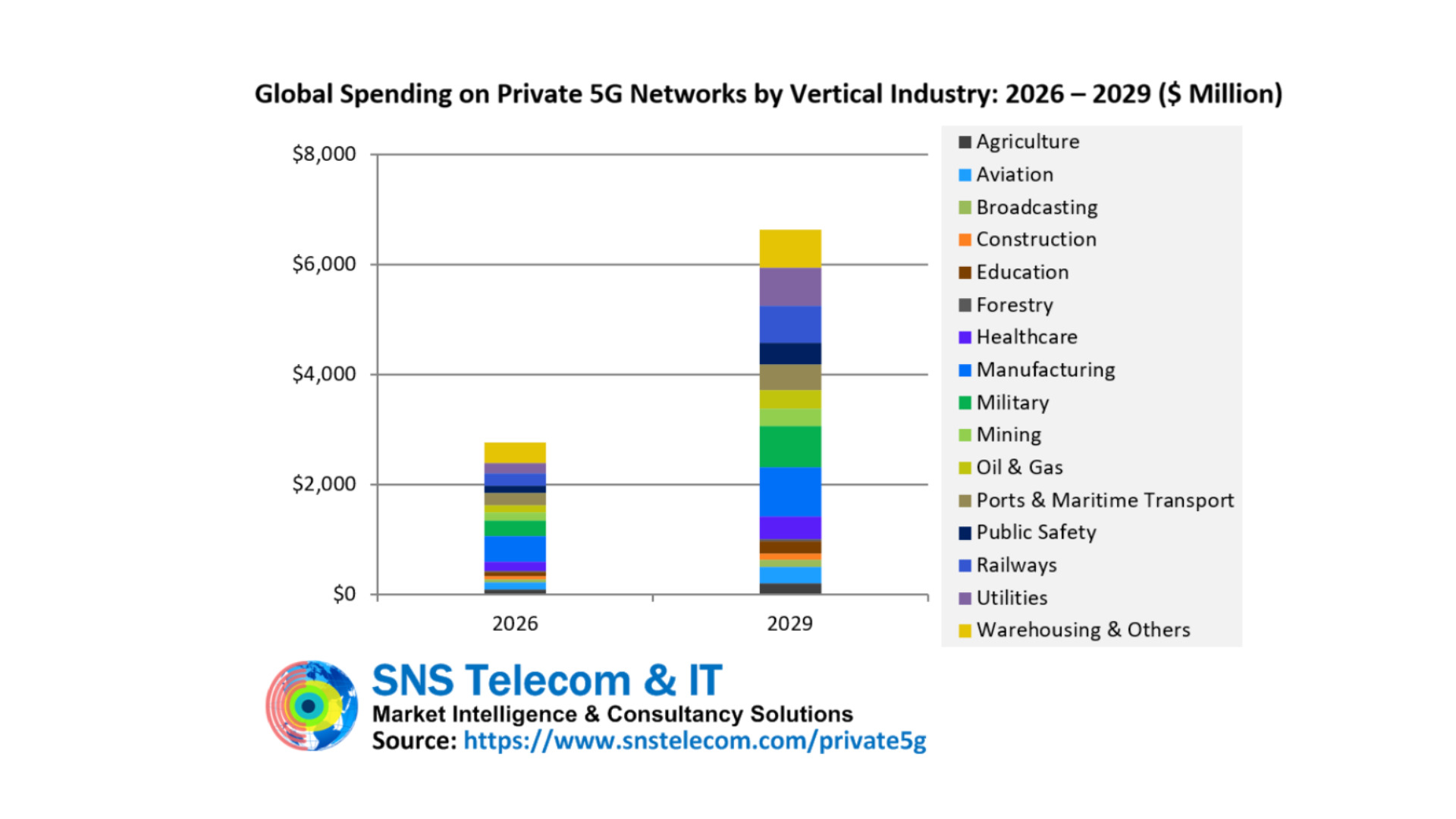
Private 5G mobile networks passed 2,000 enterprise deployments in the first quarter, driven heavily by complex industrial automation demands.The Global mobile Suppliers Association (GSA) tracked 2,003 organisations running private cellular infrastructure with contract values exceeding €100,000. These corporate and governmental operations now stretch across 88 nations, representing a compound annual growth trajectory of 37 percent sustained since 2019. The market added 48 new major deployments between January and March to push past the 1,953 total recorded at the close of last year.Opaque sector data and securityHigh-security industries routinely obscure their physical communications infrastructure. The GSA Private Mobile Networks Special Interest Group submits 76 percent of the tracked references under strict anonymity.Military operators, maritime authorities, and power grid operators keep over 80 percent of their network builds out of the public domain to protect operational integrity. Operators strictly guard frequency usage and physical antenna coordinates.A coalition of seventeen telecom hardware and software vendors supplies this anonymised intelligence, drawing on direct installation data from firms like Ericsson, Nokia, Dell, Keysight Technologies, and Mavenir.Industrial production topologiesManufacturing generates the highest volume of dedicated cellular adoption, followed closely by education, academic research, and mining. Thirteen new manufacturing facilities commissioned cellular networks in the first quarter alone, while mining operations and seaports activated six sites each.Factory architectures deliberately bypass public carrier cores. Enterprises install the User Plane Function directly on the factory floor, driving local routing latency below 10ms. Automated guided vehicles maintain continuous, uninterrupted connections across wide manufacturing spaces where standard Wi-Fi protocols struggle with access point handovers in metal dense environments. Cellular radios manage active mobility natively without dropping packets.Heavy industry relies on dedicated frequencies to avoid the high electromagnetic noise generated by welding equipment and massive motors. Licensed cellular spectrum cuts through ambient noise floors, isolating factory floor packet delivery from standard corporate IT networks.Full production environments represent the bulk of these €100,000+ deployments, though a secondary tier of 178 smaller reference sites exists in the €50,000 to €100,000 bracket, which added eight new customers recently.Extraction sector architectureExtraction companies face physical environments requiring dedicated communication lines deep underground or across expansive open pits. Network architects deploy massive multiple-input multiple-output antennas at the surface edge and run leaky feeder cellular cables through subterranean tunnels.Haul trucks send constant telemetry to autonomous control systems where even minor packet loss initiates hard safety stops on 400-ton vehicles, bringing production to a complete halt. Private cellular networks provide the deterministic routing required to prevent these communication failures, keeping autonomous fleets operational.The technology stack is advancing beyond older standards, with 5G now accounting for the majority of new private network builds initiated over the past two years.Heavy industrial operations absolutely depend on the superior uplink capacity inherent to 5G architecture to transmit massive outbound data payloads. High-definition optical sensors mounted along assembly lines continuously stream footage to local machine vision models, scanning conveyor belts for microscopic material flaws in real-time. Older LTE protocols manage basic telemetry effectively, but 5G is strictly required to handle the video traffic required by modern automated quality control systems.Implementation hurdles and integrationNetwork administrators face high technical hurdles during physical implementation. IT departments traditionally specialise in local area networks and ethernet protocols, making cellular architecture a completely different operational standard. Enterprises often struggle to bridge their established information technology platforms with new operational technology systems.Baseband units require precise synchronisation and extensive physical radio frequency mapping, as structural steel reflects signals unpredictably. Engineers must conduct detailed site surveys to position remote radio heads effectively.Security presents another challenge with many businesses understandably mandating strict zero-trust architectures to manage risk. Integrating mobile edge compute nodes with legacy industrial controllers introduces unfamiliar attack vectors that require careful mitigation. Administration teams configure strict virtual routing and forwarding tables to tightly segment factory traffic, ensuring subnets keep 5G-enabled machinery isolated from corporate email servers and external internet access.Factory operators routinely report reduced equipment downtime after clearing these implementation hurdles. Ports now automate massive crane operations with zero physical tethering, using cellular coverage to blanket massive acreage with a fraction of the access points required by legacy Wi-Fi topologies. Enterprises accept the steep learning curve to achieve this level of deterministic networking.Geographic distribution and spectrum accessDeployment volume remains heavily concentrated in high-income and upper-middle-income economies, paced overwhelmingly by adoption rates in the US, Germany, and the UK. North American and European markets continue to expand their enterprise cellular footprints, with Canada growing its active customer base by five percent during the opening quarter and the UK increasing by four percent. The US and German markets posted two percent and one percent respective gains over the same period.Data transparency varies by region, but the vast majority (85% of all database entries) now include verified country-level deployment locations. The first quarter also recorded emerging market penetration, with Lithuania, Namibia, and Suriname registering their first dedicated private networks.Spectrum availability heavily dictates these adoption rates. Market data indicates a strong positive correlation between private mobile network volumes and jurisdictions offering dedicated enterprise spectrum. Regulators ultimately control the physical layer of the network, and IT directors require uncontested airwaves to build reliable architectures.China presents a persistent data anomaly in global tracking. Regional reports frequently claim China operates over 40,000 networks, a metric the GSA actively disputes. The association assesses that the vast majority of those Chinese deployments run on shared public infrastructure rather than meeting the strict technical definition of a dedicated private network.Joe Barrett, President of GSA, commented: “A large number and varied range of market participants are actively engaged in developing and delivering solutions for private mobile networks. With so much opportunity, and so many regulators planning initiatives to make spectrum available for LTE and 5G private usage, we expect significant market developments over the next couple of years.“Crucially, over three-quarters of the references included in the GSA database underpinning this report have been provided by members of the Private Mobile Networks SIG on the basis of anonymity, and information for these references will generally not be found in the public domain.”The reliance on anonymous, direct-from-vendor installation data ensures the tracking avoids marketing inflation, providing the telecoms sector with independent and verifiable metrics on actual enterprise adoption.See also: Ricoh deploys Thread AI facility management platformWant to learn more about the IoT from industry leaders? Check out IoT Tech Expo taking place in Amsterdam, California, and London. The comprehensive event is part of TechEx and is co-located with other leading technology events including AI & Big Data Expo and the Cyber Security Expo. Click here for more information.IoT News is powered by TechForge Media. Explore other upcoming enterprise technology events and webinars here.
Industrial automation drives private 5G past 2,000 deployments
Private 5G mobile networks passed 2,000 enterprise deployments in the first quarter, driven heavily by complex industrial automation demands.
1,097 words~5 min read