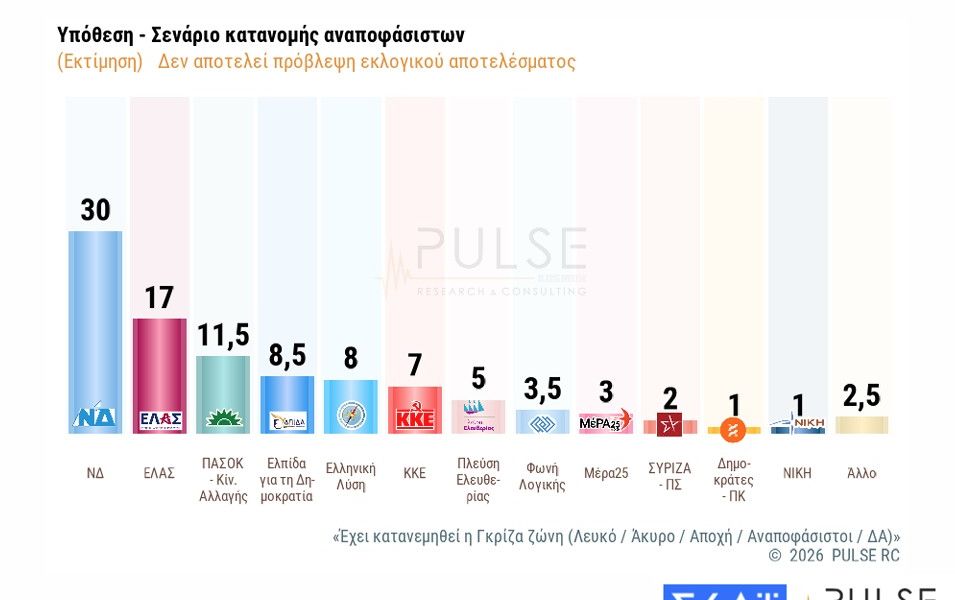
In the runup to the next national election, which Prime Minister Kyriakos Mitsotakis insists will take place sometime during Spring 2027, the ruling New Democracy party is constantly commissioning private opinion surveys, increasingly localized, down to constituency level.
The results show a clear trend: the ruling party performs best in the capital region and the further away from the cities, the weaker it becomes.
Voting intentions may slightly vary among surveys, but they all point out that, in the Attica region, New Democracy polls 2-3 percentage points above its national average. In the difficult north, where parties to its right obtain their best results, ND polls around 3% lower than the national average in the city of Thessaloniki but 8-10 points lower elsewhere.
The trend is almost uniform across the country: in the seats of the former prefectures, now called regional units, ND performs 4-7 percentage points better than in the rest of what are also multi-seat constituencies. The exceptions are some islands.
This is a reversal of past trends: ND’s main strongholds were to be found in the more culturally conservative countryside. In 2004, for example, when New Democracy won 45.36% of the vote, ending ten and a half years of socialist rule, it had obtained 45% in central Athens and 40% in the Athens suburbs, while it exceeded 50% in many agricultural regions.