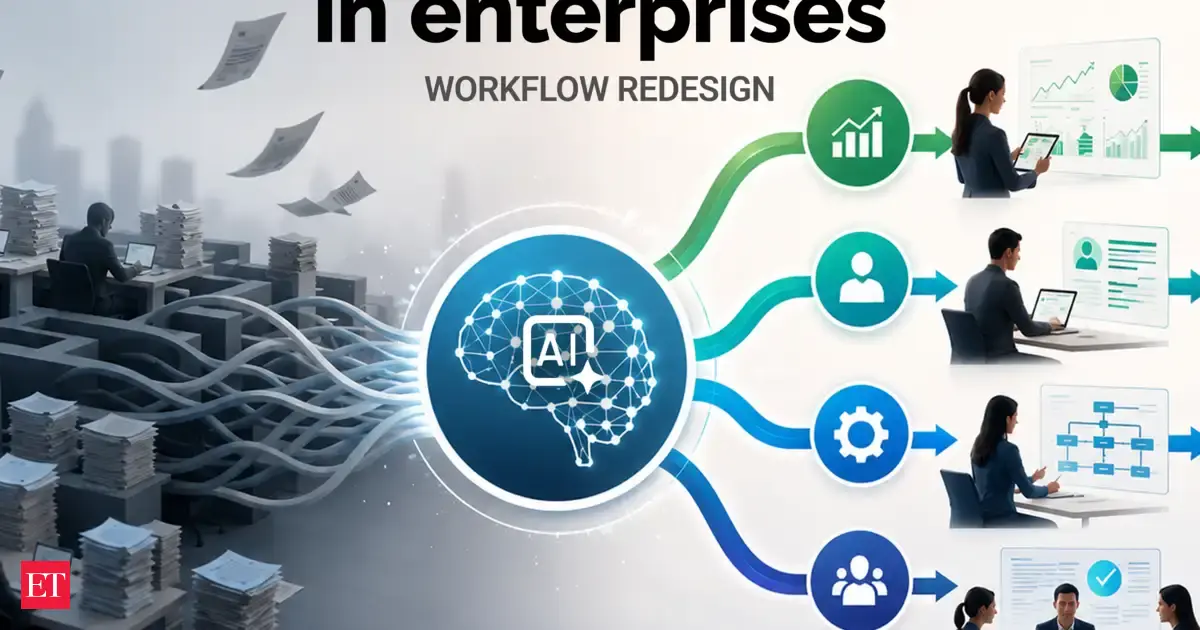
Maria Scott, CEO of TAINA Technology, provider of a world-class tax technology platform.gettyOver the years, I’ve spent a great deal of time with tax and operations teams across financial institutions. These are highly capable, thoughtful professionals, often working under intense pressure to manage complexity, meet regulatory demands and maintain accuracy at scale.What has always stood out to me is not a lack of talent or effort, but the constraints of the operating models they are working within.For years, conversations about AI in financial services have centered on efficiency, including how to process faster, reduce costs and automate repetitive tasks. While those benefits are real, they only scratch the surface of what is now possible. What we are beginning to see is something far more fundamental.Agentic AI is starting to reshape the way work itself is structured, executed and experienced across organizations. Nowhere is this shift more visible than in tax operations, where complexity, regulation and data dependencies have traditionally driven highly structured operating models. These models were built for control and consistency, but they have also led to fragmentation of processes, data and institutional knowledge.Over time, this fragmentation creates an environment where organizations become increasingly reactive, identify issues late, invest heavily in remediation and rely on individuals to bridge the gaps between systems and workflows. What makes this moment different is that we now have the ability to rethink these foundations.From Static Structures To Adaptive OrganizationsAgentic AI introduces the possibility of moving away from static, siloed structures toward something more fluid and adaptive. Instead of work being confined within fixed teams, organizations can begin to organize around clearly defined objectives to bring together the right combination of skills, technology and expertise to solve problems in focused, fast-moving deployments.These are not permanent structures, but dynamic formations that evolve as the work itself evolves. This shift has profound implications, not only for efficiency, but for how organizations learn.Why Governance Matters More Than EverOf course, none of this can happen without trust. As organizations move toward more autonomous and adaptive AI-driven operating models, governance, risk and control frameworks become even more critical.Agentic AI cannot operate as an uncontrolled black box, particularly in highly regulated environments such as financial services and tax operations. These systems must be enterprise-grade, secure, auditable and designed with clear guardrails, oversight and built-in layers of quality assurance from the outset.In many ways, the future of AI adoption will depend not only on capability, but on confidence. At a time when concerns around cybersecurity, data integrity and AI-driven decision-making continue to grow, organizations will increasingly differentiate themselves through responsible implementation, strong governance and operational trust.Creating Organizational Memory At ScaleHistorically, much of what makes an organization effective has lived in the experience of its people, their understanding of edge cases, their memory of past decisions and their ability to navigate ambiguity. While invaluable, this form of knowledge is inherently fragile. It is difficult to scale, inconsistent in its application and often lost over time. One of the most powerful, yet underappreciated, aspects of agentic AI is its ability to change this.By embedding learning directly into processes, organizations can begin to capture and reuse knowledge in a way that was previously impossible. Every interaction, every validation and every exception becomes part of a continuously evolving system of organizational memory.Over time, this creates a compounding effect, improving consistency, strengthening controls and reducing the need to revisit the same problems repeatedly. This is where the real return on investment begins to emerge.As data quality improves at the point of capture, downstream remediation reduces. As decisions become more consistent, auditability strengthens. And as knowledge is retained and reapplied, operational efficiency increases in ways that extend far beyond simple task automation. Redefining The Nature Of WorkThe impact, however, is not limited to processes. It extends to the nature of work itself.As repetitive activities are reduced, professionals are able to focus more on judgment, analysis and strategic contribution. The work becomes more varied, more engaging and, ultimately, more valuable. In turn, this has implications for how organizations attract and retain talent, particularly as expectations around meaningful work continue to evolve. For leaders, this transformation requires a shift in mindset.Managing static teams and rigid structures becomes less relevant than the ability to assemble the right capabilities at the right time, set clear objectives and ensure quality across dynamic environments. Leadership becomes less about control and more about enablement. This is not a distant future scenario.Many organizations are already beginning to explore these models, particularly in areas where complexity and scale make traditional approaches increasingly difficult to sustain. What matters now is how leaders respond.What This Means For Leaders TodayTo begin unlocking the real value of agentic AI, organizations should focus on a few practical shifts:• Reassess where knowledge lives. If critical expertise sits only with individuals, it creates risk. Embedding that knowledge into systems creates consistency and resilience.• Move validation and decision-making upstream. The earlier issues are identified and resolved, the less costly they become.• Design workflows around outcomes, not functions. Instead of structuring teams around tasks, align them to objectives and allow technology to orchestrate execution.• Start with high-friction processes. Onboarding, validation and remediation are often the most immediate opportunities for impact.• Focus on augmentation, not replacement. The goal is not to remove people, but to enable them to operate at a higher level.Final ThoughtsAgentic AI is not just a tool for doing the same things faster. It is an enabler of a fundamentally different way of operating, one that is more adaptive, more intelligent and more aligned with the demands of modern financial institutions.The organizations that recognize this shift early will realize efficiency gains as they begin to redesign how work is done, how knowledge is retained and how value is created.And in doing so, they will unlock a far more meaningful definition of return on investment than we have seen before.Forbes Technology Council is an invitation-only community for world-class CIOs, CTOs and technology executives. Do I qualify?
Why The Real ROI Of Agentic AI Lies Beyond Automation
Agentic AI is reshaping financial services by enabling organizations to redesign workflows, capture institutional knowledge and build more adaptive operating models grounded in governance, trust and continuous learning.
992 words~5 min read