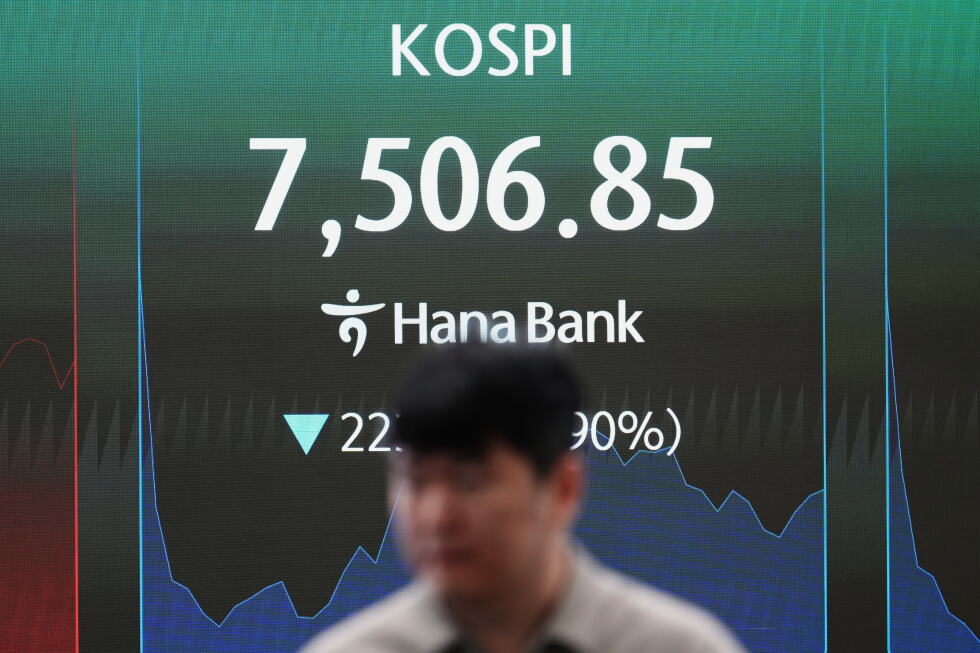
Global stocks surged and oil prices fell on Monday as an agreement between Iran and the US to reopen the Strait of Hormuz raised hopes for an end to the energy crisis triggered by the conflict.The S&P 500 rose 1.9 per cent by early afternoon in New York, while the Nasdaq Composite jumped 3 per cent. The gains came after the Stoxx Europe 600 index recouped its losses since the start of the Iran war to reach a new all-time high, before trimming gains to close 0.2 per cent higher.Investors are betting the US-Iran deal will reverse a surge in energy prices that has hit a wide range of industries since the war began at the end of February.Oil prices fell sharply on Monday, extending Friday’s drop, with Brent crude, the international benchmark, down 5.2 per cent at $82.80 (€71.35) a barrel, having earlier fallen as low as $82.40, its lowest level in more than three months.“From the market perspective, a deal is a clear positive,” said Mohit Kumar, chief European economist at Jefferies.The rally was mirrored across stock markets in Asia, particularly oil-importing economies hit hard by the energy crisis. In Japan, the Nikkei 225 index soared 5 per cent to a record high while South Korea’s Kospi gained 5.2 per cent.‘No profit and crap governance’ – is Elon Musk’s SpaceX actually worth $1.75 trillion? Listen | 41:54In a sign that investors are less fearful of a prolonged period of higher inflation, government bonds rallied and investors scaled back their bets on the speed of interest rate rises by major central banks.The yield on 10-year US Treasuries slipped 0.03 percentage points to 4.45 per cent. UK 10-year yields dropped as low as 4.77 per cent, the lowest level since mid-April, and were later down 0.03 percentage points on the day at 4.82 per cent. Yields on 10-year German Bunds dropped 0.04 percentage points to 2.96 per cent. Yields move inversely to prices.Investors are fully pricing in a quarter-point interest rate rise by the US Federal Reserve by April 2027. As recently as last Friday, such a move had been expected by January next year. Over the weekend, investors pushed back their expectations for the Bank of England’s next rate rise from November to December.The euro rose 0.4 per cent against a broadly weaker dollar, taking it back above $1.16.“The deal should help to reduce the risk of a more disruptive outcome for the global economy and financial markets,” said Lee Hardman, senior currency analyst at MUFG.Investors said sentiment towards equities was also helped by the 19 per cent jump on Friday in newly floated SpaceX. The shares climbed another 10 per cent on Monday. Meta rose 6 per cent and Amazon gained 3.1 per cent, while chipmakers Micron Technology and AMD were up 9.7 per cent and 7.5 per cent, respectively.Bullishness on the tech sector helped the tech-heavy Kospi, which has become an Asian bellwether for investors’ enthusiasm for AI-linked stocks. Samsung Electronics was up more than 5 per cent, while rival chipmaker SK Hynix gained 6.4 per cent.The buying in Tokyo focused most heavily on Japanese companies seen as critical to the semiconductor, AI and data centre industries, pushing the likes of Murata Manufacturing up 18 per cent and SoftBank more than 10 per cent higher.Bruce Kirk, Japan equity strategist at Goldman Sachs, said investors’ rush to maximise their exposure to AI-related stocks continued to be the big market move, with Tokyo stocks benefiting from the “spillover” flows from the rest of the region. – Copyright The Financial Times Limited 2026
Stocks surge as US-Iran deal raises hopes of end to energy crisis
Asian shares climb with Japan’s Nikkei nearing record close
593 words~3 min read