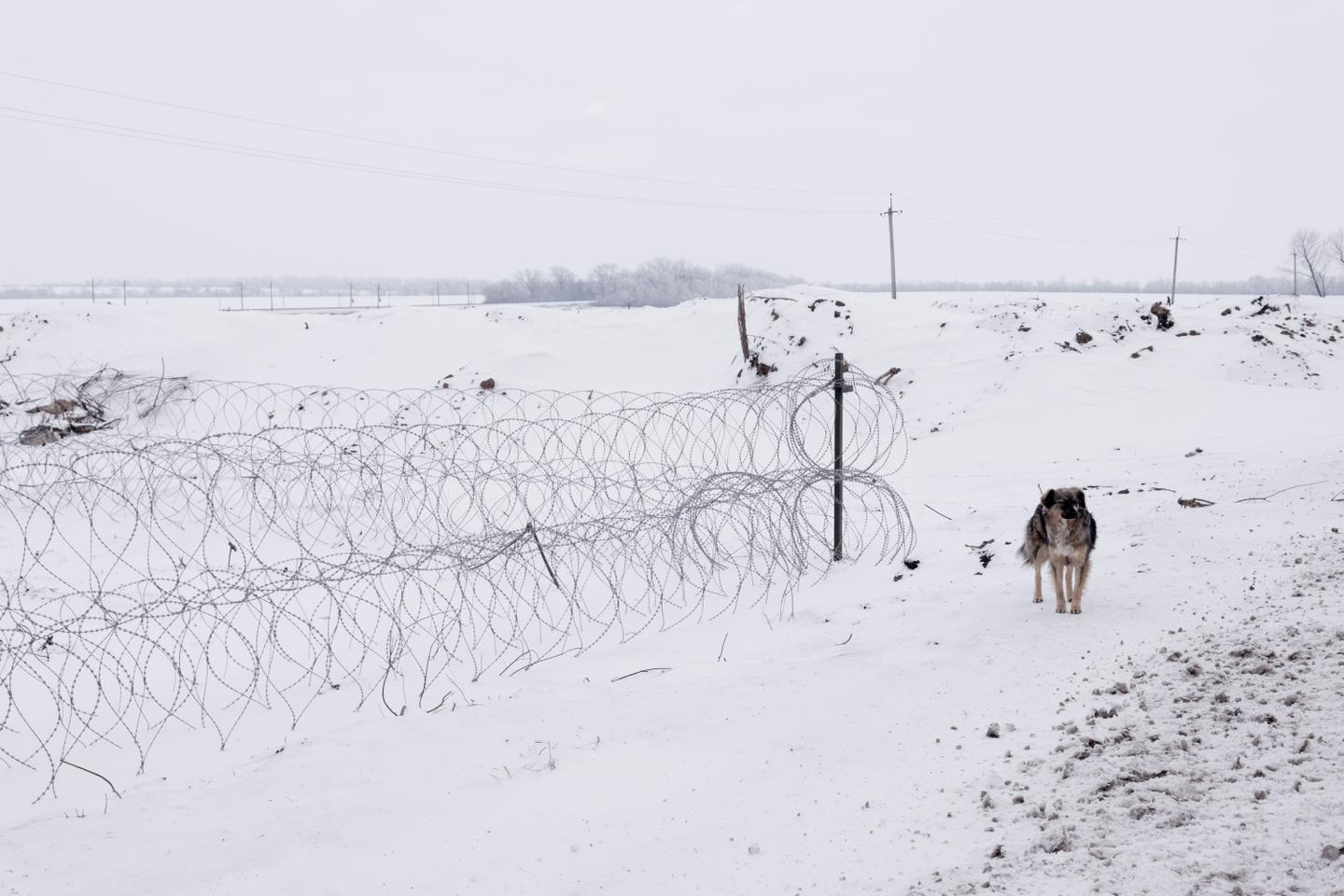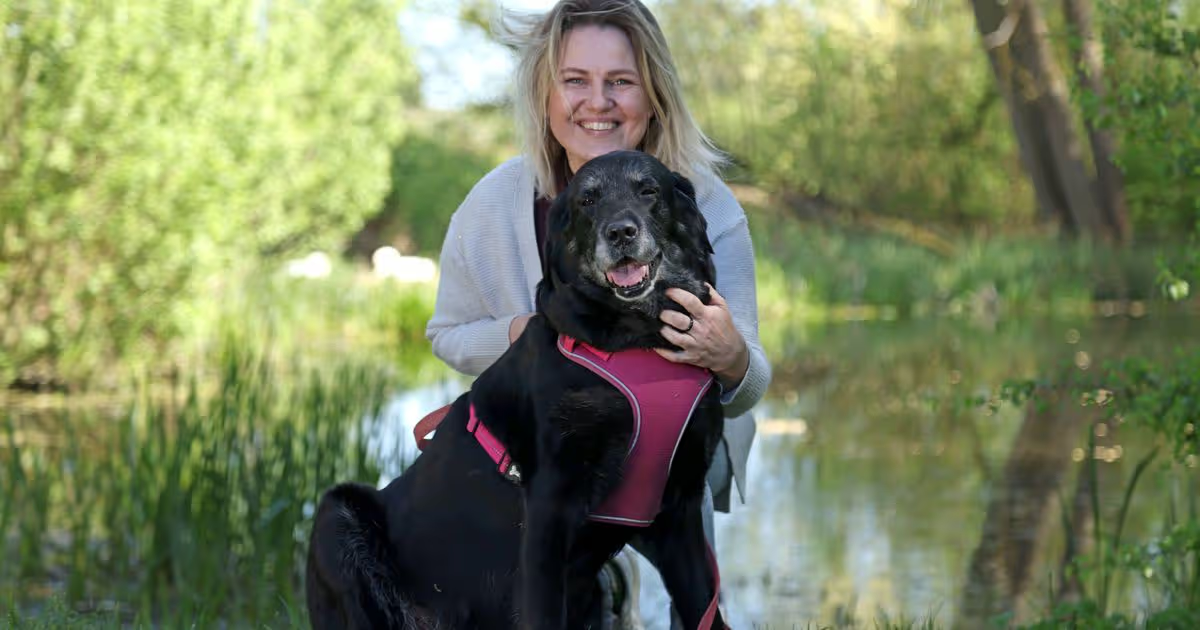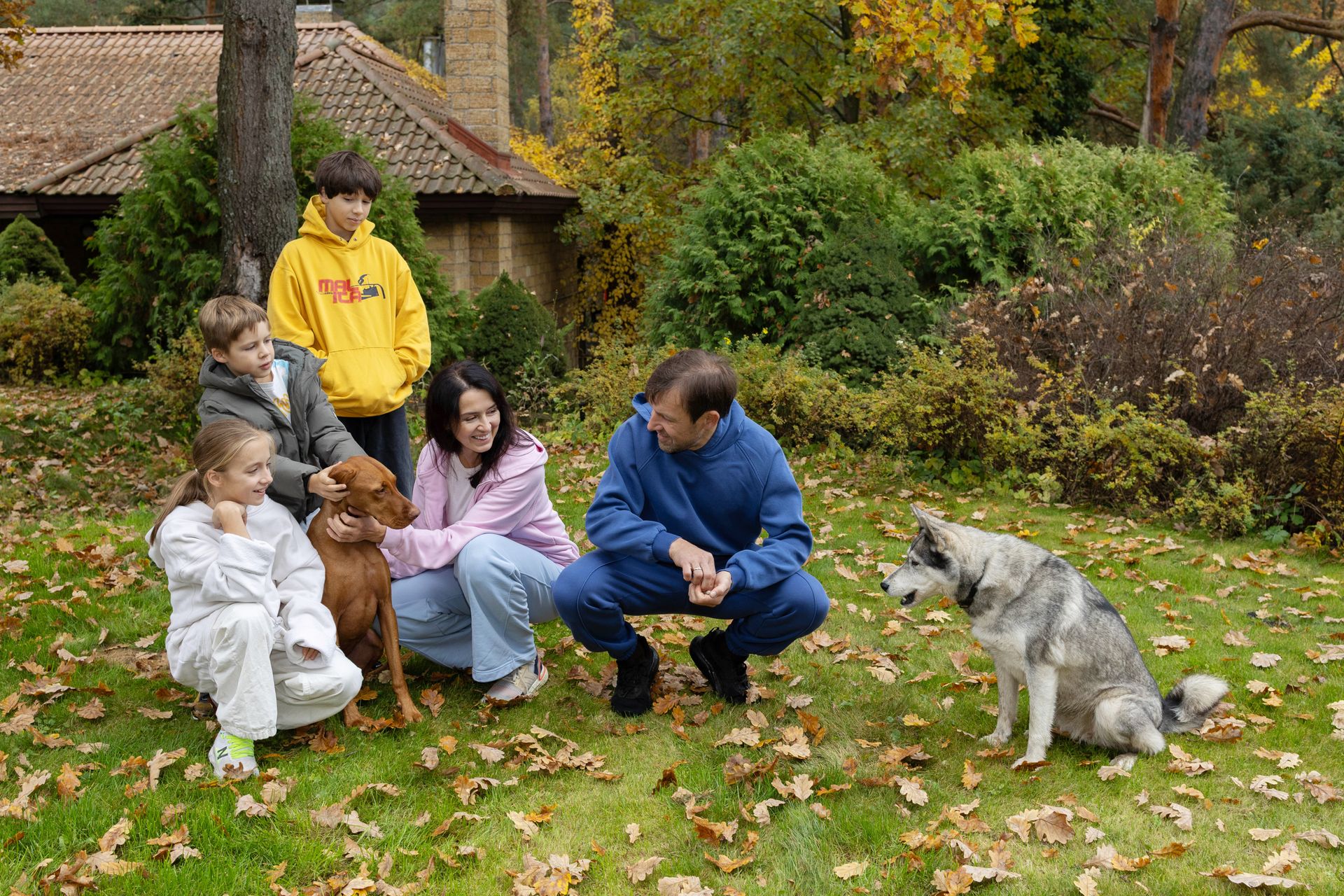
Andrii Onistrat, Valentyna Khamaiko, and their kids - Andriiko, Myroslava, Mykhailo, and their rescued dogs Divchulia (black and white) and Hugo (ginger) in Bobrytsia, Kyiv Oblast, Ukraine, on Oct. 22, 2025. (Anna Donets / The Kyiv Independent)When war approaches, people may be able to pack their lives into a suitcase and flee within hours. Animals, however, cannot.In areas where humans can no longer enter, animals are often the last living beings left behind amid relentless drone attacks and artillery fire, with little chance of survival. As the front line shifts across Ukraine, more and more animals are abandoned to face the realities of war alone — stranded on the streets, constantly at risk of being killed by strikes or trapped in anti-drone nets and left to starve.UAnimals, a Ukrainian animal rights and welfare organization, said it is difficult to determine the exact number of homeless animals in Ukraine, but added that the figure has risen sharply since 2022. Many animals are abandoned after their owners are unable to evacuate with them or are killed in Russian attacks.While there is no government-organized evacuation of animals in Ukraine's war-torn regions, a small group of volunteers continues to rescue those left to fend for themselves in some of the country's most dangerous areas. They evacuate not only dogs and cats, but also large farm animals trapped in combat zones — all in the hope of giving them a safer, better life far from the constant threat of explosions and destruction.As part of the "Finding Home" project, the Kyiv Independent spoke with five families who opened their homes to animals rescued from the war zone.FasoliaFasolia ("Bean") was evacuated to Kyiv from Pokrovsk, Donetsk Oblast, in late 2024, along with her sister, who later also found a home in the capital.The dogs' former home has been heavily damaged by Russian strikes and now bears little resemblance to what it once was. Pokrovsk has reportedly been under full Russian occupation since May 18, 2026, according to the Ukrainian monitoring project DeepState, though Ukrainian authorities have not officially confirmed this.Kateryna Hodunova, 28, a reporter who had dreamed of having a dog since childhood, came across photos of Fasolia on a friend's Instagram and suggested to her partner, Andrii Boiko, 28, who works in IT, that they meet her.Kateryna Hodunova and Andrii Boiko with their rescued dog Fasolia from Pokrovsk, Donetsk Oblast, in Kyiv, Ukraine, on Oct. 12, 2025. (Anna Donets / The Kyiv Independent)"Andrii was naive because he thought we were really going to see Fasolia just to meet her," Hodunova said.Within days, the five-month-old puppy had moved into her new home, quickly upending her owners' routines and even the layout of their apartment. With no prior experience of living with a dog, Kateryna and Andrii gradually began working with a trainer to build trust and establish a routine with Fasolia — though not without incident."It was a complete disaster, but actually not as bad as I imagined," Boiko said, recalling how Fasolia's first actions in the new home included chewing up a mattress, tearing wallpaper, and damaging a headphone case.Kateryna Hodunova plays with her rescued dog Fasolia from Pokrovsk, Donetsk Oblast, in Kyiv, Ukraine, on Oct. 12, 2025. (Anna Donets / The Kyiv Independent)Fasolia's favorite toys photographed in Kyiv, Ukraine, on Oct. 12, 2025. (Anna Donets / The Kyiv Independent)The most difficult stage of Fasolia's puppyhood is now behind them, and she has grown into a devoted companion."When I take her for a walk, I know I'll feel better — we'll play and spend time together. I'll focus on her first and foremost, rather than on what's been upsetting me, and there are plenty of such things during wartime," Hodunova said.Hugo and DivchuliaAndrii Onistrat, 52, a soldier, and Valentyna Khamaiko, 44, a TV presenter and entrepreneur, had a family that included three children and a dog named Mimi. After the start of Russia's full-scale invasion, their household grew even larger.In 2022, the couple took in Hugo and Grace, then still puppies, after their home in the town of Irpin in Kyiv Oblast — occupied by Russian forces for 23 days — was destroyed.At the time, the puppies were about a month old and required round-the-clock care. Grace was later adopted by another family, while Hugo remained with Andrii and Valentyna.Myroslava and Andriiko with their rescued dog, Hugo (ginger), and their dog Mimi in Bobrytsia, Kyiv Oblast, Ukraine, on Oct. 22, 2025. (Anna Donets / The Kyiv Independent)Myroslava looks at her rescued dog Divchulia in Bobrytsia, Kyiv Oblast, Ukraine, on Oct. 22, 2025. (Anna Donets / The Kyiv Independent)"There was so much sadness (in 2022)," Khamaiko said. "But when these little ginger ones appeared, I felt a huge emotional relief."Another dog joined the family in 2023, when Onistrat, an officer in the Ukrainian Armed Forces, was serving in Kharkiv Oblast. He found Divchulia (a sweet nickname for "Girl" in Ukrainian) in the village of Borova, where she had been living near a local grocery store since the beginning of the fullscale war.
'Finding Home' — Giving Ukraine's war-rescued animals a second chance at life
When war approaches, people may be able to pack their lives into a suitcase and flee within hours. Animals, however, cannot. In areas where humans can no longer enter, animals are often the last living beings left behind amid relentless drone attacks and artillery fire, with little chance of survival. As the front line shifts across Ukraine, more and more animals are abandoned to face the realities of war alone — stranded on the streets, constantly at risk of being killed by strikes or trapped
1,913 words~9 min read