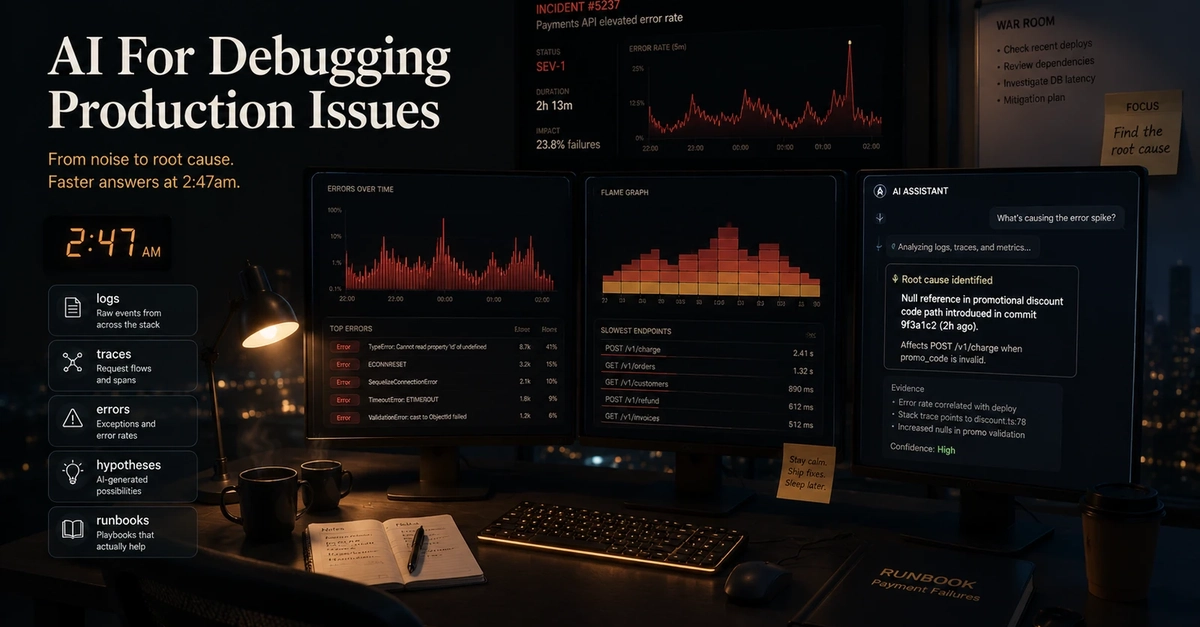
It's 2:47am. The pager has just gone off for the third time in twenty minutes. Checkout latency is spiking. The error rate on /api/orders is climbing. Slack is filling with screenshots of half-finished trace views. Somewhere in your logs, the answer is sitting there in plain text, buried under a few million other lines that all look just as urgent.
This is the moment people are talking about when they say "AI is going to change how we debug production." Not the demo where someone asks ChatGPT to write a regex. The 2:47am moment. The one where a tired human has to hold five tabs open in their head and form a hypothesis before the executive team starts asking for an ETA.
It turns out that's where the technology has the most to offer, and also where it embarrasses itself most often. Let's break down what's actually working in 2026, where the seams still show, and how to wire an LLM into your incident-response loop so it earns its keep instead of just adding another window to glance at.
What AI is genuinely good at during an incident
The two boring superpowers first: reading fast and correlating across heterogeneous signals. Those are the things humans get worst at when they're tired and time-pressured, and they're the things a good LLM does at the same speed at 2am as at 2pm.