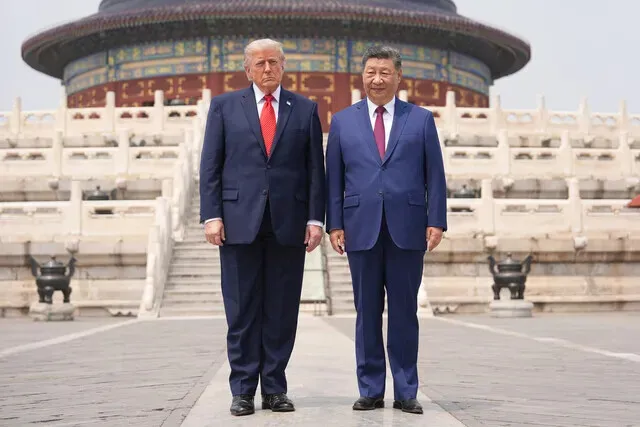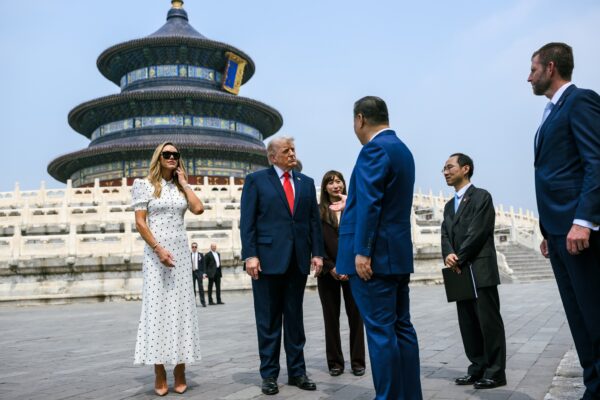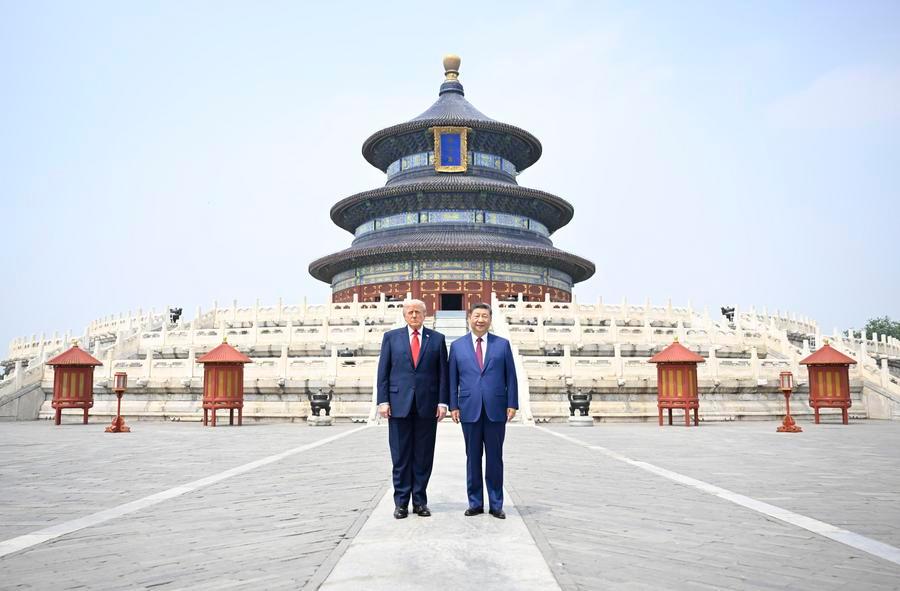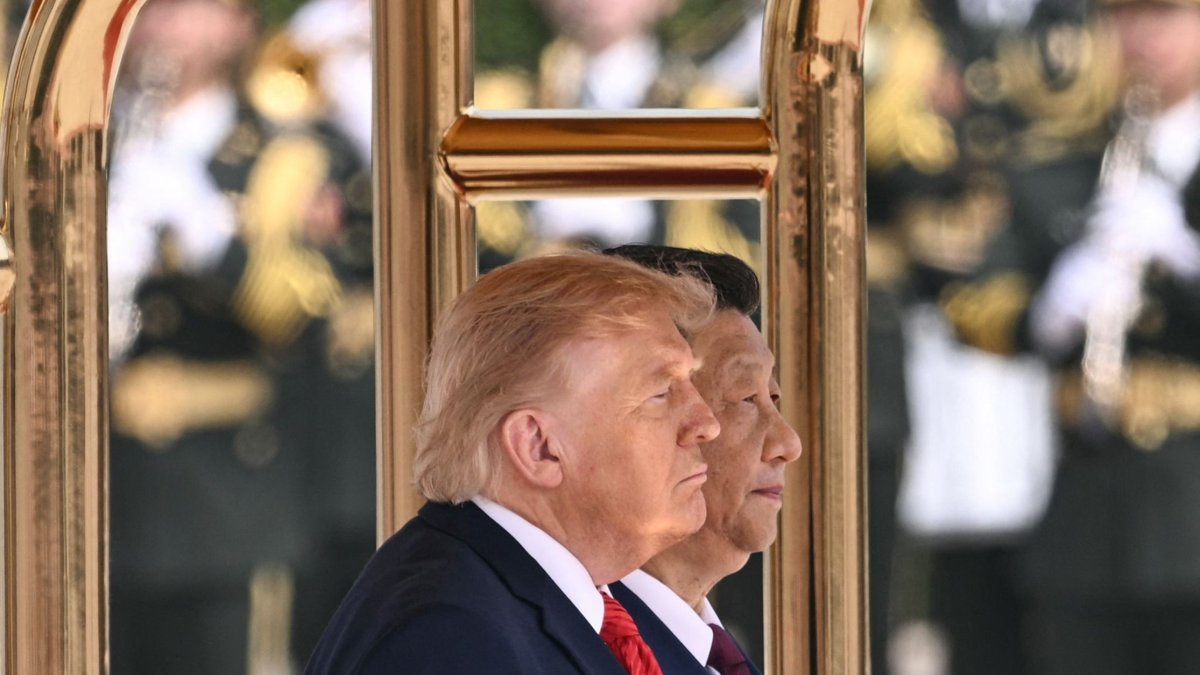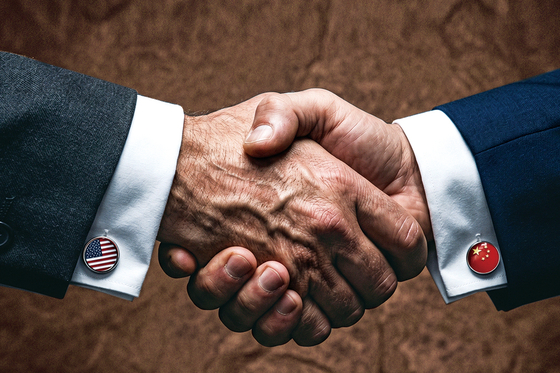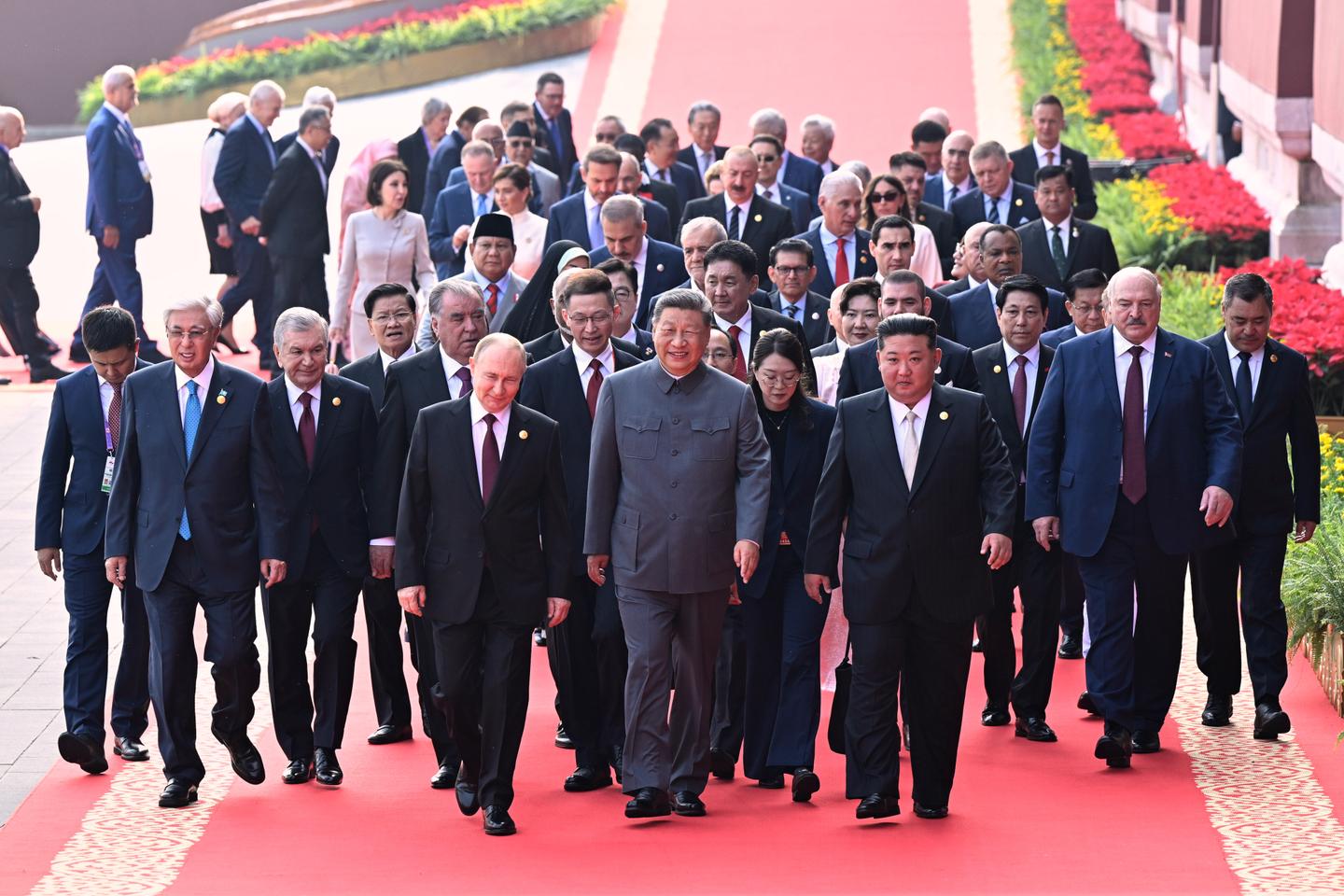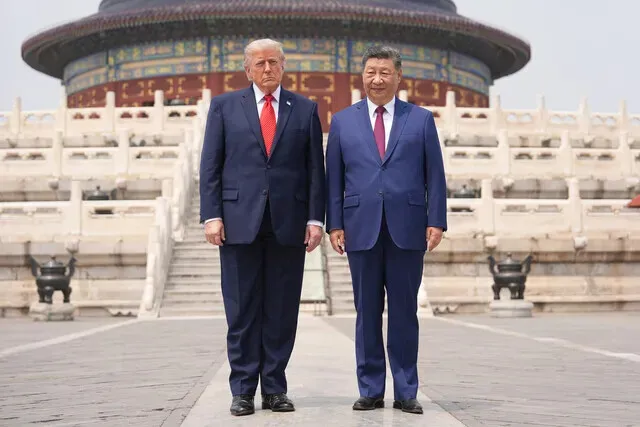
US President Donald Trump and Chinese President Xi Jinping stand outside the Temple of Heaven complex in Beijing on May 14, 2026. (AP/Yonhap)
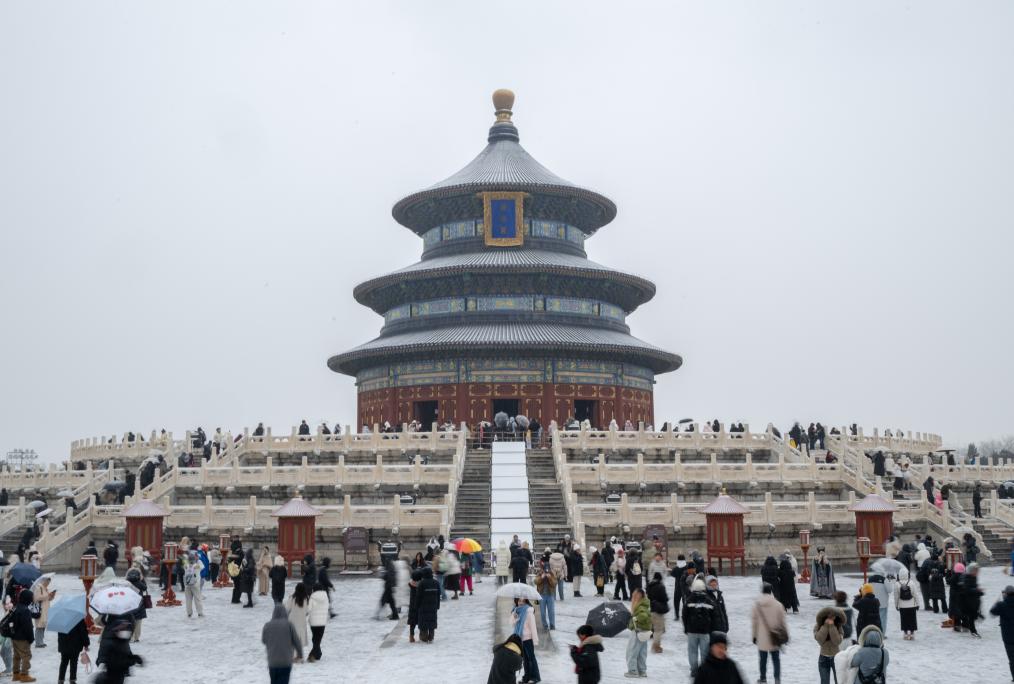
Beijing’s Temple of Heaven, where Chinese emperors once officiated heavenly rites, symbolizes the order of the universe and the authority of the emperor.While the temple was first built under the Yongle Emperor of the Ming dynasty, it was elevated to its current splendor under the Qianlong Emperor during the heyday of the Qing dynasty.Seeking to prove he was the Son of Heaven, entrusted with the Mandate of Heaven despite his Manchurian background, the Qianlong Emperor enlarged the Temple of Heaven to four times the size of the Forbidden City and offered sacrifices to heaven a grand total of 155 times during his reign. That was the period when the Qing dynasty enjoyed its greatest economic success and military strength.When US President Donald Trump visited China last month, he toured the Temple of Heaven with Chinese President Xi Jinping. The first visit to China by an American president in nine years gave Xi an opportunity to frame China as being on equal terms with the US and to present himself as a “new emperor” who is more stable and credible than Trump’s America to a domestic and international audience.At the beginning of his summit with Trump, Xi noted that the world is at a crossroads and provocatively asked whether China and the US can overcome the Thucydides trap — a concept based on historical observation that a hegemonic power’s attempt to fend off a challenger often ends in war.Xi’s appeal for Trump to avoid the Thucydides trap contained the following implicit message: The US is in decline, and the Mandate of Heaven is passing to China. The US needs to accept that and not try to stop that through military means.After a stroll through the Zhongnanhai complex, where the residence and offices of the leadership of the Chinese Communist Party are located, Xi described Trump’s visit as “historic and symbolic.” The title of the White House’s fact sheet also mentioned “historic deals.”But what exactly did Xi and Trump mean when they described their summit as “historic”? The key development in the summit was Trump’s agreement to Xi’s proposal that the US and China reorient their rivalry on a “constructive relationship of strategic stability.”Following the summit, Chinese Foreign Minister Wang Yi said that the two leaders’ agreement to establish a constructive relationship of strategic stability was “the most important political consensus of the meeting.”In other words, the US and China have agreed to institute a new relationship of managed competition that allows their fierce rivalry to continue while preventing conflict.China has made clear that it means to shape and manage the world order alongside the US.While sitting with Trump at a banquet held at the Great Hall of the People, Xi said that his vision of the “great rejuvenation of the Chinese nation” is compatible with Trump’s MAGA vision of “making America great again.”That’s reminiscent of Xi’s proposal of “a new model of great power relations” during a summit with then US President Barack Obama in June 2013. Xi remarked that “the vast Pacific Ocean has enough space for two large countries like the United States and China,” but Obama disagreed.The US, which was still much more powerful than China at the time, announced the “pivot to Asia” in an attempt to counter Beijing’s ambitions.But repeated internal political crises and the situation in the Middle East have prevented the US from focusing on containing China. Beijing, meanwhile, has rapidly expanded its economic and military capabilities, and the second Trump administration eventually accepted Xi’s demand to divide the Pacific into east and west and recognize China’s sphere of influence. Xi is effectively leveraging the fact that his counterpart is Trump.Even now in the US, China hawks still hold sway within the US government and political establishment. The Chinese strategy, however, is to exploit the prospect of Trump, who focuses on short-term gains rather than long-term strategies, agreeing to a deal proposed by Beijing. Despite boldly slapping a 145% tariff on Chinese-made products, the American president was helpless when China played its rare earth elements card and is now stuck in the mess that is the war against Iran. The most important thing that Trump’s summit with Xi signaled is that the US leader has agreed that the US will do business with China instead of trying to block its rise — at least for the remainder of his term.Beijing, however, is not rushing to the conclusion that America is in decline and the era of a Chinese-led order has arrived. China’s confidence has grown as it projects the image of a winner endowed with the Mandate of Heaven, but Beijing is well aware of its power gap with the US, setting the stage for an intense competition that will last decades.Since the Sino-US rivalry for hegemony intensified in 2017, Xi has consistently cited Mao Zedong’s theory of protracted war, which was presented in 1938 as a strategy to counter Japanese imperialism. This three-stage strategy in which the weak fight the strong uses a “strategic defensive” in the first phase, when one is weaker than one’s opponent; a “stalemate” in the second, where a back-and-forth battle continues between both sides as they grow nearly equal in strength; and a “strategic counteroffensive” as the finale, in which one grows stronger than the enemy to achieve final victory.Beijing believes that its ties with Washington have entered the second phase, as the first saw China defend itself against the unilateral pressure of the US as the world’s dominant power; thus, the two countries can now compete on equal footing. Beijing is taking the lead in setting new rules of the game, urging the US not to arbitrarily use its military superiority or impose financial sanctions against China, but rather to compete more fiercely in the economy, advanced technologies, and military and diplomatic influence. Beijing plans to further strengthen its high-tech and manufacturing prowess and capitalize on the instability of the American alliance system in Asia and Europe.For Xi, no issue is more central than Taiwan in proving that the Mandate of Heaven belongs to China. China’s official Xinhua News Agency said that during the bilateral summit, Xi told Trump that Taiwan is the most important issue in Sino-US relations and that any “mishandling” of this matter could put “the entire relationship in great jeopardy.” This was a clear warning that Washington must not cross the line on Taiwan if a “constructive strategic stable relationship” is to be maintained.In an interview with Fox News following the summit, Trump said he and Xi discussed “in great detail” arms sales to Taiwan, adding his hesitation on whether to approve a US$13 billion arms sale to Taiwan despite the deal receiving congressional approval. Still, there is no indication that Trump has made explicit concessions to China on Taiwan. Washington’s decision to discuss arms sales to Taiwan with China — breaking its 1982 pledge to Taipei not to consult with China on arms sales as part of the “Six Assurances”— is widely regarded as a major gain for Beijing. Trump said in a Fox News interview on May 16 that Taiwan should not declare independence, saying, “They’re going independent because they want to get into a war and they figure they have the United States behind them.” This comment was taken as a public reference to China’s long-standing demand to oppose Taiwanese independence.Whether Trump will halt arms sales to Taiwan is unclear, but he has openly called Taiwan “a very good bargaining chip” for striking a deal with China. Recognizing that tariff pressure and displays of military might are ineffective against China, he will likely use the Taiwan issue as a bargaining chip in negotiations with China. Key items among the weapons the US has agreed to sell to Taiwan could be omitted, or the sale might even be canceled.Some say May’s summit yielded few concrete results, but this is not the end of Trump-Xi dealmaking. With additional talks between both leaders scheduled throughout 2026 through events like Xi’s visit to the US in September, the Asia-Pacific Economic Cooperation leaders’ meeting in Shenzhen, China, in November and the Group of 20 summit in Florida in December, talks between the two leaders are likely to help finalize major Sino-American agreements.The trade and investment committees that Washington and Beijing agreed to launch at last month’s summit are likely to serve as channels for striking a major bilateral deal. One scenario could see the US allowing Chinese investment and exports to America in sectors other than advanced technology, while China reciprocates with large-scale purchases of US agricultural products and energy as well as a further opening of its domestic market to American companies. Both sides are also considering discussions on artificial intelligence, and could seek to take the lead in setting international rules for AI. If the US opens its doors wide to Chinese corporate investment, the fear is that companies from other countries like Korea with pledges of major investments in the US could suffer due to competition with China in the US.The Trump-Xi summit has temporarily lowered the risk of a bilateral conflict, and could present opportunities for countries like Korea by reducing the pressure to choose sides. Risks have grown, however, given the increasing probability that major global issues will be decided by a “grand bargain” between the two superpowers. Major powers in the late 19th and early 20th centuries divided up the world by military force; today, such an effort may be carried out through other means. “New domains such as core technologies like AI, cyberspace and space have grown more important, and the melting of Arctic ice has blurred the distinction between Asia and Europe and the Western Hemisphere, making the division of geographical ‘spheres of influence’ an outdated concept,” assessed Jung Sung-chul, a professor of political science and diplomacy at Myongji University in Seoul.To avoid turning into a pawn on a chessboard that the two major powers can manipulate at will, Korea must now exert greater efforts toward self-strengthening and solidarity with other nations in similar positions while carefully weighing the opportunities and risks of “deals” with China and the US.