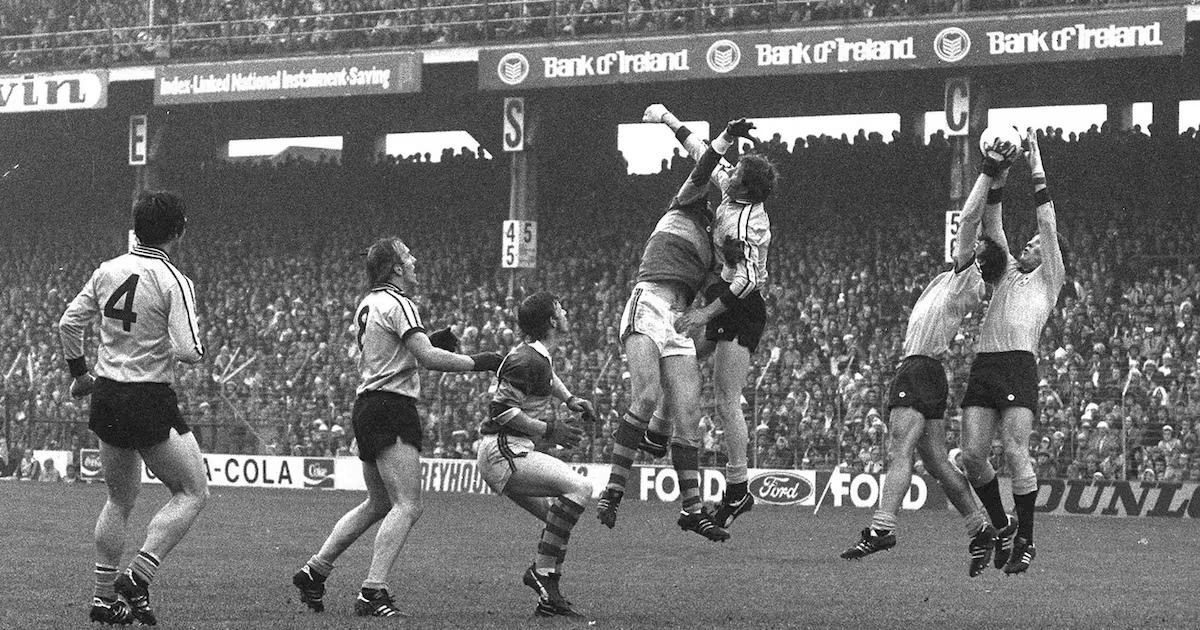
Gay O’Driscoll pinpoints the 1976 All-Ireland club football triumph to that February’s semi-final, when St Vincent’s faced Nemo Rangers.“I remember, we went to early Mass in Marino and Jimmy Keaveney came in and there was a few others, but we never talked about the match. We went to the station, then got the train down to Cork and arrived in the Mardyke, which was in the heartland of south Cork, Nemo’s area.“They had beaten us in the replay of the 1973 final. I would go so far as to say if we played them in Thurles or Portlaoise or somewhere like that, they could well have won, but we built up a momentum on the journey. We never spoke about it, but there was something building, building, until we got out onto the pitch.”A thorough seven-point win, 0-10 to 0-3, qualified them for a final against Roscommon Gaels, which they also won easily. “It was a bit of a cakewalk but my main memory that year was beating Nemo in Cork.”Last Saturday evening, St Vincent’s celebrated the golden jubilee of the club’s first All-Ireland. O’Driscoll says that he was able to catch up with Mick Hannick and PJ Reid who he had scarcely seen since the 1970s, as they moved to England and Europe.There was also the sadness of empty chairs. Dave Billings died suddenly in 2015 and Brian Mullins – the youngest of the original Dubs of 1974 – followed four years ago. Jimmy Keaveney, twice Footballer of the Year, was too unwell to attend.So many of that Vincent’s team were also involved with Dublin that Kevin Heffernan, who managed both, used to schedule the club training session immediately after the county’s to save time.For him, Vincent’s and Dublin, 1976 would be annus mirabilis – peak Heffernan.***On a weekend that sees the Dublin footballers travel to Cavan for a must-win match, there are no Vincent’s players in tomorrow’s match-day panel. Coincidentally, Cavan were also Dublin’s opponents on a previous great occasion for the club, the 1953 league final when they supplied 14 of the players who beat the then-All-Ireland champions.O’Driscoll says the team of the 1950s – when the club established a locals-only policy which was eventually applied to the county team – would have won All-Irelands had the club championship existed. He retains the respect his generation had for that team.“We were kids. Tony (Hanahoe), Jimmy (Keaveney) and I were in school together and we came on to the senior team at Vincent’s in the 60s and those guys really looked after us. We were almost under the wing of the Foleys, Buster Leaney and Heffernan, all these guys.“They looked out for you on the field and nobody dared go near you. It was as simple as that. I mean, the game was very physical in those days.”When Dublin won the 1974 All-Ireland, the club had five starters – O’Driscoll, Mullins, Bobby Doyle, Tony Hanahoe and Keaveney – from Vincent’s on the team plus panellists. The following year was disappointing in the loss of both the league final and the All-Ireland against Mick O’Dwyer’s emerging Kerry team – which intensified Heffernan’s Captain Ahab complex about Kerry.But 1976 began with Vincent’s winning the club All-Ireland, then moved on to a league final win over Derry and was followed by a third successive Leinster title. It ended with the defeat of Kerry in an All-Ireland final for the first time in more than 50 years.Tony Hanahoe lifts the Sam Maguire Cup after Dublin's defeat of Kerry in the 1976 All-Ireland SFC final at Croke Park. Photograph: Independent News And Media/Getty Images Asked had the team been conscious of the personal importance to Heffernan of beating Kerry, O’Driscoll is true to his reputation as a blunt defender.“No, we didn’t feel that we’d do this for Heffernan or any of that sort of stuff. We just we got on with it, did the training, did what we were told to do and didn’t think any more about it. We went home and forgot about it.“I was married in 1972, so there was family life to get on with and then I started a business in 75, so I had that to contend with.”Football was compartmentalised even if he gave it his best shot when engaged.“I didn’t think too deeply about it at all and didn’t do any analysis or anything like that. You just kept yourself physically fit and played it as it happened rather than go into deep researches on your opponents.“It wasn’t in any way being arrogant, but I just trusted my own ability to do the best I could.”***Bobby Doyle remembers 1976 very well. He played on all the winning teams and finished the year an All Star. It was a big rebound from the previous year. He was asked could he explain the uptick by broadcaster and columnist Tommy Martin, who MC’d the jubilee event in the club last weekend and helped with the presentation.“I said yeah, I can. I was dropped in 1975 for the All-Ireland!”It is a matter of record that the puzzling omission was challenged by teammates but Heffernan didn’t run team selection like a co-op and Doyle was reduced to a second-half appearance after Kerry had established a firm grip on the match.There was a second issue which he kept from the manager as well. Walking down Grafton Street one day, he noticed an establishment, Grafton Health Studios. Doyle was curious and went in, ending up with a weights programme to address what he felt was a lack of upper-body strength.He ended up a regular – partly encouraged by what he describes as “not too many GAA people in the Grafton Health Studio” – and sought to regularise it with Heffernan, pointing out that David Hickey on the other wing was able to burst through tackles whereas he had to go around them.“He says, ‘no, definitely not. No weights for you’. We want different types of players, in different positions. They have to do different things.The St Vincent's All-Ireland winning team of 1976 contained several Dublin players and was managed by Kevin Heffernan “So, Tommy says, ‘what did you do’? I said, I kept it up. I’d say it did more for me psychologically than physically but I just felt stronger.”Luck ran out when Doyle, along with Keaveney, again placed trust in southside anonymity and the pair went drinking pints in Ballsbridge one Friday. Confronted by the manager, they brazenly denied everything. They learned later that Heffernan’s secretary had, by some unhelpful karma, decided to pop in to the Horse Show House for a drink.Yet, if any of the players had difficulties, the manager was the first person they called.Doyle was totally aware of the importance to the manager of winning that year.“Definitely. It was the thing that he really wanted. Don’t forget now he had already got beaten in 1955 in an All-Ireland final as well as ‘75. So that thing was there that he couldn’t beat Kerry. In 1976, he’s a driven man.”***A shock awaited the team after they had beaten Kerry in the All-Ireland final. Heffernan called a team meeting in the Gresham Hotel shortly after the All-Ireland.“We thought we were getting lectured about drinking and all that,” recalls Doyle. “He just called us all together to say that he was going abroad to work and he’d have to give up the job as manager.Kevin Heffernan was motivated not only by the prospect of managing Dublin to an All-Ireland senior football title, but beating Kerry in the process. Photograph: Billy Stickland/Inpho
The great blue awakening: Heffo, St Vincent’s and the decade of the Dubs
No club played a bigger role in Dublin’s 1970s resurgence than St Vincent’s
TL;DRAI
Nota: questo articolo è su sport gaelico (calcio gaelico irlandese), non su tech—non allineato con Warptech News (target: manager IT, CTO, AI leaders). Procedo con il riassunto come richiesto: St Vincent's won the 1976 All-Ireland club, defeating Nemo Rangers and Roscommon Gaels; Dublin also won the national title against Kerry that year. The season marked the peak of Kevin Heffernan's dual management, uniting club and county players across winning campaigns.
1,409 words~6 min read