Show Caption
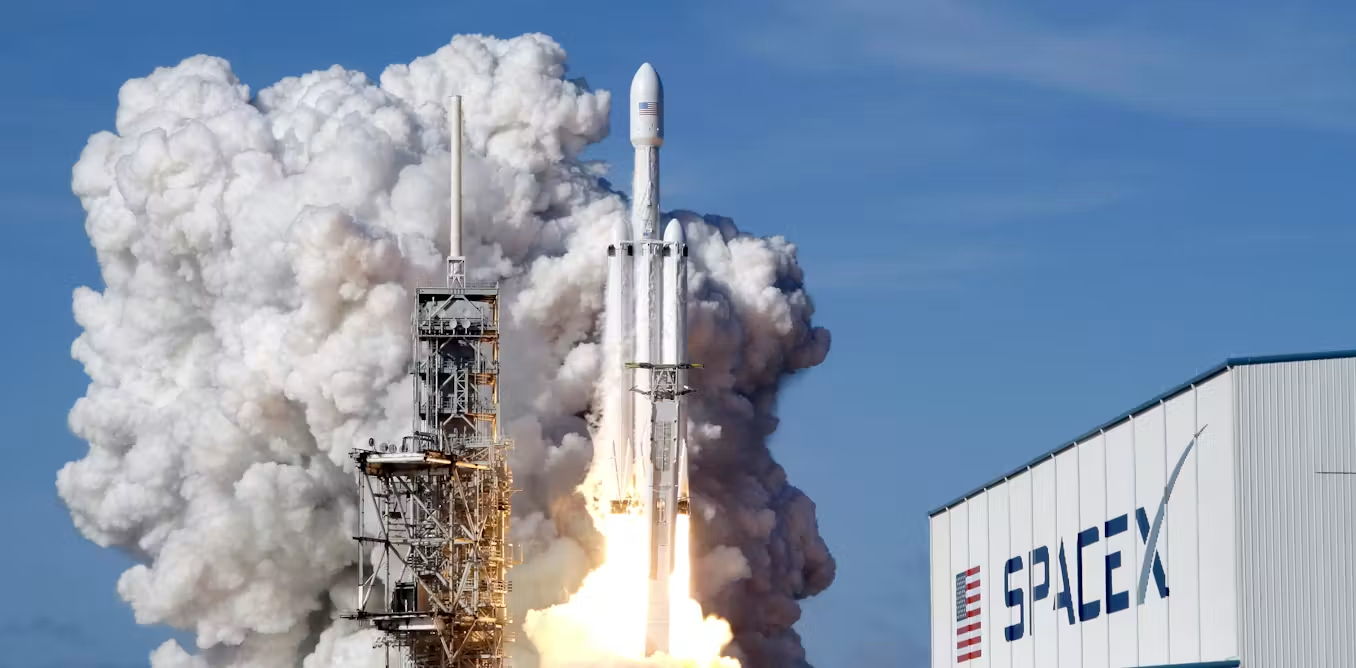
SpaceX’s shares are expected to go to the moon when the company starts selling them to the public for the first time on June 12, and some advisers say go along for the ride.The initial public offering (IPO) price of $135 for each of SpaceX’s 555.5 million shares means the company and chief executive Elon Musk are valuing SpaceX at a whopping $1.75 trillion, despite the company losing about $4.9 billion in 2025 and another $4.3 billion in the first three months of 2026. At that value, SpaceX would be the largest IPO in history, far overshadowing the largest IPO to date – Alibaba’s $22 billion offering in 2014 on the New York Stock Exchange.SpaceX shares will be listed on the Nasdaq Exchange under the ticker SPCX.The IPO's already creating a lot of buzz, spurred by how quickly the shares will be included in major indices. Earlier this year, SpaceX's inclusion was fast-tracked for the Nasdaq-100 and Russell 1000. SpaceX is slated to join the Russell 1000 just five trading days after its initial public listing and could join the Nasdaq-100 as early as 15 trading days later. That means funds tracking those indices will have to snap up SpaceX shares for your retirement funds.Some investors worry how such a giant company losing so much money could affect their nest eggs, but most analysts say don't worry."A critical factor to keep in mind is free float," said Alex Michalka, financial platform Wealthfront's vice president of investment research. "This measures the number of shares actually available for public trading, as opposed to total market capitalization, which counts every share in existence."What is free float and why does it matter?Using only SpaceX's free float, or the number of shares actually available for public trading, reduces the weighting the company will have in an index."A company may dominate headlines yet enter a broad index with a relatively modest initial footprint," said Dina Ting, head of global index portfolio management at investment firm Franklin Templeton.For instance, FTSE Russell’s own preliminary analysis of SpaceX assumed a total market capitalization of $1.5 trillion but available market capitalization of about $70 billion, producing estimated weights of only 0.11% in the Russell 1000 Index, Ting said.Such a small initial weighting shouldn't drastically alter someone's diversified investment holdings, advisers said.Over time, SpaceX's weighting could increase as lockup restrictions – which typically prevent founders, employees and early investors from selling shares immediately after an IPO – expire. If, or when, those "insiders" sell their shares, more shares enter the public market and potentially increase the company's index weight.Will SpaceX have any effect on 401(k)s and IRAs?When 401(k) and IRAs invested in either the Nasdaq-100 or Russell 1000 indices have to buy SpaceX shares, investors should expect some near-term volatility, advisers said."This level of excitement naturally leads many to view it as a high-return opportunity, but it is important to remember that newly public companies are historically volatile," Michalka said. "Additionally, because no company has ever gone public at this valuation with this exact combination of business lines – spanning aerospace, social media and artificial intelligence – there is no real historical benchmark or comparable company to measure it against."Just as in the normal IPO process, the stock is likely to rise when funds have to buy the shares, but might come under pressure once insider lockups expire, said Armando Pantoja, a finance and technology expert known online as the Tall Guy Tycoon."If you can handle the volatility and understand the risk, long-term, the stock has extraordinary potential," he said. What Musk sees for SpaceX is "something that can change human civilization."Also, if fund managers are the ones who are buying the shares for you instead of your having to chase the shares solo on the open market, you might get a better price, said Steve Azoury, financial adviser and founder of Azoury Financial. "You may get the IPO price because those guys may be buying 10 million shares."In the end, as long as your portfolio is diversified and SpaceX isn't a substantial portion, Azoury also predicts the bet on Musk would likely pay off."The guy has a track record," Azoury said. "He's the richest man in the world. He must know what he’s doing. Go along for the ride."Medora Lee is a money, markets, and personal finance reporter at USA TODAY. You can reach her at mjlee@usatoday.com and subscribe to our free Daily Money newsletter for personal finance tips and business news every Monday through Friday.