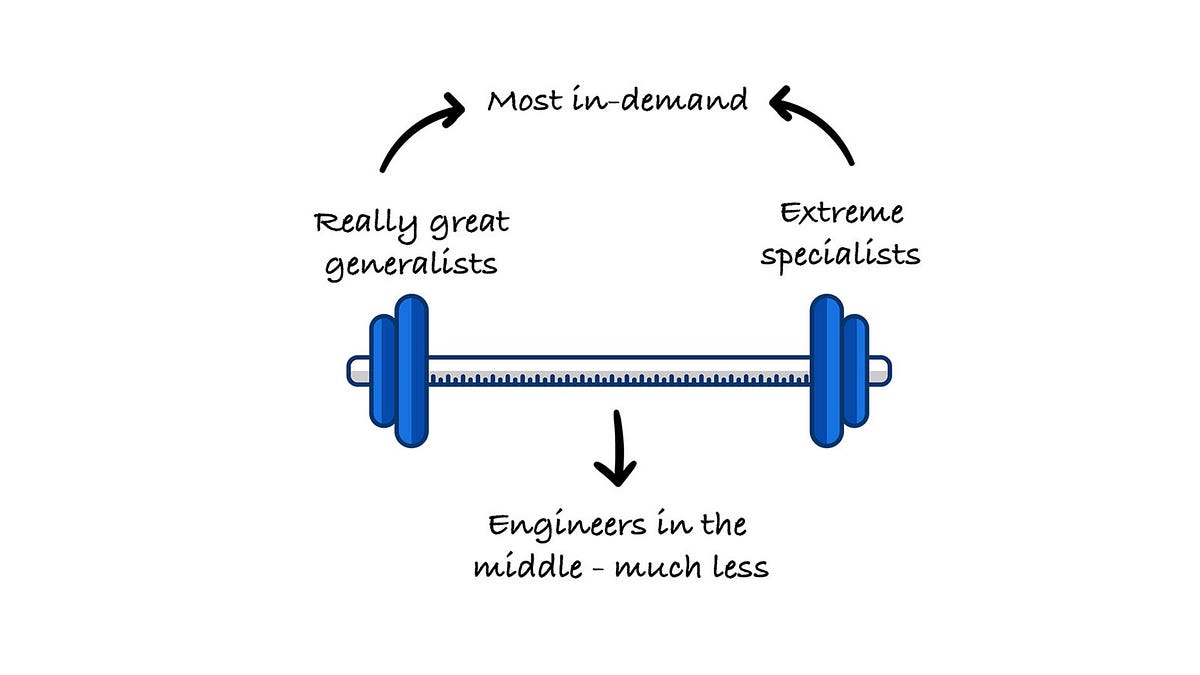
For much of the modern professional era, career advice followed a remarkably consistent pattern. Choose a field, develop expertise, build experience, and steadily establish yourself as an authority within a specific domain. Whether in finance, engineering, marketing, consulting, or technology, specialisation was often regarded as one of the most reliable routes to professional success.The reasoning was straightforward. Organisations valued expertise because expertise was difficult to acquire. Knowledge accumulated over years of practice, exposure, and problem-solving. The deeper an individual's understanding of a subject, the greater their value to the organisation. In many ways, careers, leadership pipelines, and organisational structures were built around this principle.Even today, there is little evidence to suggest that expertise has become less important. Organisations continue to depend on specialists to solve complex problems, drive innovation, and provide the depth of knowledge required to navigate increasingly sophisticated business environments. Deep expertise remains one of the strongest foundations of professional credibility. Yet a growing debate is beginning to emerge around whether expertise alone is enough.Many of the roles attracting investment today look very different from those that existed a decade ago. Entire functions have evolved as organisations respond to changing technologies, shifting customer expectations, new business models, and increasingly interconnected ways of working. Professionals are finding themselves operating in environments where responsibilities change more frequently, industries evolve more rapidly, and knowledge itself is updated at an unprecedented pace. Under these conditions, the traditional relationship between expertise and value becomes more complicated.For decades, organisations rewarded individuals for becoming the most knowledgeable person in the room. Today, knowledge remains important, but some of the most valuable contributions often come from people capable of connecting knowledge across disciplines, translating ideas into action, and navigating unfamiliar situations. The challenge is no longer simply knowing more. Increasingly, it is knowing how to apply what you know in contexts that may not have existed when that expertise was first acquired.This raises an uncomfortable question. If the half-life of knowledge is shortening in many industries, should professionals focus exclusively on becoming experts, or should they invest just as heavily in their ability to learn, adapt, and evolve? The answer is not obvious.Specialisation continues to create significant value. Organisations still need engineers, analysts, researchers, consultants, doctors, lawyers, and domain experts whose knowledge cannot be replicated overnight. At the same time, enterprises are increasingly searching for individuals who can operate across functions, understand multiple perspectives, and respond effectively to changing business realities. The growing demand for adaptability does not diminish the importance of expertise, but it does challenge the assumption that expertise alone guarantees long-term relevance.The implications extend beyond individual careers.Many organisations have spent decades building recruitment strategies, promotion frameworks, leadership pipelines, and performance systems around specialised knowledge. If the balance between expertise and adaptability is beginning to shift, enterprises may need to reconsider how they identify potential, develop talent, and prepare future leaders. The question is no longer limited to what professionals should learn. It is increasingly about how organisations define value in the first place.This debate sits at the centre of a broader conversation taking place across industries. As enterprises rethink workforce development, leadership, organisational capability, and the future of professional work, there is growing recognition that career success may no longer follow a single formula. The professionals who thrive over the next decade may not be those who abandon expertise, nor those who chase every new trend. They may be the ones who combine deep knowledge with the ability to continuously expand and apply it in new ways.These are precisely the kinds of questions that leaders, workforce strategists, CIOs, CHROs, educators, and enterprise decision-makers will explore at the Future of Knowledge Work Summit in Bengaluru on 17 June. As organisations prepare for a future shaped by changing expectations around work, talent, and capability, the debate is becoming increasingly difficult to ignore.For years, the advice was simple: specialise and stay the course. The more interesting question today is whether the course itself is changing.
Is "pick a specialisation and stick to it" still good career advice?
For decades, career success was built on a simple formula: choose a specialisation, develop expertise, and stay the course. But as industries evolve, new roles emerge, and organisations place greater emphasis on adaptability, professionals are beginning to question whether the most trusted career advice still applies. Has the balance between expertise and adaptability started to shift?
659 words~3 min read