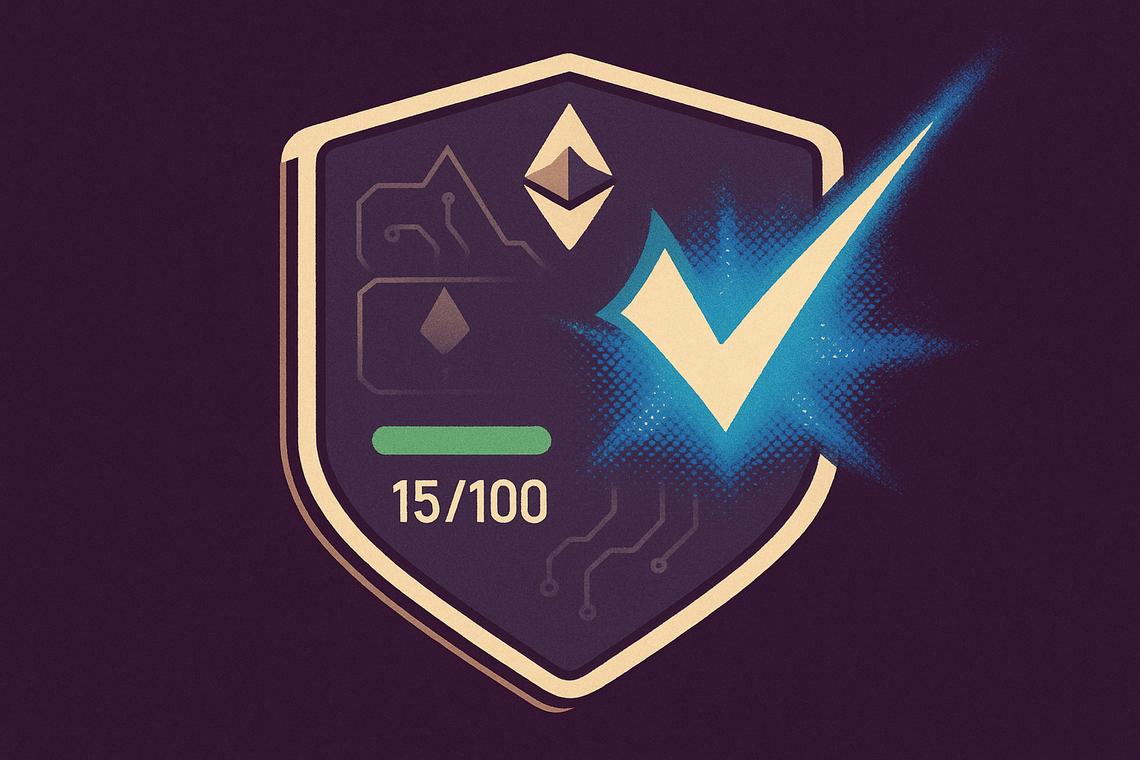
Ethereum now has a formal playbook for verifying AI agents without exposing their private data. ERC-8126, which reached finalized status in early June 2026, introduces a multi-layer verification framework that produces a single risk score from 0 to 100, all while keeping sensitive information locked behind zero-knowledge cryptography.
What ERC-8126 actually does
The standard was first proposed on January 15, 2026, by co-authors Leigh Cronian and Chris Johnson. It was built specifically for AI agents registered under the earlier ERC-8004 standard, which established a registration framework dating back to an August 2025 draft.
ERC-8126 introduces five modular verification checks, each targeting a different attack surface. Ethereum Token Verification (ETV) examines the agent’s token interactions. Media Content Verification (MCV) scrutinizes any media the agent produces or handles. Solidity Code Verification (SCV) audits the smart contract code the agent deploys or interacts with. Web Application Verification (WAV) covers the agent’s web-facing interfaces. And Wallet Verification (WV) validates the integrity of the agent’s wallet operations.
Each of these checks feeds into a unified risk score ranging from 0 to 100. A low score signals a trustworthy agent. A high score is a red flag.