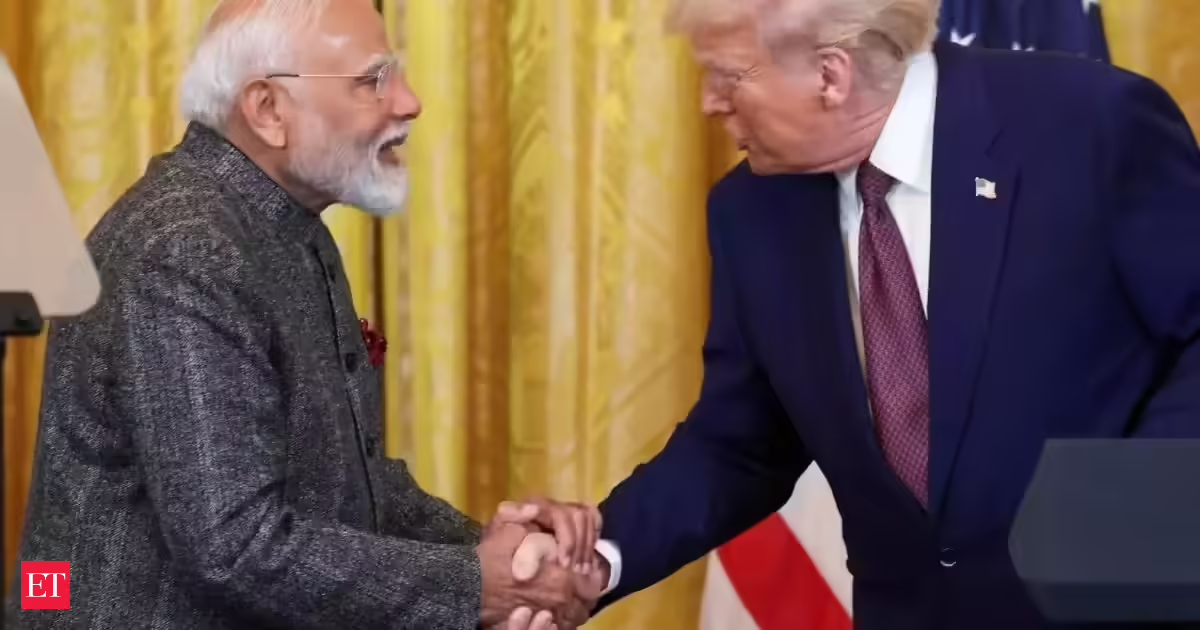
A possible meeting next week between Indian Prime Minister Narendra Modi and US President Donald Trump offers a chance to reset ties following a year of strained relations over tariffs, Pakistan, and now, the Iran war.US forces this week attacked three Indian-crewed vessels in the Gulf of Oman region, killing at least three sailors and prompting protests from New Delhi.Modi and Trump would likely want to contain the latest tensions and avoid derailing efforts to get relations back on track after a rocky year, analysts said. The expected meeting on the sidelines of the Group of Seven leaders’ summit in France next week would be their first face-to-face since a falling out last year following India’s military clash with Pakistan and Trump’s tariffs.Also Read: US military confirms attack on third Indian-crewed tanker off Gulf of OmanWhile it’s important to New Delhi that the US understands the damage that the latest strikes cause, “I don’t think this will spiral out to something bigger,” said Harsh Pant, vice president at the Observer Research Foundation, a New Delhi think tank. “There are bigger issues on the table which both India and US need to handle.”“In the larger scheme of things, there is understanding that this is a war zone and both sides are likely to discount it,” he said. The US attacks on the vessels with Indian crew drew strong condemnation from New Delhi on Thursday. “The continuing attacks on shipping are deeply worrisome,” Randhir Jaiswal, spokesman for India’s Ministry of External Affairs, told reporters. “We have lodged a strong protest with the US. It’s our expectation that due note will be taken.”The vessel attacks come as Trump continues to offer mixed signals about the wind-down of the war. On Thursday, Trump pulled back from a threat of additional strikes on Iran, claiming once more that a deal was close.Also Read: India, US exploring possibility of Modi-Trump meeting on margins of G7 summit in FranceA spokesman for the US Embassy in New Delhi said the US was in direct contact with the Indian government on the vessel strikes. Next week’s highly anticipated G7 meeting would build on steps taken by India and the US in recent months to repair damaged ties. Last month, Trump dispatched Secretary of State Marco Rubio for a multi-day visit to India, where he met with multiple Indian officials and with envoys from Japan and Australia as part of a security grouping known as the Quad. The trip, the highest-profile visit by a US official in more than a year, was followed by a visit this month by a US trade team to advance a trade deal the two nations struck in February. Shortly after New Delhi’s announcement that it had summoned US Chargé d’Affaires Jason Meeks over the vessel strike late Wednesday, Trump posted a message on social media congratulating Modi on his 12-year tenure in office. Modi reciprocated with a warm thanks.— narendramodi (@narendramodi) “The relationship has reached a manageable floor, but it is not exactly soaring to the sky,” said Ashok Malik, India chair at the Asia Group, a consulting firm. He said it’s too soon to say whether the Iran issue will arise during any meeting between Modi and Trump, though pressures are building on Modi to raise it. “Both sides have been engaging and let’s just say it’s not getting worse.” Indian nationals are particularly vulnerable to attacks on commercial shipping. Indians are among the top three nationalities represented aboard such vessels, according to the Indian government, with more 300,000 Indians — about 12% of the global seafaring workforce — working in the industry. Thirteen Indian-flagged vessels have been trapped in the Strait of Hormuz since the US’s war on Iran started in February, while multiple Indian nationals have been killed. Disruptions to global oil supplies have contributed to shortages in India and to a record slide in the rupee.The agenda of next week’s face-to-face meeting remains unclear. It’s possible the two leaders may discuss progress in ongoing trade talks, although there’s no clarity on whether an announcement would be made regarding the signing of the deal.The two countries had agreed to an interim trade pact in February. The deal was initially set to be signed in March, but was delayed following a US Supreme Court ruling that struck down Trump’s so-called reciprocal tariffs. Indian and US trade negotiators have met twice since March, including in Washington in April and during a four-day meeting this month in New Delhi, to resolve outstanding issues. Indian officials have maintained that finalizing the deal is unlikely until the outcome of two so-called Section 301 trade probes. Relations between the US and India were in an ebb for much of the last year following the India-Pakistan clash. That conflict ended with Trump claiming credit for brokering a ceasefire, a claim that Pakistan embraced but India repeatedly denied. Trump has since fostered close personal ties with Pakistan’s leadership — in particular with military chief Asim Munir, who has emerged as the unofficial mediator in peace negotiations between Washington and Tehran. The prospect of a Trump-Modi meeting is notable given that the two leaders have gone so long without a face-to-face meeting. Trump’s first term was marked by warm ties and mutual visits by the two leaders. However, Modi has avoided meeting Trump in public settings since the Pakistan clash for fear that the US president might bring up India’s arch-rival in his presence, Bloomberg News has reported. Efforts to patch up ties between the US and India have stepped up since the arrival in New Delhi of US Ambassador Sergio Gor in January. Gor, a close aide to Trump, has helped to increase the Trump administration’s attention on India and has been a visible advocate around the country for the US president.
Donald Trump, Narendra Modi look to repair ties in shadow of new US strikes
A potential meeting between Indian Prime Minister Modi and US President Trump could reset strained ties following recent attacks on Indian-crewed vessels in the Gulf of Oman. Analysts suggest this incident, while concerning, is unlikely to derail broader efforts to improve relations, with both leaders focused on larger geopolitical issues.
TL;DRAI
Modi and Trump meet next week at G7 following US attacks on Indian vessels that killed three sailors. For IT managers, USA-India normalization affects offshore outsourcing access, Quad supply-chain security, and global energy costs tied to Iran conflict.
963 words~4 min read