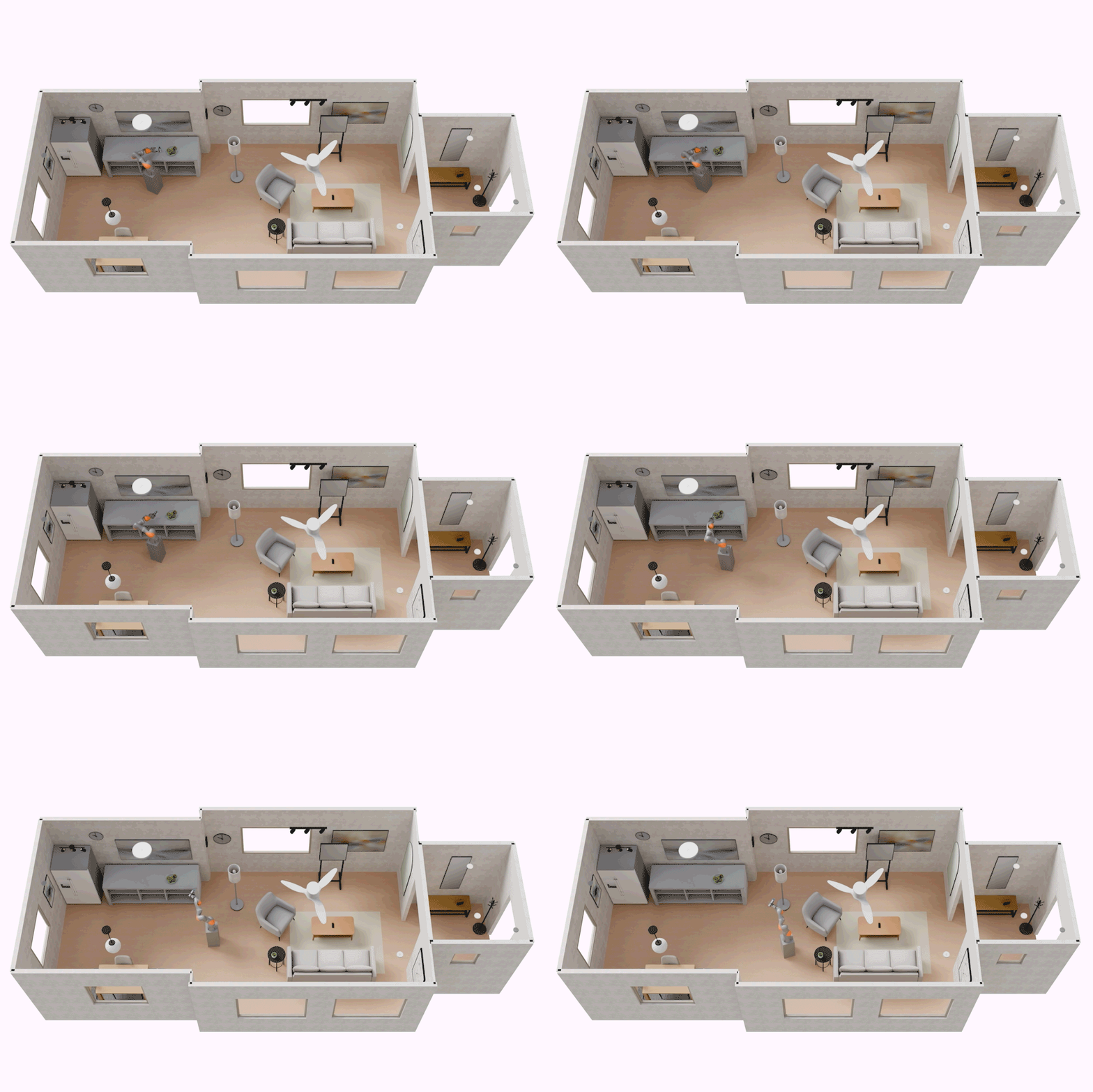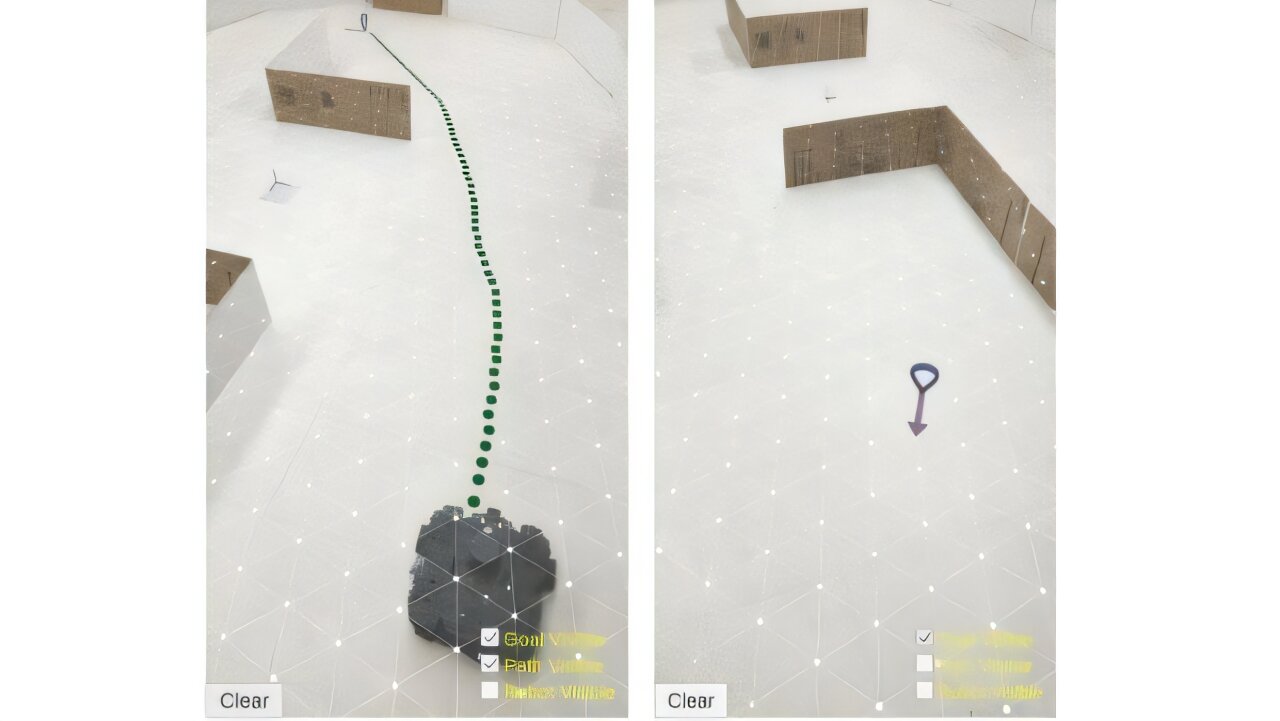
AR interface screenshots. The green dots represent the projected navigation path, and the blue location pushpin with purple arrow denotes the target goal pose. Credit: NYU Tandon School of Engineering
As robots increasingly move out of factories and into workplaces, hospitals, warehouses and public spaces, a simple challenge becomes increasingly important: helping people understand what those machines are about to do.
A new study by researchers at Bowling Green State University (BGSU) and NYU Tandon suggests that augmented reality (AR) may offer a surprisingly effective solution. By overlaying a robot's goals, planned routes and safety zones onto the real world through a smartphone, the researchers found that people became significantly better at anticipating robot behavior and identifying potential hazards.
The work, published in the journal Empathic Computing, addresses a growing concern in human-robot interaction: transparency. While robots are becoming increasingly autonomous, their decision-making processes often remain opaque to nearby humans. That uncertainty can create confusion, reduce trust and, in some situations, compromise safety.
"One of the biggest challenges in human-robot collaboration is helping people understand what a robot intends to do before it acts," says co-author Vikram Kapila, professor of mechanical and aerospace engineering at NYU Tandon. "When users can see a robot's planned path, destination and safety boundaries, they are better able to anticipate its actions and make informed decisions about their own movements."