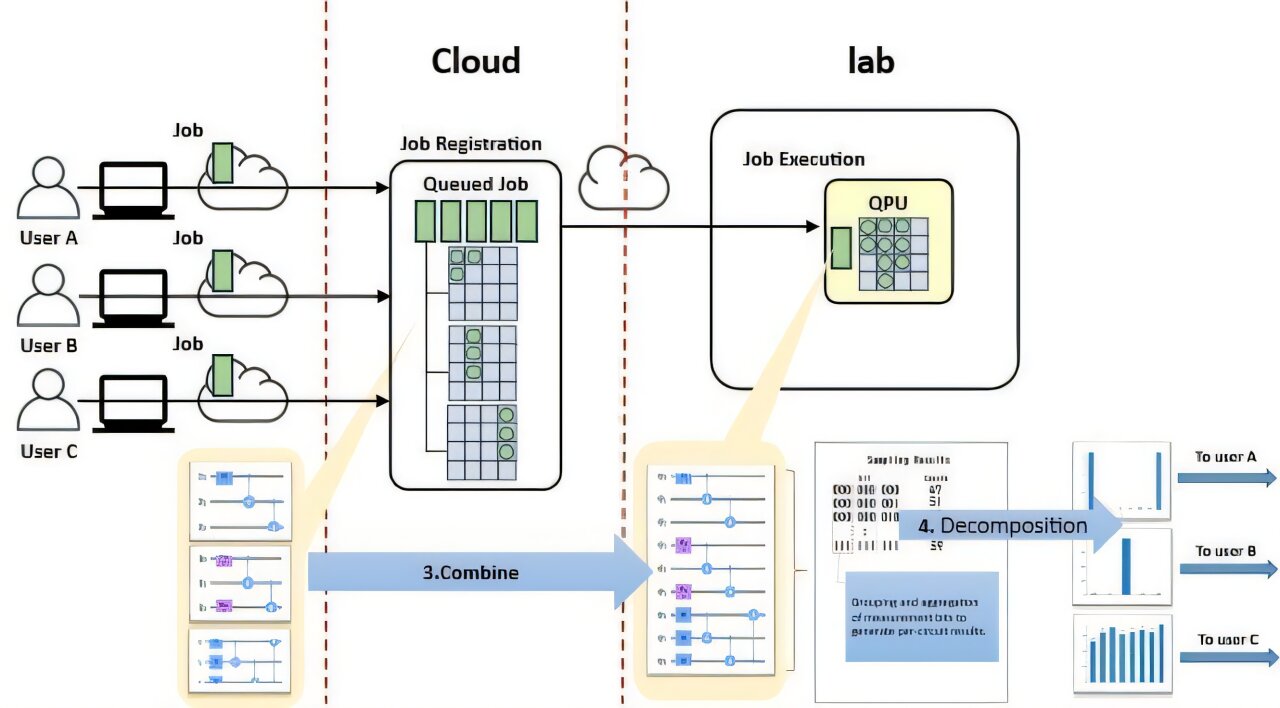
Mechanism of quantum multi-programming (auto mode). Credit: QIQB Cloud Team, The University of Osaka
Researchers in Japan have developed quantum multi-programming auto mode, a function that automatically runs quantum programs from different users in parallel. Launched on the Center for Quantum Information and Quantum Biology (QIQB) quantum computer cloud service at the University of Osaka, the system reduces idle qubit resources, improves throughput and may help ease congestion in quantum cloud computing.
Quantum computers are expected to become powerful next-generation computing platforms, but access to real quantum hardware remains limited. Because quantum chips require specialized facilities and careful control to operate stably, many universities, research institutes and companies now provide access to them through cloud services.
However, cloud access creates a new challenge: waiting. Current noisy intermediate-scale quantum computers have a limited number of qubits, and conventional cloud operation often allows one job to occupy an entire quantum chip. This means many qubits can remain unused, even while other users are waiting for their programs to run.
A research group led by QIQB at the University of Osaka, in collaboration with Systems Engineering Consultants Co., LTD. (SEC) and Juntendo University, has now developed and launched quantum multi-programming (auto mode), a function that automatically executes quantum programs from different users in parallel on QIQB's quantum computer cloud service.