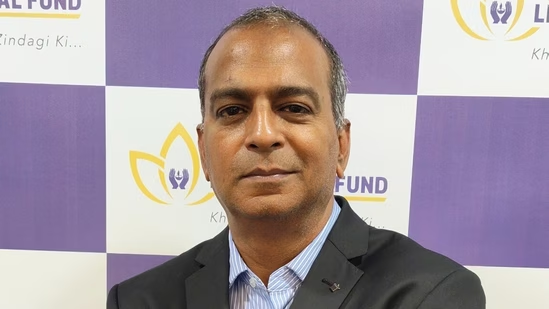
SynopsisIndia is increasingly becoming a long-term structural investment destination rather than a short-term strategic bet. Global capital is moving toward markets that offer domestic demand, policy stability, and supply-chain relevance, and India offers all three, says Tsutomu Takemura, senior managing director and global head of investment banking at Nomura.Tsutomu Takemura, senior managing director and global head of investment banking at NomuraJapanese companies and financial institutions invested an estimated $9 billion (Rs 85,866 crore) in India last year, underscoring a sharp acceleration of investment interest from the East Asian country. In financial services, Japanese investors backed marquee deals involving institutions such as Yes Bank and Shriram Finance. Speaking to ET, Tsutomu Takemura, senior managing director and global head of investment banking at Nomura, discusses why India is emerging as a preferred destination for Japanese capital. Edited excerpts:How does Nomura view India's attractiveness compared to other Asian markets, especially in M&A?India is increasingly becoming a long-term structural investment destination rather than a short-term strategic bet. Global capital is moving toward markets that offer domestic demand, policy stability, and supply-chain relevance, and India offers all three. Over the next three to five years, we expect India to be one of Asia's most important M&A destinations alongside Japan. Its combination of growth, scale, and supply-chain diversification benefits is rare.China was historically a much larger destination for global capital. How does its market compare today?From the perspective of Japanese corporate investors, interest has shifted more towards India than China. While existing investments in China are largely being maintained, there is limited appetite for fresh capital deployment. Geopolitical tensions between the US and China have encouraged investors to look elsewhere, and India has emerged as a key alternative. Although some European investors have begun reassessing China, overall investment activity there remains relatively stagnant.The market regulator should fix flawed IPO rules to stem inflated valuations, and capital flightJapanese companies deployed around $9 billion in India last year, largely in financial services. Is this a recent phenomenon?This trend has been building for some time. Japanese financial institutions have accumulated significant capital after decades of operating in a low-growth domestic economy. Rising stock markets and the unwinding of cross-shareholdings have further increased available capital. India offers an attractive destination for that capital because of its strong growth prospects. Beyond banks, Japanese life and non-life insurance companies are also actively seeking opportunities across Asia, with India emerging as a key focus market. In conversations with Japanese institutions, India is consistently one of the most discussed investment destinations.India grants retrospective custom duty relief on imports of select nuclear power generation equipmentWhich sectors are commanding the most investor attention in India right now?Infrastructure is attracting the strongest interest, though the definition of infrastructure has broadened significantly. Beyond roads and bridges, it now includes data centres, logistics facilities, renewable energy, transmission assets, and social infrastructure. These sectors require large amounts of capital and offer attractive long-term opportunities. Financial services and real estate are also areas where Japanese investors see significant potential.How do Japanese investments in Indian infrastructure compare with those from global pension and sovereign funds?Japanese capital has not historically flowed directly into infrastructure funds in a major way, but that is beginning to change. Infrastructure investing is becoming increasingly popular in Japan, with global infrastructure funds actively raising capital from Japanese institutions. Large pension funds such as GPIF are already meaningful investors in private equity and infrastructure funds, which in turn are deploying capital into markets like India.How do you see energy transition as an investment destination in India?India's renewable energy ambitions represent a significant investment opportunity. Unlike Japan, which faces land constraints, India has substantial space available for solar and renewable projects. Achieving the country's renewable energy targets will require significant capital investments. Beyond generation assets, battery storage is emerging as a critical opportunity. As renewable power production fluctuates throughout the day, storage infrastructure will play a key role in ensuring reliable energy supply. This is a global trend that is expected to accelerate in India as well.Indian companies have long been eyeing the Japanese pharma market but have struggled to gain traction. What are the key challenges?Japan's healthcare system is heavily regulated, with the government focused on controlling healthcare costs and pharmaceutical pricing. This creates challenges for both generic and innovative drug manufacturers. While Japan has gradually become more open to higher-value medicines and diagnostics, the pace of change remains slow compared with markets such as the US. In addition, evolving US pharmaceutical pricing policies have made global companies more cautious about selling products at lower prices in markets like Japan, adding another layer of complexity for companies seeking to expand there.Read More News on
Japanese investors are looking beyond China... India is key alternative: Tsutomu Takemura, Senior MD, Nomura
India is increasingly becoming a long-term structural investment destination rather than a short-term strategic bet. Global capital is moving toward markets that offer domestic demand, policy stability, and supply-chain relevance, and India offers all three, says Tsutomu Takemura, senior managing director and global head of investment banking at Nomura.
775 words~4 min read