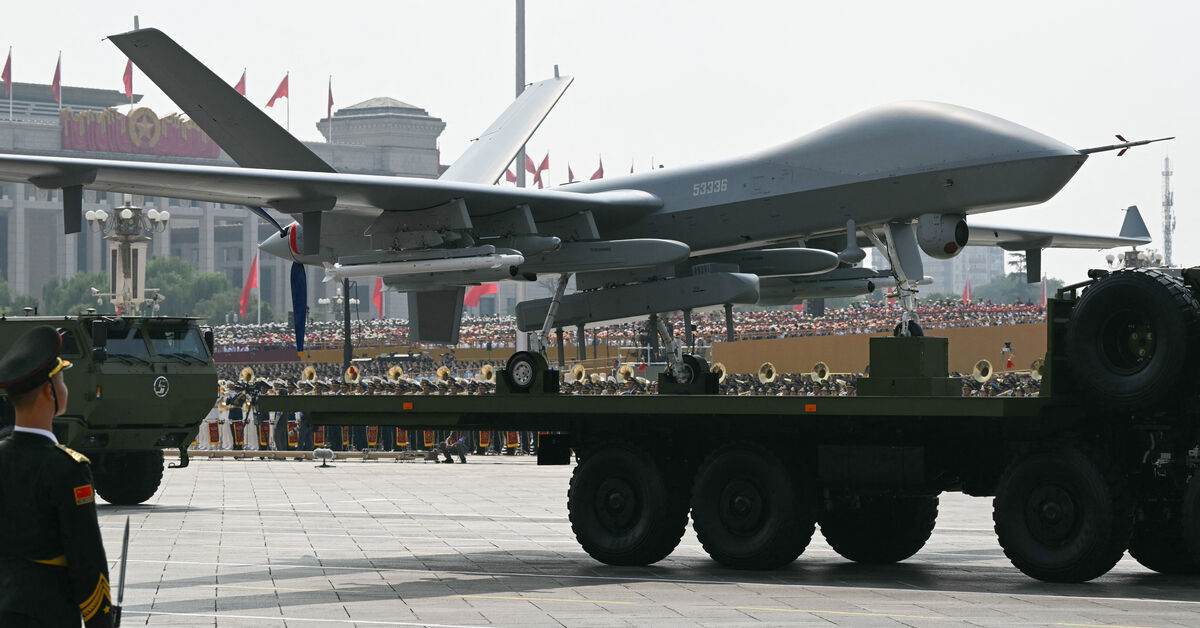
You're reading an excerpt from Al-Monitor China-Middle East, where we analyze China's deepening engagement with the region. To get this newsletter in your inbox weekly, sign up here.WASHINGTON — The main focus on China’s role in the US-Israel-Iran war has revolved around its relationship with Tehran, but this obscures a broader story: China's military and defense ties across the Gulf, particularly in drone technology, that have only grown since the conflict began.As the war spills inside Arab Gulf states through missile threats, proxy activity and attacks on critical infrastructure, it is exposing gaps in Gulf air defenses and accelerating demand for systems that are fast, scalable and relatively affordable. That plays right into Beijing's strength in a growing industry. Iran's attacks on its neighbors in the Gulf have injected new urgency into efforts to strengthen and localize air defense systems across Saudi Arabia, the United Arab Emirates, Qatar, Bahrain, Kuwait and Oman.➡️ Enter China. Systems like the Wing Loong and CH-4 — often compared to US-made MQ-9 Reapers — offer Gulf states armed surveillance and strike capabilities without the political constraints that typically accompany Western arms sales. They are cheaper, faster to acquire and come with fewer end-use restrictions.Gulf states turned to China for these drones in the past "because they wanted quick drone solutions that could be acquired relatively affordably 'off the shelf' to be used in regional conflicts," according to Seth Frantzman, drone expert and author of "Drone Wars: Pioneers, Killing Machines, Artificial Intelligence, and the Battle for the Future."🇸🇦 In March, reports indicated that Saudi Arabia and China had reached a $5 billion agreement to establish a production line for Wing Loong-3 combat drones in Jeddah. Under the reported arrangement between the Aviation Industry Corporation of China and Saudi Arabia's General Authority for Military Industries, the facility would manufacture approximately 48 drones annually. Neither Beijing nor Riyadh has publicly confirmed the deal.Saudi Arabia and the UAE have been among the largest buyers of Chinese drones in the Middle East.The UAE was one of the earliest Middle Eastern buyers of Chinese drones, acquiring Wing Loong drones in the mid-2010s and later becoming one of the first operators of the more advanced Wing Loong-2. The UAE has also expanded its defense cooperation with Beijing beyond drones. In 2023, it became the first Middle Eastern country to purchase China's L-15 trainer aircraft, acquiring 12 jets. Just last week, the UAE's undersecretary of defense, Lt. Gen. Ibrahim Nasser Al-Alawi, met with Zeng Jixin, China's ambassador to the UAE.Saudi Arabia has purchased and operates CH-4 drones from China Aerospace Science and Technology Corporation as well as Wing Loong-2 drones.Chinese weapons have appeared in the latest conflict. In April, Iran shot down a Chinese-made Wing Loong II drone near the southern city of Shiraz. In May, analysts identified what appeared to be a Chinese-made Silent Hunter laser anti-drone air defense system at Dubai International Airport in the UAE.BIG: Iran shot down a Chinese-made Wing Loong II drone near Shiraz.The drone is commonly used by Saudi Arabia and UAE, not the US.If true, it suggests a Gulf state drone was operating over Iran, which would be a major escalation.Source: @Osinttechnical pic.twitter.com/kGsWWebW3C— OSINTreport (@Tourosenta14746) April 2, 2026
How Iran war is giving China an opening in Gulf drone market
The ongoing war has helped China carve out a growing role in Gulf defense by offering cheaper, faster and less restricted drone capabilities.
532 words~2 min read