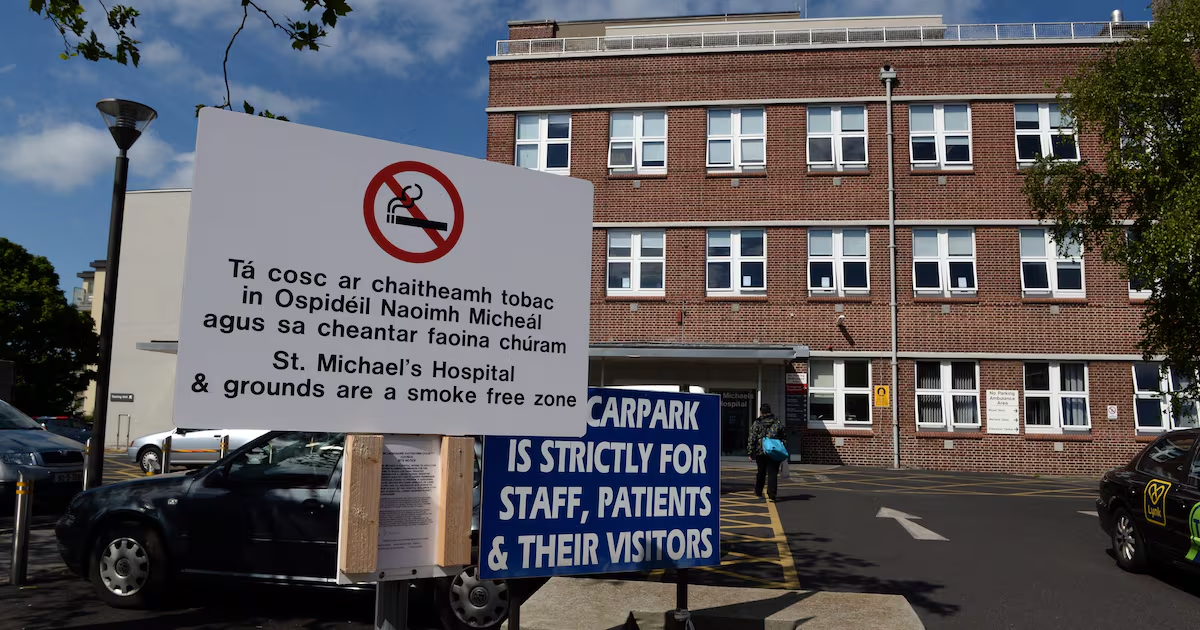
In its former guise of Kingstown, what is now Dún Laoghaire was often satirised as the capital of west Britain, or a remote outpost of the mother island gazing forlornly eastward. That image is immortalised in Ulysses, when James Joyce’s alter ego Stephen Dedalus, teaching schoolboys in Dalkey, asks one of his pupils to define the word “pier”. The vague answer (“a kind of bridge”) attracts scornful laughter from the class. But Dedalus finds himself agreeing: “Kingstown Pier ... Yes, a disappointed bridge.”For much of the 19th century, the town was also a byword for well-heeled Victorian suburbia. By the 1870s, however, after decades of rapid population growth, the reality of most people’s lives there was starkly different.A visiting doctor of the period, John Byrne Power, recorded his impressions: “ ... the first thing that struck me was the number and wretchedness of what I may call the slums – miserable courts and rows of wretched hovels, in which a healthy or even decent life is well-nigh impossible ... The number of such hovels and of their inhabitants indicates a proletariat out of all proportion to the possibility of employment.”He continued: “Kingstown presents some of the worst features of a town of decaying industry ... and an undue proportion of perhaps the most helpless class in the economy; worn-out workmen, too old to seek employment elsewhere and clinging to the spot which once afforded them the means of comfortable existence. To these conditions we owe our low birth-rate, relatively high death rate, and large admission to the union workhouse.”Medical facilities, meanwhile, were hopelessly inadequate. There was a tiny maternity hospital, of 11 beds, and a slightly larger fever hospital (15 beds) that had been overwhelmed by the cholera epidemic of 1866. Then there was the Poor Law dispensary, a Protestant-run body in a mostly Catholic town, which in 1870 became the subject of bitter controversy in the opinion pages of this newspaper. The catalyst then was a vacancy on the dispensary’s medical staff for which the local parish priest, Canon McCabe, supported a Catholic candidate. So doing, he voiced concerns about certain obstetrical practices, specifically one called foetal craniotomy, in which unborn babies sometimes died. Calling this “murder”, he claimed it was nevertheless encouraged by “eminent Protestant authorities”.Believing that last phrase to refer to him, Dr Thomas Edward Beatty, president of the Royal College of Surgeons Ireland, took to the letters page of The Irish Times to reply. His first attempt was considered too incendiary to print. Even the one that did get published, however, was so extreme that the paper had to dissociate itself.In the more moderate parts, Beatty pointed out that the practice referred to by Canon McCabe had become so rare as to be almost extinct. But offended by the priest’s use of the word “murder”, he also wrote this: “How dare any man presume to use such language towards Protestant gentlemen infinitely his superiors in status, education, high principle, and religious knowledge and feeling, and who, thank God, can exercise the brains with which they were born, and are not unable to form conclusions on scientific subjects without priestly interference and dictation.”The Irish Times was moved to respond with an unusual editorial explaining, first, that the unpublished version had been “even more offensive”. Had Beatty restricted his opinions to the scientific questions as advised, the paper added, “no member of the medical profession could be entitled to more attention or respect.”Instead, “by indulging in low abuse and religious intolerance, he has destroyed any value, as well as any interest, his communication might otherwise possess.”Canon McCabe went on to become an archbishop of Dublin and later cardinal. In the meantime, he was the driving force behind the creation of St Michael’s Hospital, which officially opened in Kingstown 150 years ago this week, on June 12th, 1876.Despite the sectarian tensions of the time, McCabe decreed that the new facility should be “free and open to everyone ... without religious distinction” and that the conscientious convictions of patients would be “most scrupulously respected”.This cross-community approach was reflected in fundraising. Donations at a first public meeting amounted to 20 per cent of the overall cost, half of that contributed by one man: James Crosthwaite, a local entrepreneur and builder.The site was donated too, by General Sir Michael Galwey, a Cork-born army officer who after many years in India had retired to south Dublin. [ A Tale of Two Hospitals – Frank McNally on the architectural dramas of KilmainhamOpens in new window ]Dr Byrne Power’s comments on Kingstown were made at the opening ceremony. And as Tom Conlon noted in a 2020 paper for the Old Dublin Society, they provided “a useful insight into the largely undocumented conditions of poverty at that time in a town where wealth and poverty were close neighbours”. The 150th anniversary of the hospital will be marked this Friday with a ceremony attended by the Minister for Health. Jennifer Carroll MacNeill.Today, St Michael’s has 108 inpatient beds and provides many outpatient services too. Newer facilities, unimaginable in 1876, include the National Pelvic Floor Centre, opened in 2024.
The controversial origins of a Dún Laoghaire hospital, 150 years old this week
Parish priest Canon McCabe was the driving force behind the creation of St Michael’s Hospital, which officially opened in Kingstown on June 12th, 1876
851 words~4 min read