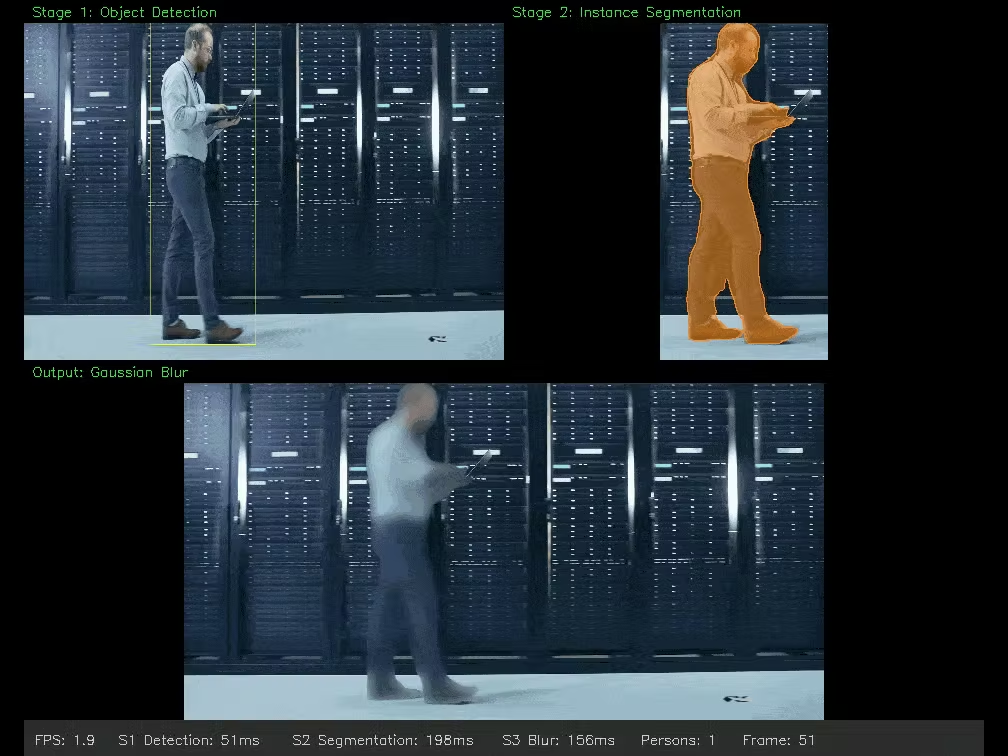
For a hot minute, getting an AI to tell you exactly where an object lives inside an image was a complete architectural nightmare. You had to chain together a massive LLM to understand the prompt, and then pipe that output into some rigid, dedicated computer vision model like YOLO or a CNN just to extract a few coordinates.
Gemini completely flips the script with its native bounding box (bbox) capability. Instead of treating spatial tracking as a totally separate data science problem, it treats coordinates as part of its own vocabulary without any extra pipelines.
Open-Vocabulary Detection
If you've ever worked with traditional object detection models, you know they are bound by a fixed dictionary. If you train a model on the standard COCO dataset, it knows exactly 80 things: "car," "dog," "banana," you get the drill. Ask it to find "the dented part of the bumper" or "the signature on this ancient manuscript," and it completely blanks out.
Gemini gives us open-vocabulary object detection. You can prompt it like a normal human being because its spatial understanding is baked directly into its multimodal core: