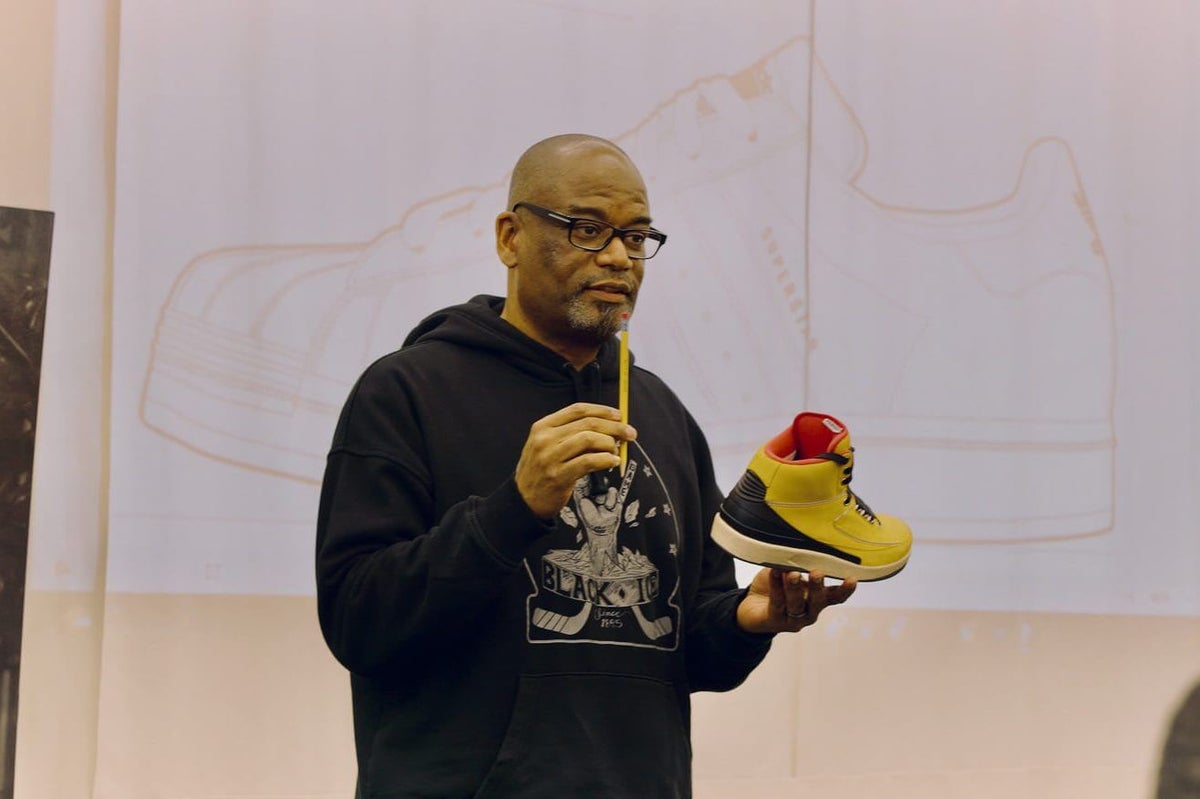
Staring down the company suggestion box at LA Gear, 19-year-old D’Wayne Edwards sketched a sneaker on a 3-by-5 notecard, signed his name and dropped it in the box. The next day, a different idea, and a different illustration, went in.Never mind that the Inglewood, Calif., native had no formal design education or training, or that his high school guidance counselor had dismissed his design dreams, telling him he’d be better off focusing on the military. Who cared that his job, as a file clerk in the accounting department of the trendy lifestyle brand, had nothing to do with design? Edwards, who had been sketching sneakers since he was 12, had ideas — lots of them.So for six months, he dropped a different design in the suggestion box, waiting to be noticed.Nearly 40 years later, Edwards’ fingerprints are all over the sneaker industry and, correspondingly, the NBA Finals.Widely considered the most influential Black designer in the history of footwear, the former Jordan Brand executive who didn’t go to college has dedicated the second half of his career to creating a path for aspiring Black designers that didn’t exist for him. Edwards never set out to work in education, but a young future hoops Hall of Famer sparked his idea to teach, and Edwards first launched Pensole design academy in 2010 in Portland, Ore. Now 56, Edwards is president of Pensole Lewis College in Detroit, where he took over a formerly shuttered historically Black college and built a pipeline to footwear companies across the world.Consider the work from Edwards’ mentees and former students on display. While trying to lead the New York Knicks to their first title since 1973, Jalen Brunson is wearing Nike Kobe Bryant sneakers; Erin Reyes and Jaime Rojas, two Pensole graduates who studied under Edwards, are among the lead designers of the Kobe division.“People talk about Bill Parcells’ coaching tree or Gregg Popovich’s coaching tree,” Allen Largin, one of Edwards’ first students, said, “but D’Wayne’s ripple effect is second to none. His impact dwarfs everyone else’s.”With a market valued at more than $90 billion annually, the sneaker industry has long moved beyond gear worn only by athletes on the court to everyday streetwear that can make — or break — your outfit. NBA games double as a footwear fashion shows. Who is wearing what becomes one of the biggest talking points each night for sneakerheads worldwide.It’s all part of the reason Cleveland Cavaliers owner Dan Gilbert’s foundation chipped in $10 million to help Edwards launch his vision of teaching sneaker design at an HBCU.“The culture around sneakers represents creativity, storytelling and self-expression,” Gilbert, who lives in Detroit, wrote in an email to The Athletic.“As an NBA owner, I see how sneakers are not just apparel. They are an extension of the game and of identity.”Edwards has lived a screenplay-worthy life since he turned the LA Gear suggestion box into his launching pad, even as he’s remained behind the scenes.“I don’t dream small,” he said. “And when you dream big, you get kind of addicted to it.”Edwards worked his way up from LA Gear, where the CEO rewarded his ambition with an entry-level gig as an assistant footwear designer in 1989. He worked at Sketchers, MVP Footwear and eventually Nike, moving in 2001 to Jordan Brand, where he created products related to one of the most iconic logos and athletes in sports. He worked on signature products with celebrities including Jordan, Derek Jeter, Dr. Dre and Snoop Dogg.Many view design as subjective, but Edwards became known in the industry for rooting his work in facts. He was a storyteller above all else, using tidbits from athletes’ lives and backgrounds to create products layered with unique details.Michael Jordan, for example, was one of the first Americans to own the Bentley Continental GT Coupe, which Edwards used as inspiration when designing the Air Jordan 21 in 2005. That sneaker was meant to showcase Jordan’s hobbies — which is why it featured premium leather and high-quality suede, just like his luxury car.Though they share a campus, Nike and Jordan are different, a distinction that mattered deeply to the notoriously competitive namesake. Nike has its Swoosh and Jordan Brand its Jumpman logo. Jordan Brand also signs its own athletes to endorsement deals. Edwards joked that because Nike was Jordan Brand’s biggest competitor, the namesake “did not like Nike, so we didn’t, either.”The first basketball athlete to sign with Jordan Brand was future Hall of Famer Carmelo Anthony. A 19-year-old superstar drafted No. 3 by the Denver Nuggets in 2003, Anthony signed with Jordan as a rookie. When Edwards, then Jordan’s design director, flew to Denver to meet with Anthony, the player peppered Edwards with questions, insisting that he understand every granular detail. Edwards considers his work with Anthony “the birth of my teaching career.”D’Wayne Edwards and Carmelo Anthony started working together at the start of Anthony’s Hall of Fame career. (Courtesy of Nick DePaula / Sole Collector)“Melo was engaged from Day One, he was a student of the process, a student of creativity, of business,” Edwards said, adding that in his previous experience, it was unusual for an athlete to be interested to that level. “He didn’t just want me to say, ‘Here’s a shoe, go wear it.’ He wanted to know the why.”Anthony’s participation got Edwards thinking about the future.An uneasy truth had always nagged at Edwards: Brands make products representing Black athletes and market them to young Black customers, he said, typically without empowering or educating aspiring Black designers.
He designed sneakers for Jordan, Melo. Now he’s revived an HBCU to teach the next generation
The former Jordan Brand executive who didn’t go to college is creating a path for aspiring designers that didn't exist for him.
2,495 words~11 min read