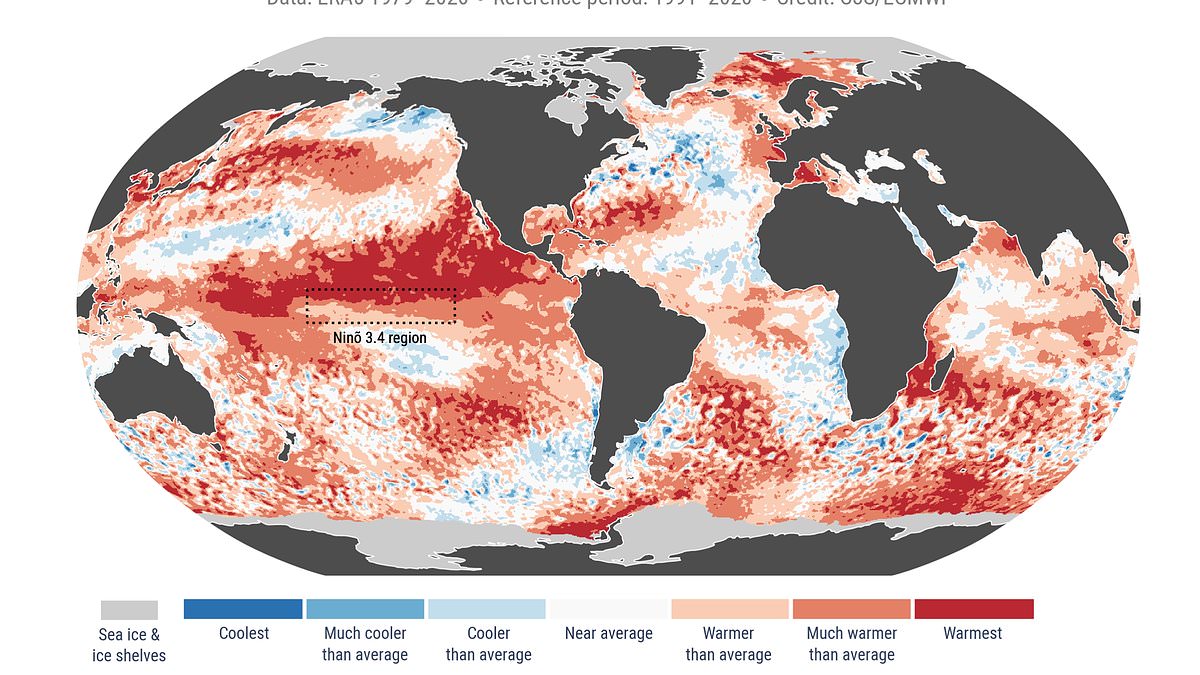
May 2026 was the second-warmest May in analyses of global weather data going back to 1850, behind only May 2024, NOAA’s National Centers for Environmental Information, or NCEI, reported June 10. NASA and the European Copernicus Climate Change Service rated May 2026 as the second-warmest May. The global-average temperature for January-May 2026 was the fourth-highest on record, NOAA said.
According to NCEI’s statistical analysis, there is about a 95% chance that 2026 will rank among the four warmest years on record. This statistics-based product is not designed to explicitly take El Niño or La Niña events into account, so with a global-atmosphere-warming El Niño event about to unfold, the odds may be higher still.
Figure 1. Departure of temperature from average for May 2026, the world’s second-warmest May since record-keeping began in 1850. Record-high May temperatures covered 6% of the Earth’s surface. Record-cold May temperatures were confined to a small region in the Southern Ocean, encompassing less than 1% of the world. (Image credit: NOAA/NCEI)
Figure 2. Daily surface air temperature (°C) averaged over western Europe (11° W-15° E, 34-55° N) for the period 1 March to 1 September. The year 2026 is shown with a thick red line. All other years between 1940 and 2025 are shown with gray lines. The daily average for the 1991-2020 reference period is shown with a dashed red line. Data source: ERA5. Credit: C3S/ECMWF.