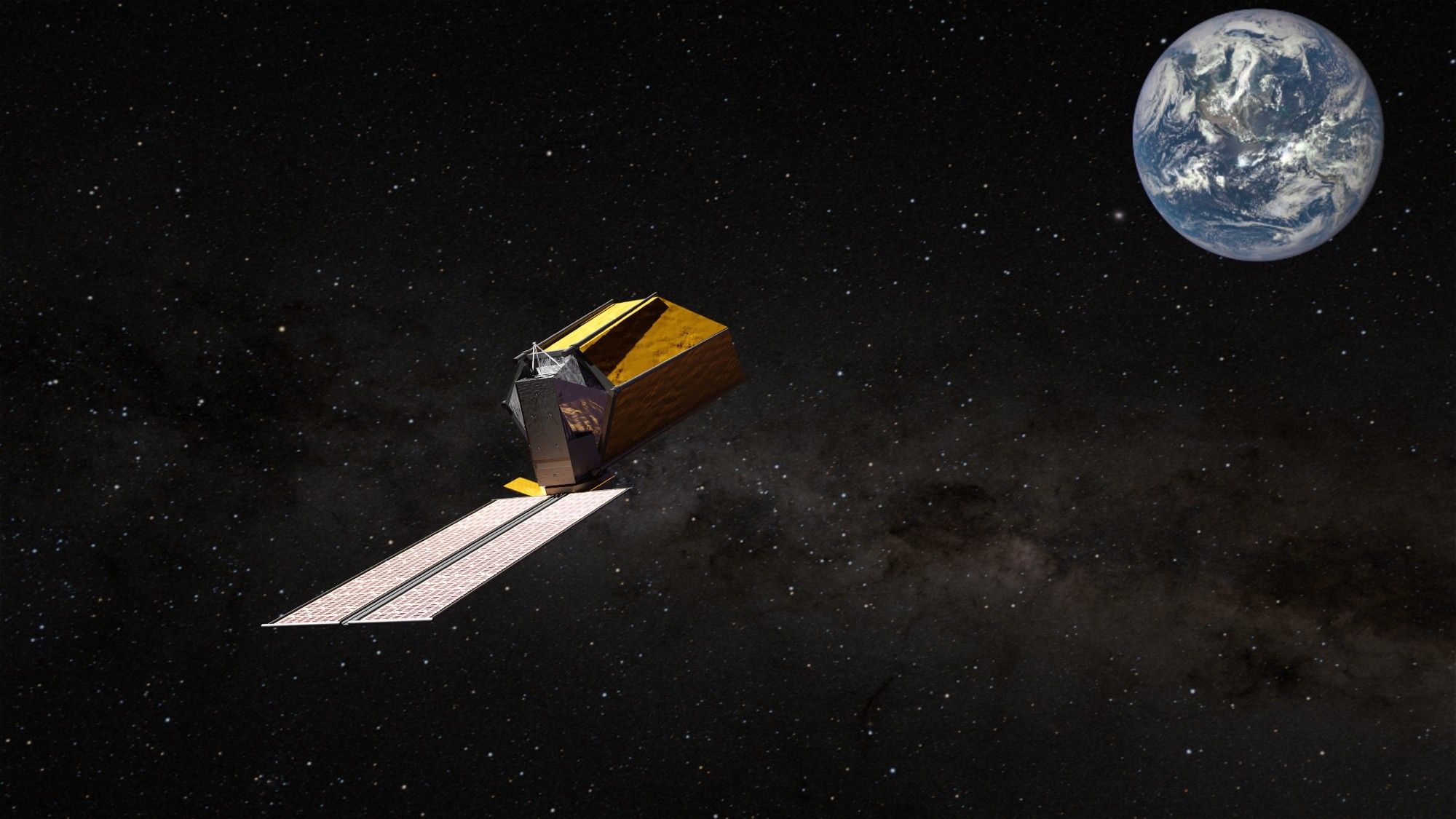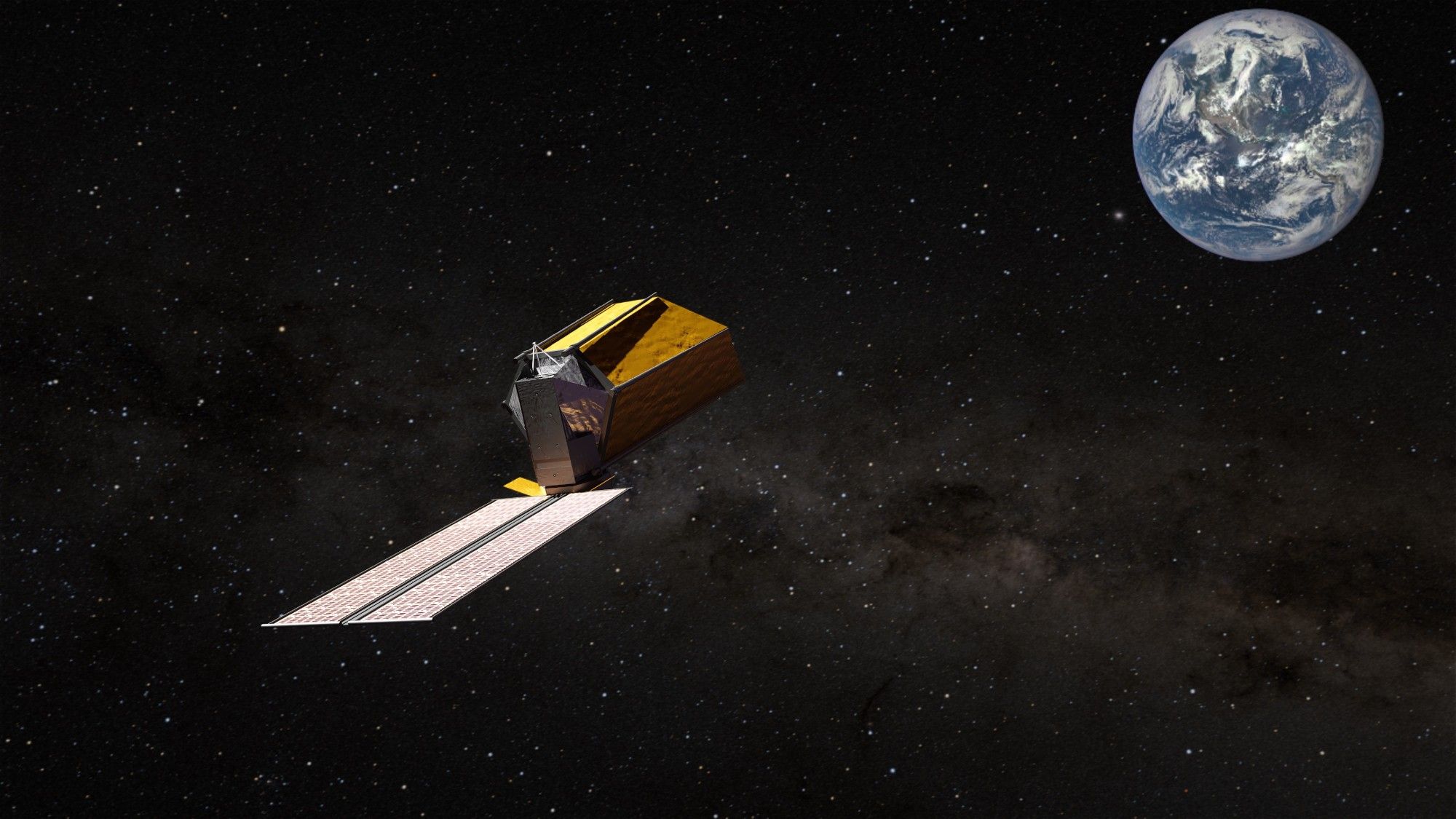
Artist's illustration of NASA's Habitable Worlds Observatory, with an inset photo of Earth taken by the Deep Space Climate Observatory (DSCOVR) spacecraft.
(Image credit: NASA)
NASA's Habitable Worlds Observatory is the agency's next flagship space telescope, designed to do something no previous instrument has managed: directly image Earth-like planets around nearby stars and analyze the light reflecting off their atmospheres for signs of life.The mission is still years from launch. But the design choices being made right now will determine what it can actually detect. A new paper posted to the arXiv preprint server tackles one of the most consequential of those choices: spectral resolution.The authors of the study ran a careful analysis of how finely the Habitable Worlds Observatory (HWO) would need to slice up the light from a distant Earth to confidently spot biosignatures in its atmosphere. The question matters more than you might think.Spectral resolution is how well a telescope can distinguish between adjacent colors of light. Higher resolution means a more detailed atmospheric fingerprint, but it also means longer exposure times, more detector noise, and trickier engineering. Push too high and you blow the mission's observing schedule. Push too low and you can't tell the difference between an inhabited planet and a barren one.To estimate what type of spectral resolution would be needed to detect biological signatures on our planet in its infancy, the team modeled what HWO would see when staring at versions of Earth through geological time.Earth's atmosphere has changed dramatically over its history. The Archean Earth, before plants and cyanobacteria got going, had almost no oxygen. The Proterozoic Earth had some, but not much. The Phanerozoic Earth, the one we know, hit roughly 20 percent oxygen once complex life took hold. Each leaves a different spectral signature, and HWO will need to recognize all three.The headline numbers are surprisingly modest. To detect molecular oxygen, the gold-standard biosignature on a planet like our own, HWO needs a visible-light resolving power of about 140. Ozone shows up at a much lower resolving power of around 7 in the ultraviolet. Those numbers are well within what current optical designs can deliver.The infrared is harder. Carbon dioxide and carbon monoxide have spectral features that overlap, and if HWO can't tell them apart, it could mistake a volcanically active dead planet for a living one. The team found that a near-infrared resolving power of at least 40 is the minimum needed to break that degeneracy. To characterize an atmosphere through Earth's entire geological history, they recommend a nominal infrared resolving power of about 70.