in Education, Literature | July 28th, 2025 3 Comments
Whether willed, involuntary, or a mix of both, the declining literacy of college students is by now so often lamented that reports of it should no longer come as a surprise. And yet, on some level, they still do: English majors in regional Kansas universities find the opening to Bleak House virtually unintelligible; even students at “highly selective, elite colleges” struggle to read, let alone comprehend, books in their entirety. Things were different in 1941, and very different indeed if you happened to be taking English 135 at the University of Michigan, a class titled “Fate and the Individual in European Literature.” The instructor: a certain W. H. Auden.
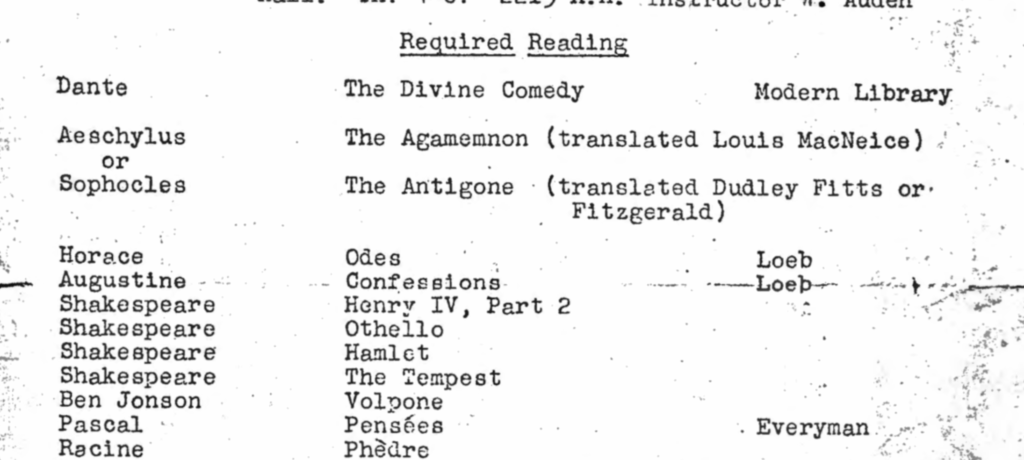
In his capacity as an educator, the poet threw down the gauntlet of an “infamously difficult” syllabus, as literary academic and YouTuber Adam Walker explains in his new video above, that “asked undergraduates to read about 6,000 pages of classic literature.”
Not that the course was out of touch with current events: in its historical moment, “Nazi Germany had invaded the Soviet Union and expanded into Eastern Europe. Systematic extermination begins with mass shootings, and the machinery of genocide is accelerating. It’s no accident that Auden takes an interest in fate and the individual in European literature” — a theme that, as he frames it, begins with Dante. After the entirety of The Divine Comedy, Auden’s students had their free choice between Aeschylus’ Agamemnon or Sophocles’ Antigone.