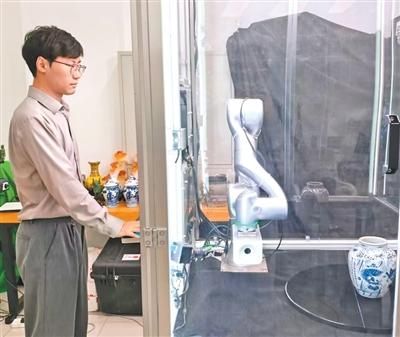
A researcher tests the generation of 'digital fingerprints' for cultural relics.
A Chinese research team led by Tianjin University has introduced an innovative solution that gives cultural relics a unique, non-detachable "digital fingerprint," offering a new technological safeguard for cultural relic protection.
The special "fingerprints" refer to the unique surface texture features revealed when relics are magnified to the micrometer level.
Tianjin University, in collaboration with multiple institutions, including universities, museums, and cultural heritage institutions, has developed a system that captures microscopic surface features of cultural relics to create unique digital identities, aiming to address long-standing challenges in verifying cultural relics' identity during storage, transport, and exhibition.
"The system is based on the principle that at the microscopic scale, the surface of an object exhibits random physical features. These physically random characteristics at such an observation scale are similar to human fingerprints: they are unique, stable, universally present, and cannot be replicated," explained Feng Wei, a professor in charge of Tianjin University's Visual Intelligence Lab, which spearheaded the project's core technology development.