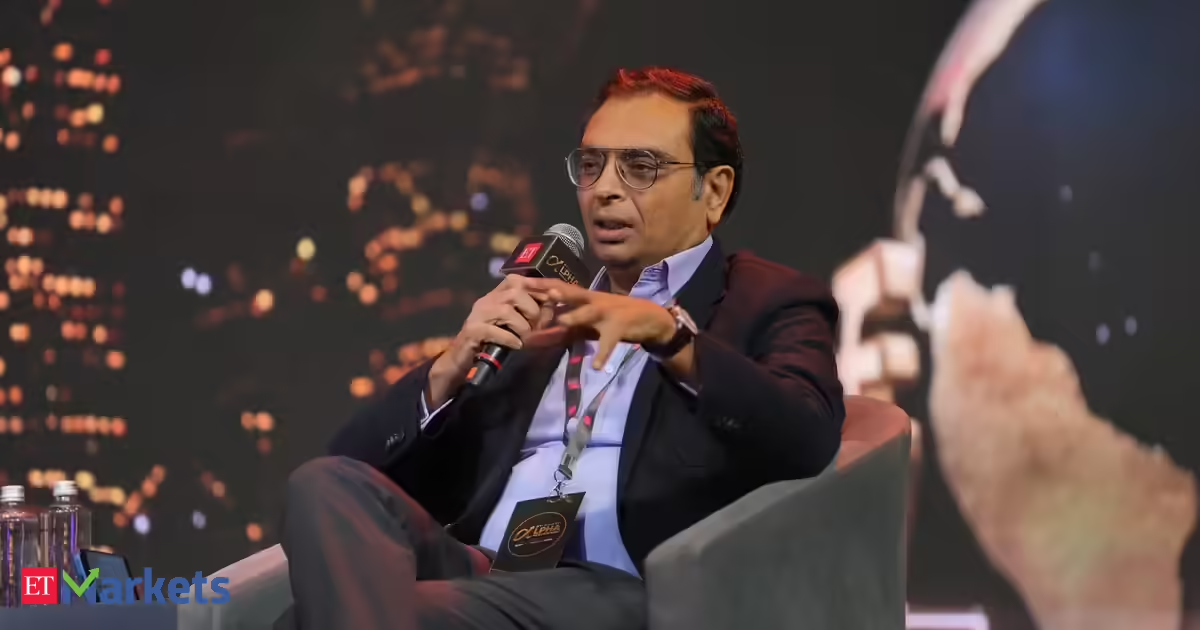
At the ET Alpha Wealth Summit in Mumbai, Saurabh Mukherjea, Founder & Chief Investment Officer, Marcellus, delivered one of the most provocative takes of the evening. While others spoke of Amritkaal and AI-Kaal, he introduced a third term: Sankat Kaal. Not to alarm, but to illuminate. Because in his view, understanding the disruption is the only way to find the opportunity inside it.India's economic pivot has arrived, and manufacturing exporters, not consumer-centric darlings, will drive the next wave of EPS growth. The era of 100 PE consumer stocks is fading; five years from now, it will be well-run goods exporters who command the spotlight. Every major free market economy reinvents itself every 30 years — America did it, China did it, and India's turn is now. "We are in Sankat Kaal, but we will come out of this, and in this Sagar Manthan, our job is to look for the next generation of winners, the companies who will drive India forward," said Mukherjea.Other than Mukherjea, leading fund managers, Vikas Khemani, Founder & Chief Investment Officer, Carnelian Asset Management & Advisors , Hiren Ved, Director & CIO, Alchemy Capital Management and Kailash Kulkarni, CEO, HSBC Mutual Fund, were part of the panel that debated on 'India, Amritkaal or AI-Kaal? India's Next Decade'. Kshitij Anand, Editor-Markets & Finance, ET Digital, moderated the panel discussionIndia has been falling behind, and the data proves itMukherjea opened with an uncomfortable truth. India's Nifty 50 dollar EPS CAGR, measured across 3, 5, 10, and 20-year periods, hovers near just 6%. The S&P 500 delivers 11%. In the last five years, India has fallen meaningfully behind not just America but East Asian economies and even Vietnam and Bangladesh in export competitiveness.You Might Also Like:The culprit, in part, has been an overvalued rupee, propped up by $400 billion in IT and services exports, which has quietly handicapped India's manufacturing exporters for decades, forcing them to compete globally with one hand tied behind their back.AI is the wrecking ball hitting India's middle classThe more urgent disruption, Mukherjea argued, is happening right now inside corporate India. AI is systematically eliminating well-paid white collar jobs at scale. He pointed to the annual reports of ICICI Bank, HDFC Bank, Bajaj Finance, and TCS as evidence, each showing 5,000 to 20,000 jobs being removed from headcount.The downstream effect is already visible in property markets. Residential real estate in Gurgaon and Hyderabad is, in his words, "almost frozen solid" as IT and tech job losses drain purchasing power from India's most affluent urban middle class.The rupee will fall further, and that is good news for manufacturersHere is where Mukherjea's thesis turns counterintuitive. As IT exports weaken under AI pressure, the rupee's historical 40% depreciation per decade accelerates to closer to 50%. For white collar workers, that is painful. For India's manufacturing exporters in Gujarat, Coimbatore, and Ludhiana, it is a long-awaited levelling of the playing field.You Might Also Like:"Five years hence," he told the panel, "it will be manufactured goods exporters who will be the toast of the town." The era of consumer-centric companies commanding 100 PE multiples, he believes, is gradually ending.Gig work and the rise of tier II citiesMukherjea also identified a quieter but profound social shift. Laid-off IT professionals are bypassing the job market entirely, turning to platforms like Upwork to bid for global projects, and doing so from Indore, Nashik, Dehradun, and Coorg instead of Bangalore or Gurgaon. With AI tools enabling a sole practitioner to bill $50,000 in one to two days, the economics of big-city life no longer stack up.The consequence: big-city real estate faces sustained inventory pressure, while Tier II and Tier III markets, both residential and commercial, look increasingly promising.The steady compounders still hold their groundDespite the upheaval, Mukherjea's faith in clean, well-run businesses with consistent returns on capital remains intact. Auditing his own 2016 book Unusual Billionaires, he found that companies like Asian Paints, Marico, and HDFC Bank continue to beat benchmarks. The noise around disruptive IPOs and new-age businesses, he cautioned, rarely survives contact with long-term data.You Might Also Like:His one structural concern: a rising cost of capital globally will compress valuations, in the West and in India alike. The era of cheap money, he said plainly, is behind us.
We are in Sankat Kaal, and in this Sagar Manthan, our job is to look for the next generation of winners: Saurabh Mukherjea
India's economic future lies with manufacturing exporters, not consumer companies. Saurabh Mukherjea predicts this shift will drive earnings growth. Artificial intelligence is reshaping jobs, impacting the middle class. A weaker rupee will benefit goods producers. Gig work and smaller cities are gaining prominence. Well-managed companies remain strong investments. The era of cheap money is over.
706 words~3 min read