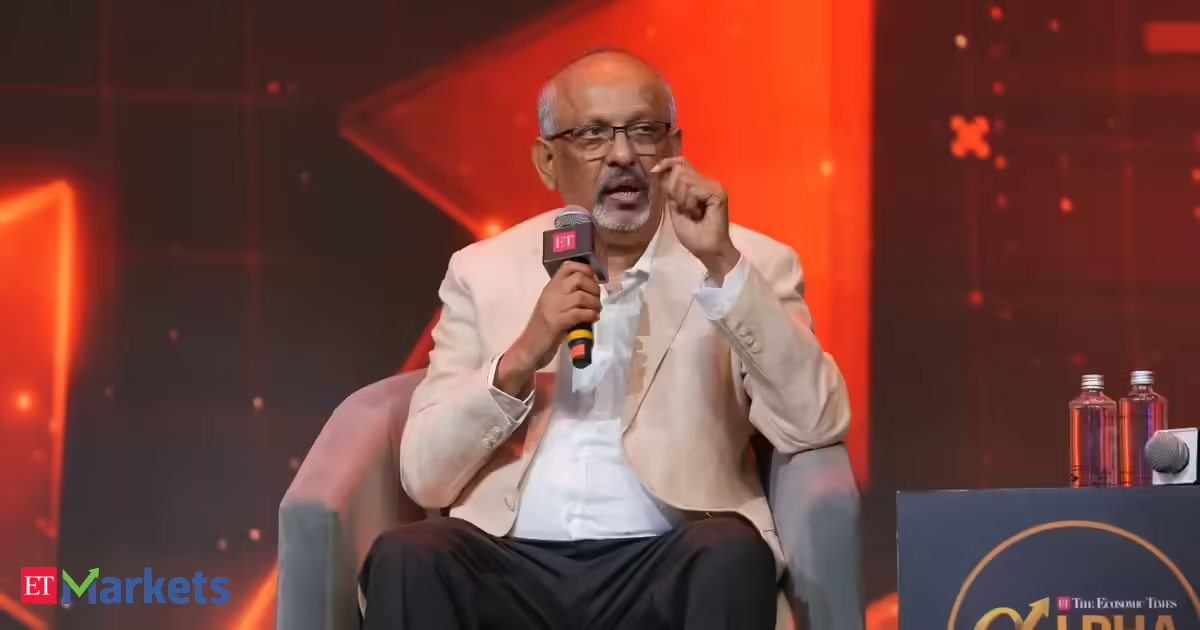
At the ET Alpha Wealth Summit, held in Mumbai last week, leading fund managers, Vikas Khemani, Founder & Chief Investment Officer, Carnelian Asset Management & Advisors , Saurabh Mukherjea, Founder & Chief Investment Officer, Marcellus, Hiren Ved, Director & CIO, Alchemy Capital Management and Kailash Kulkarni, CEO, HSBC Mutual Fund, held a discussion on 'India, Amritkaal or AI-Kaal? India's Next Decade'. Here we focus on what Khemani had to say. Kshitij Anand, Editor-Markets & Finance, ET Digital, moderated the panel discussionThe foundation has already been builtVikas Khemani, Founder and CIO of Carnelian Asset Management, opened with a striking observation. India has spent the last decade quietly laying the groundwork that most economies take generations to establish, digital infrastructure, physical connectivity through roads, railways, ports and airports, and landmark regulatory reforms including GST, the Insolvency and Bankruptcy Code, and RERA."India has built a very nice foundation," Khemani told the panel. The results speak for themselves: Indian corporate earnings have compounded at a CAGR of 14–15% over the last 20–25 years, a track record few major economies can match.Demographics: The dividend nobody else hasPerhaps India's most powerful and irreplaceable advantage is its people. Two-thirds of India's population is of working age, making it the youngest major economy in the world at a time when China is ageing and most developed markets face shrinking labour pools.More earners means more consumers. More consumers means GDP growth. It is, as Khemani put it, almost arithmetic.You Might Also Like:Why India is different from every other emerging marketOne of the panel's sharpest insights was the contrast between India and its emerging market peers. China was built on exports. Brazil runs on commodities. Taiwan and South Korea are hostage to the semiconductor cycle.India, by contrast, is structurally diversified, across BFSI, manufacturing, consumer, services, and infrastructure. That breadth is not a weakness. It is a buffer, and increasingly, a source of compounding strength.5 sectors set to create wealth over the next decadeKhemani outlined five broad themes he believes will drive wealth creation through India's Amritkaal period, ranked by his conviction:You Might Also Like:1. Manufacturing : India's manufacturing GDP sits at just 14–15% of the economy. Khemani has been bullish since 2020, when Carnelian launched a dedicated manufacturing fund. He sees this figure rising to 20–25% over the next 10–15 years, driven by both import substitution and export-oriented growth. He calls it a "multi-decade opportunity."2. Financials: As per capita income rises, savings pools deepen and get channelled into formal financial products. The evolution from PSU banks to NBFCs, wealth platforms, and AMCs is far from complete. The next wave of financial product innovation could generate the largest absolute quantum of wealth in the market.3. Consumption: Rising incomes mean rising consumption — not just more of the same, but newer, better, and more aspirational products. The premium and premiumisation trends visible across FMCG, retail, and lifestyle categories are still in early innings.4. Services: Including IT and related sectors, services remains a significant opportunity though Khemani places it lower in his pecking order compared to the first three themes.5. Infrastructure: Capital-heavy but strategically critical, infrastructure investment continues at a pace India has never seen before. Returns may be slower, but the tailwind from government spending is real.The right lens for Indian investorsThe panel's broader message was a call for perspective. Short-term volatility, whether from global trade disruptions, geopolitical uncertainty, or domestic earnings misses, will always create moments of doubt. But as Khemani noted, no economy grows in a straight line, and no human life does either.You Might Also Like:The investors who have consistently generated alpha in India are those who resisted the urge to zoom in when things looked ugly, and instead held their view of the larger picture."Very often when we zoom in, we look at short term, things look very ugly. But when you zoom out and look at a larger picture, I think things look very, very good," says Khemani.For long-term investors, that picture continues to look very good indeed.
'When you zoom out, things look very good;" Vikas Khemani on the India story every investor needs to hear now
India has built a strong foundation for growth over the past decade, according to Vikas Khemani of Carnelian Asset Management. He highlighted robust digital and physical infrastructure, alongside regulatory reforms. With a young demographic and a diversified economy, India is poised for significant wealth creation, particularly in manufacturing, financials, consumption, services, and infrastructure over the next decade.
661 words~3 min read