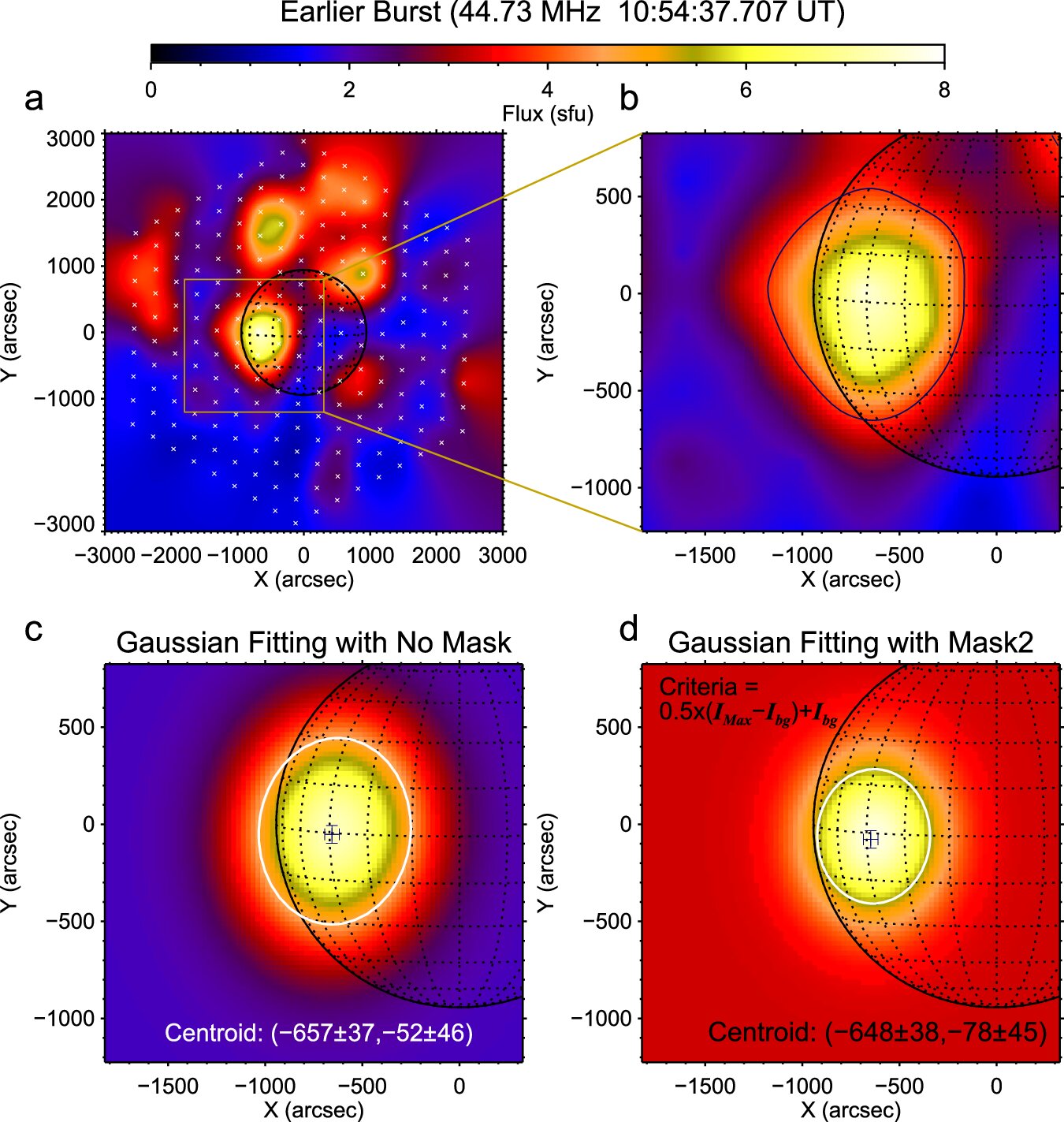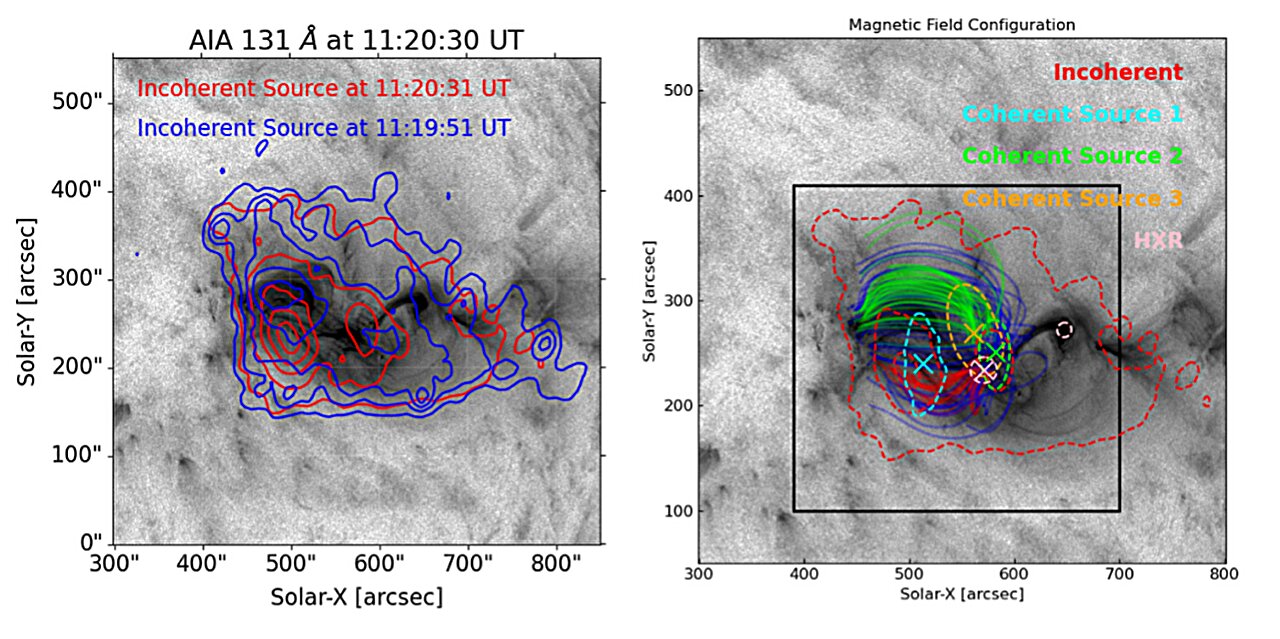
Left panel shows contours of the incoherent radio emission overlaid on SDO/AIA images, with blue and red contours corresponding to the pre-burst and burst phases, respectively. The emission extends beyond the EUV loop structures, indicating the presence of diffuse hot plasma not captured by EUV observations. Right panel shows NLFFF extrapolated magnetic field lines projected onto the helioprojective frame, with colored curves representing coronal loops associated with different radio sources, linking the emission to distinct magnetic structures. Credit: Luo et al. (2026)
Solar flares are the most explosive energy-release events in the solar corona, leading to intense particle acceleration, plasma heating and bulk plasma motions on short timescales. Core questions during solar flares remain unresolved, including how and where particle acceleration occurs, and how energized electrons propagate through coronal magnetic structures.
Radio observations, due to their unique sensitivity to nonthermal and thermal electrons, serve as powerful diagnostics of electron dynamics and high-temperature plasma in the low corona. However, these diagnostics have long been constrained by instrumental limitations.