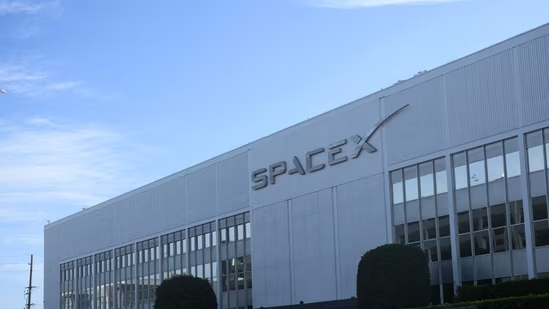
If you grew up in the 2000s, you may remember “Passive,” the hit song by A Perfect Circle. The song painted passive behavior as something frustrating and inactive. Fast-forward to today, and “passive” has become one of the most popular words in investing. But thanks to Elon Musk’s SpaceX IPO, many Americans are learning that so-called “passive” investment funds are not completely passive.What the SpaceX IPO is teaching investors about passive investing today (Photo by Patrick T. Fallon / AFP) (AFP)What is passive investing?Passive investing means investing money in index funds or ETFs that follow a market index like the S&P 500 and keeping those investments for many years. In passive investing, fund managers do not actively pick stocks. Instead, they follow the stocks that are already included in a benchmark index, as explained by Investopedia.Passive investing became popular because it generally offers lower fees, greater transparency, tax efficiency, and a simple investment approach. One major downside is that passive funds have limited flexibility because they are designed to follow an index and cannot easily avoid stocks that enter that index.Also Read: Elon Musk could become first trillionaire if SpaceX IPO succeeds: Here's how his net worth may cross $1 trillionSpaceX IPO and passive investingAnother drawback is that passive funds rarely outperform the index they track because their goal is to match the benchmark rather than beat it. The debate around passive investing intensified as Elon Musk’s SpaceX moved closer to its expected stock market debut. SpaceX’s upcoming IPO has created concerns among some investors because major index providers recently changed their rules in ways that could allow SpaceX to enter key indexes more quickly, as reported by Axios.SpaceX IPO and index fundsTwo major index companies, Nasdaq and FTSE Russell, recently updated their methodologies to fast-track SpaceX’s inclusion in certain indexes. If SpaceX is added to those indexes, millions of passive investment funds that track them may be forced to buy SpaceX shares automatically. This means many ordinary investors could end up owning SpaceX stock through their retirement accounts or index funds even if they never personally chose the company.Some investors are unhappy because they feel they have little control over such decisions, as highlighted by Axios. However, not every index provider is making the same move. Last week, S&P Dow Jones Indices said it would not change the rules for its flagship S&P 500 index. The situation has highlighted an important fact: stock indexes are not natural market measures but products created by people using specific rules.How index providers make decisionsDifferent index providers use different criteria to decide which companies enter their indexes and how much weight each company receives. These rules can change over time, meaning index construction involves human judgment rather than an entirely automatic process. University of Chicago Law School professor Adriana Robertson said investors should understand that indexes are based on decisions made by people and organizations, as cited by the Axios report.Robertson pointed out that different index providers can make different choices, leading to different outcomes for investors. She said it is encouraging that more people are now realizing how index investing actually works, to Axios. Research cited by Axios showed that the S&P 500 changed its methodology eight times between 2015 and 2018. These changes demonstrate that indexes regularly evolve and are not fixed systems.Index providers such as Nasdaq and S&P first create lists of stocks and then determine how much influence each stock will have in the index. Large asset managers such as Vanguard and BlackRock then use those indexes as the foundation for their investment funds. Individual investors typically buy shares of those funds rather than purchasing every stock in the index themselves.Do passive funds follow indexes exactly?Research has found that index funds do not always perfectly match the indexes they track. According to a 2024 study by Adriana Robertson and University of Florida law professor Peter Molk, funds often have some freedom in how closely they follow an index, as cited by Axios. The researchers found that funds can and do differ from their benchmark indexes by meaningful amounts. For example, Fidelity’s S&P 500 fund states in its prospectus that it may not always hold all the same stocks as the S&P 500 index.Researchers also found that a Vanguard S&P 500 index fund owned Berkshire Hathaway Class A shares even though the S&P 500 index uses Berkshire Hathaway Class B shares. Berkshire Hathaway Class A shares carry greater voting rights than Class B shares, making this a notable difference. The study also found that some funds bought shares of companies before those companies were officially included in the S&P 500 index.These findings challenge the common belief that passive funds simply mirror indexes exactly. The popularity of index investing remains enormous despite these concerns. Vanguard’s flagship S&P 500 ETF, VOO, recently reached $1 trillion in assets under management.Experts say the broader lesson is that whether investors choose an active manager or an index fund, they are still trusting someone else to make decisions about how their money is managed. Axios reported that even large fund companies have largely stopped describing these products as “passive” when discussing how the funds actually operate. Adriana Robertson said the term “passive” has increasingly become a marketing and branding label rather than a perfect description of how these funds function, to Axios.About passive investingDespite the criticism, Robertson stressed that index funds still provide major benefits to investors through broad diversification and low costs. She described those advantages as extremely valuable for long-term investors, Axios reported. The SpaceX IPO controversy is therefore not necessarily an argument against index funds, but rather a reminder that passive investing involves human decisions behind the scenes.The key takeaway for investors is that index funds may be low-cost and hands-off, but the indexes they follow are constantly shaped by rule changes and judgment calls made by index providers. Robertson said it often takes a well-known person like Elon Musk to help people understand how passive investing really works.
SpaceX IPO reveals hidden reality of passive investing and index funds
SpaceX IPO is showing investors that passive investing is not fully automatic. Index funds follow rules set by people, and those rules can change.
996 words~5 min read