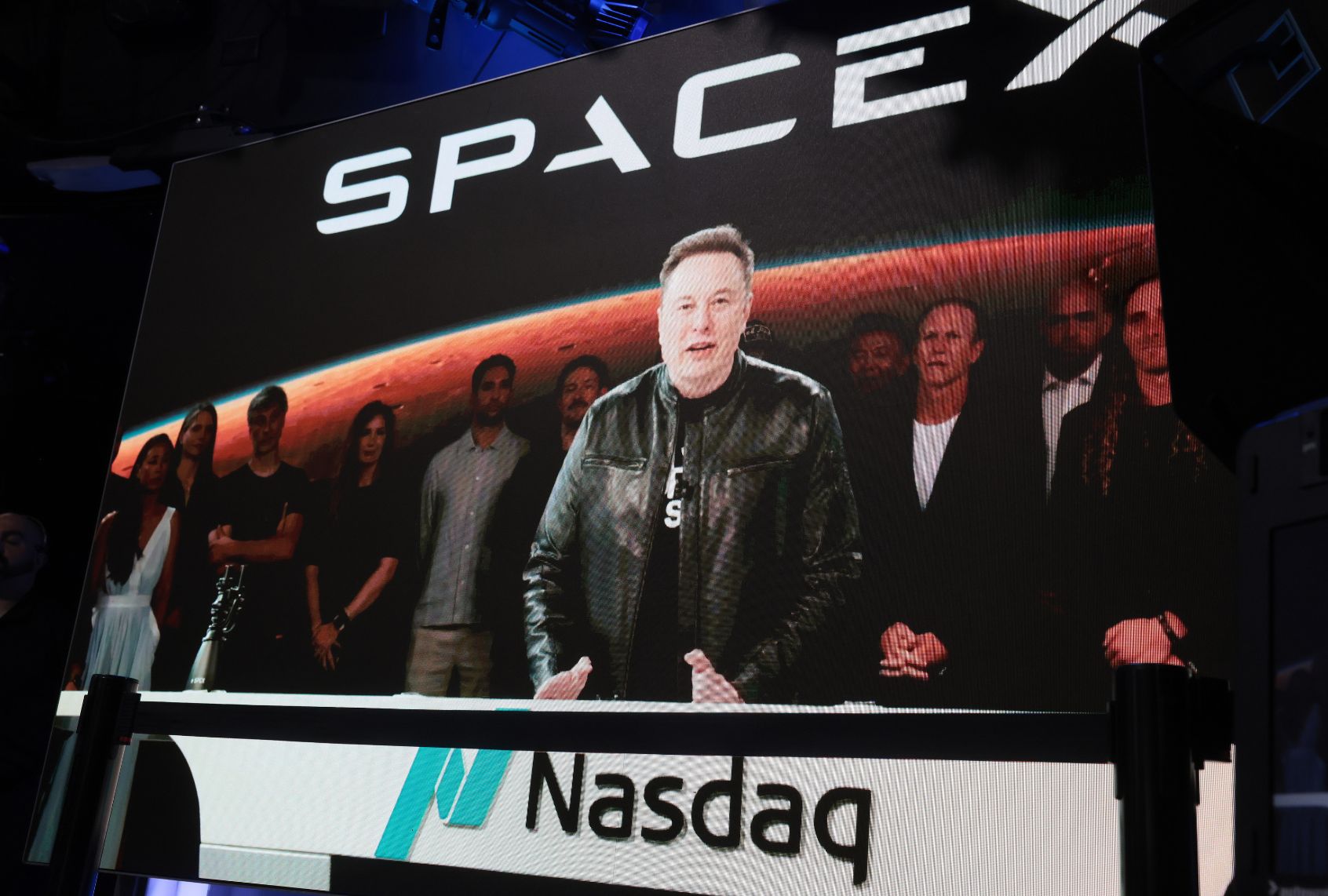
Americans are starting to realize that "passive" investment funds aren't actually that passive — and they have Elon Musk to thank for the lesson.Why it matters: Ordinary people have trillions of dollars invested in broad-based index funds meant to be a low-cost way to basically buy stocks and chill.Catch up quick: As Musk's SpaceX barrels toward its expected public market debut on Friday, things have been less than chill. Two of the companies that manage big indexes, Nasdaq and FTSE Russell, changed their rules recently in a way that will fast-track SpaceX for inclusion.That means that millions of passive investors — those who are in funds that track those indexes — will effectively have to buy SpaceX stock. Perhaps it'll be a part of your 401(k).Some aren't happy about it.Yes, but: Last week, S&P Dow Jones Indices said it decided not to modify the rules for its flagship S&P 500.The big picture: This was all a reminder that indexes like the Nasdaq 100 or the S&P 500 aren't some kind of naturally occurring phenomena.There are many different flavors of indexes governed by all sorts of subjective rules — made deliberately by human beings.Zoom in: From 2015 to 2018, the S&P 500 changed its methodology eight times, University of Chicago Law School professor Adriana Robertson noted in her 2019 paper, "Passive in Name Only. Delegated Management and 'Index' Investing.""Don't be confused about what these things are," Robertson tells Axios.It's been sort of gratifying that people are waking up to this notion now, she says. "Index funds are the product of choices people make, and different index providers can make different choices."How it works: Index companies like Nasdaq and S&P make a list of stocks and then weight them. They come up with rules to decide how to do this. The rules vary and change. Then their customers — the Vanguards, and the BlackRocks — use those lists to create funds. Regular folks then invest in those funds; the funds broadly track the indexes, but they don't line up exactly, as Robertson's research has found. Friction point: There's no hard-and-fast rule that requires a fund to perfectly replicate the underlying index, as Robertson and coauthor Peter Molk, a law professor at University of Florida, found in a 2024 paper focused on the S&P 500. Funds have discretion and "routinely depart from the underlying index by meaningful amounts," they find in an analysis.For example: The prospectus for Fidelity's S&P 500 fund states that "the fund may not always hold all of the same securities as the S&P 500 Index."A Vanguard 500 index fund that holds Berkshire Hathaway class A shares, instead of the class B shares that are represented in the S&P 500. The former category carries more voting rights. They also found that some funds begin holding certain companies before they're official added to the S&P index.Follow the money: These funds are popular! Vanguard's flagship S&P 500 fund, VOO, just hit $1 trillion under management.Between the lines: Whether you hire a specific person to manage your investments or you go the index fund route — ultimately, you're entrusting your money to someone else to manage. Even the big fund managers have stopped using the term passive to describe the mechanics of their funds. Now it's more a way to sort of sell the products. "Passive has become a branding tool," Robertson says.Reality check: None of this means that index funds are a bad choice. The ability to offer investors broad diversification at very low cost is "phenomenally valuable," she emphasizes.The bottom line: Typically, normies don't think about any of this. "It takes an Elon to get the rest of the world to pay attention," Robertson says.
SpaceX IPO highlights the catch in passive investing
Two big stock indexes changed their rules recently in a way that will fast-track Elon Musk's company for inclusion.
614 words~3 min read