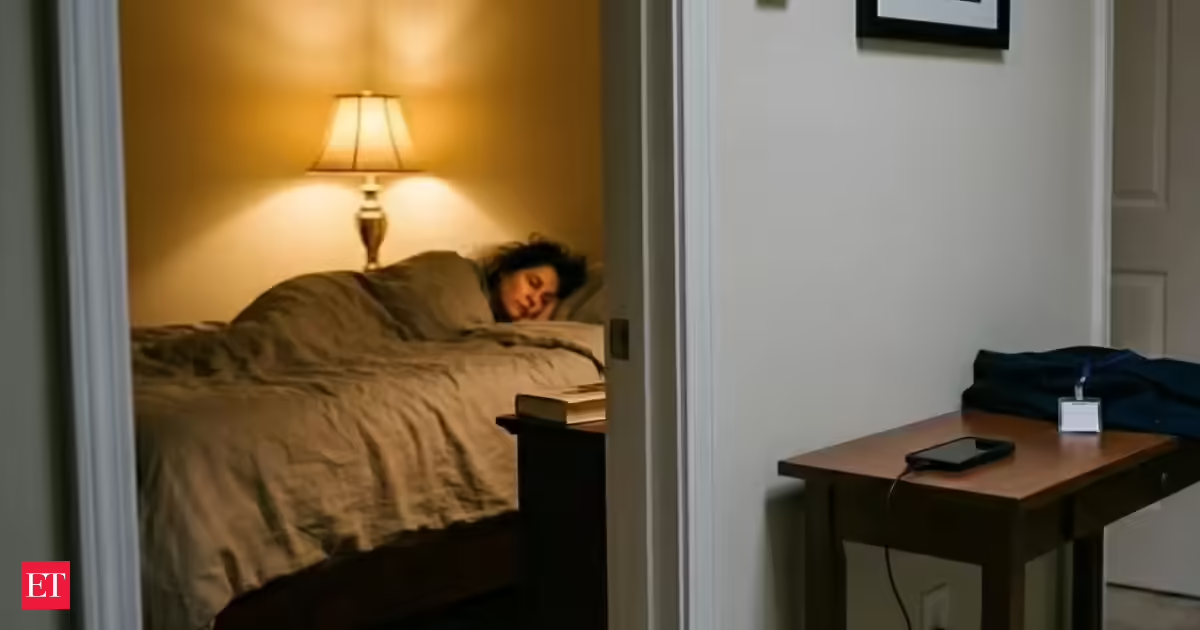
Intimacy between partners is falling foul of the 'scroll hole', say relationship experts - after new research revealed people in the UK are often wasting hours of their day 'mindlessly' browsing on their phones.In some cases, couples are so fixated with scrolling, say experts, that the last thing they touch before falling asleep every night isn't their partner but the smartphone glued to their hands.Research released last week commissioned by phone company Virgin Media 02 examined responses across three surveys carried out over the last two years and found that UK adults spent an average of four hours a day looking at their phone.And around 36 per cent of those hours - the equivalent of 86 minutes daily - was casually looking at content 'without purpose'.London-based psychotherapist Hilda Burke warns modern relationships - and sexual intimacy - are likely suffering from our evolving phone habits, saying research elsewhere shows around a third of people often argue with their partner about phone use. Couples are increasingly likely to escape into their own worlds at bedtime, say relationship experts - with phone use, including 'mindless' browsing, on the riseAppearing on BBC Radio 5 Live Breakfast, the relationship expert said: 'The most popular device used in bed is the smartphone, that tells you everything about the appetites that are being sated in the bedroom these days - they're usually digital.'She added that most of the couples she works with will 'readily admit that the last thing they look at at night, the last thing they touch at night is their device, rather than their partner'.'We're distractible - attention is getting diluted; it's very hard to focus'.A global fertility crisis has been blamed - in part - on the increased use of mobile phones and last year, the Office for National Statistics (ONS) reported that the birth rate across England and Wales had dropped again for the fourth year in a row.There were 585,000 live births in 2025, the lowest figure since 1977 and the ONS figures echo a similar trend across the rest of the world. Relationship coach Lorin Krenn tells the Daily Mail the bedroom should be a sacred space to maintain a healthy intimate relationship - and that could mean devices need to be ditched. He tells the Daily Mail: 'The bedroom is directly linked to rest, privacy, and intimacy. 'Because of this, everyday habits that might barely register elsewhere in the home can feel far more disruptive there.'Tension usually develops when partners have different needs around sleep routines, noise, order, or personal space. 'One partner might want no phones, no stimulation, and complete quiet, while the other unwinds by scrolling on their phone, reading in bed, or keeping the light on. One may want to read, the other may want darkness and stillness. Getting on the same page is hugely important, he adds, saying compromise is key even if you don't agree on how the last hour of the day should be spent. 'Resolution comes from shared responsibility. Over time, repeated disruptions in the bedroom can start to feel personal. When those needs are not clearly discussed, small irritations accumulate. What one partner experiences as normal or harmless, the other may experience as intrusive or exhausting.'The average screen time for UK adults, when TVs, gaming devices, laptops and tablets are added to smartphone use, has soared to more than seven hours a day, according to last year's annual TouchPoints survey for the Institute of Practitioners in Advertising (IPA) - up from 6.5 hours in 2015. Earlier this week, the Government announced it's set to get tougher on smartphone use amongst the youngest generations. Parents could be warned against buying their children a smartphone until they reach secondary school under plans being drawn up by ministers. Parents could be warned against buying their children a smartphone until they reach secondary schoolA consultation on screen use by under-16s will consider whether parents should be given advice on the appropriate age for children to be allowed to use a phone.The review will be co-chaired by Children's Commissioner Dame Rachel de Souza, who has previously said that pre-secondary age children are 'too young' to be using internet-enabled devices.Former safeguarding minister Jess Phillips suggested on Sunday that smartphones should be restricted to adults.Ms Phillips quit the Government partly over failure to take action to protect children online. She said the belief held by some parents that giving their child a phone can help keep them safer was 'the greatest lie ever peddled by the technology companies'.She told Times Radio: 'From what I have seen, when we give our children a smartphone, under current regulations what you are giving – not to them but to the paedophiles of this world – is direct access to your children.' The review will produce guidelines on 'healthy screen use' for children aged five to 16.
Phone use is killing sex lives, say experts
Birth rates are falling as phone use increases...and experts say the two are linked, with many of us guilty of knowing our devices more intimately than we know our partners.
806 words~4 min read