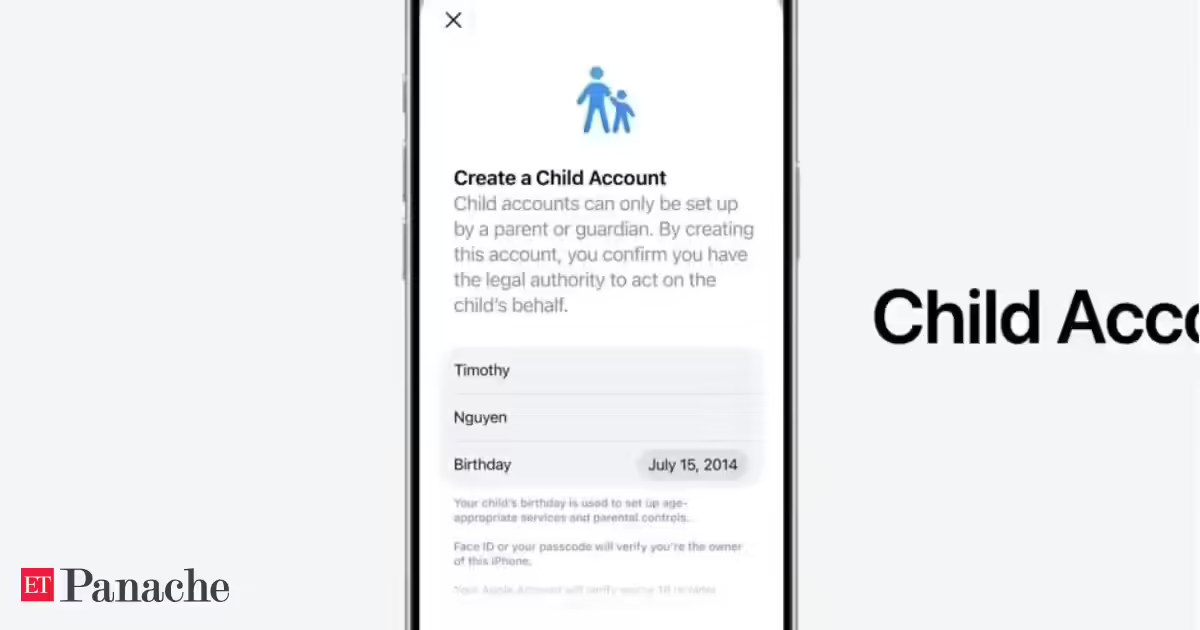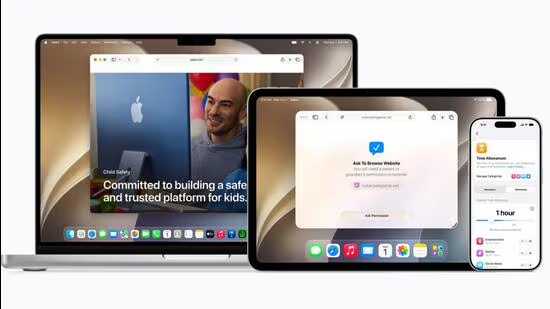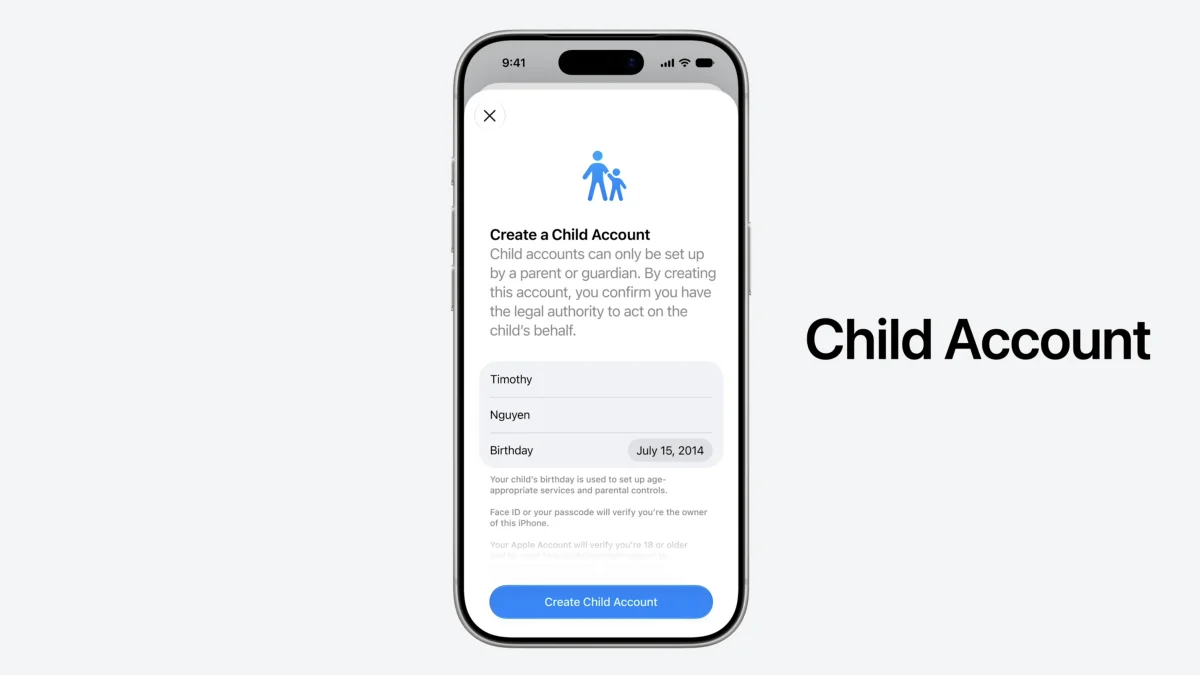
Apple is reshaping how App Store apps get sold, found and subscribed to. At WWDC 2026, the company set out a year of changes for developers: richer ways to market apps, personalised discovery for users, subscriptions that stretch across teams and organisations, and tighter links to the new parental controls in iOS 27. Most arrive through 2026. A few land as soon as this week.Key TakeawaysCreative Assets bring rich images and video to product-page headers and search results, managed from a new Asset Library.Personalized Collections and App Notes start this week in US English, explaining why the Store recommends what it does.Subscriptions gain group and organisation buying: Volume purchasing for enterprise and education this autumn, Group purchases this winter.App Store Bundles let different developers package apps together for a lower combined price, and Suites sell subscription packages as a set.The Mac App Store drops its Intel requirement, and a July age-rating change feeds the new Time Allowance parental controls.The update lands amid heavy pressure: Apple fights Epic at the US Supreme Court, has paid an EU fine, and cut fees in China and Japan, while Google opens Android.The shopfront gets a redesign: Creative Assets and an Asset LibraryStart with the window display. Creative Assets let developers put rich images and video into the product-page header and into search results, on top of the usual screenshots and previews. The point is to dress the storefront for the season: highlight a brand, push a festive offer, show off new content. They plug into custom product pages and product-page optimisation, so a developer can test which window display pulls the most footfall.Behind the counter sits the Asset Library, a single room in App Store Connect for every Creative Asset, preview video and screenshot. Reuse them across custom product pages and In-App Events, and the duplicate uploads fall away. Developers can also send assets through App Review on their own, apart from an app update, which suits seasonal imagery or a launch timed to an Apple Ads campaign. A product-page preview shows how it all reads on iPhone and iPad, across languages, in Dark Mode, and either way up.Why does the Store suggest this? App Notes now tell youApple is also changing how shoppers find the goods. Personalized Collections group apps around a user's interests, and App Notes spell out why a given app earned its place on the shelf. The recommendations show up on the Apps, Games and Search tabs, and they shift as someone's downloads and usage change. This is the part with a date you can hold: Personalized Collections and App Notes begin rolling out this week, in English, in the United States, with more languages and regions to follow.Game makers get a separate lever. Through Featuring Nominations they can pitch the App Store editorial team a plan, an in-game offer or a limited-time discount, to win a slot on the Apple Games app.Subscriptions grow up: buying seats for a whole teamHere is the heavier machinery. Powered by StoreKit 2, Apple In-App Purchase will let developers sell subscriptions to groups and organisations, with two new setup options for multi-user purchases. Think of it as moving from a single ticket to a season pass for the whole stand.Volume purchasing runs through Apple Business Manager and Apple School Manager, the channels enterprise and education buyers already use to procure apps in bulk. Seat assignments ride on the device-management workflows IT already trusts, so a subscription deploys across an organisation on familiar systems. Group purchases work for smaller crews, from independent creators teaming up to a full production company: one subscriber buys the seats, then invites others, and each person joins from their own account, which keeps the members' list easy to read. Apple sets both up from one place in App Store Connect. Volume purchasing arrives this autumn; group purchases follow this winter.Bundles let different developers share a season ticketApp Store Bundles break the one-developer rule. Two or more developers can club their apps into a single bundle and offer them together for less than the sum of the parts, the streaming-pack logic applied to apps. Suites go a step further, packaging subscriptions that sell only as a set. For developers, the prize is retention: a subscriber holding three apps in one bundle tends to stay.Retention Messaging, now open to every developer in App Store Connect, works the cancellation moment itself. As a subscriber heads for the exit, a developer can offer a tailored message or a special deal, one last reason to keep their seat.One submission, Apple-silicon-only MacsTwo changes ease the paperwork. Developers can group several In-App Purchases and related items into one App Review submission, rather than filing them piece by piece. And the Mac App Store drops its Intel requirement, so developers ship a single Apple-silicon-only binary and maintain one build instead of two. That last point lines up with macOS 27 Golden Gate, the first Mac release to leave Intel behind.The parental-controls tie-in, and a July deadline for developersThe final piece links the Store to the new family tools. Time Allowances in iOS 27, iPadOS 27 and macOS 27 let parents set how long children and teens spend in apps by category, across Entertainment, Games and Social Media. Apple builds the defaults from expert research and tunes them to a child's age range as a starting point, and parents adjust from there. New Schedules let parents pick which apps stay open at which times of day.Developers carry a task here. In July, Apple updates the age-rating questionnaire so a developer can declare whether an app holds social-media features, such as a social feed of user-generated content. The Store then sorts each app into a Time Allowance category, Social Media, Entertainment, Games or Other, so the parental tools act on accurate labels.What's coming, and whenChangeWhat it doesWhenCreative Assets & Asset LibraryRich images and video on product pages and search; one hub to manage themThis yearPersonalized Collections & App NotesInterest-based recommendations that explain themselvesThis week (US English); more regions laterFeaturing NominationsPitch in-game offers or discounts for Apple Games featuringThis yearVolume purchasingSubscriptions for enterprise and education via Business and School ManagerThis autumnGroup purchasesBuy subscription seats, then invite othersThis winterApp Store Bundles & SuitesCross-developer bundles; subscription-only packagesThis yearRetention MessagingMessages and offers at cancellationRolling out nowGrouped IAP submissionsMultiple In-App Purchases in one App ReviewThis yearApple-silicon-only Mac appsShip one build, drop IntelNowAge-rating questionnaire updateDeclare social-media features for Time AllowancesJulyWhy Apple is loosening the Store nowA fair question hangs over all of this: why would Apple hand developers more freedom at all? The pressure it now carries supplies the answer. Days before WWDC 2026, Apple published its own headline figure, a record 1.4 trillion US dollars in App Store billings and sales for the year, with commission applying to under a tenth of that total. Read the breakdown and the gloss thins. Most of the untaxed portion is physical goods and third-party advertising, the parts that have always sat outside Apple's cut. The slice that pays the commission, digital goods and subscriptions, sits near 10 per cent, and that slice is exactly where developers, courts and regulators have spent five years pushing. The marketing freedoms and external-purchase room in this year's update read less like generosity and more like a landlord redecorating before the rent tribunal sits.The regulators closing in, country by countryThe map explains the timing. In the United States, the Epic Games case still shadows Apple: in April 2025 Judge Yvonne Gonzalez Rogers found the company in contempt of her 2021 injunction for charging 27 per cent on purchases made through external links, and Apple answered by letting US developers add external payment links, buttons and calls to action with a commission of zero on those sales. Apple has since asked the US Supreme Court to review the ruling, arguing it should bind only Epic rather than every developer; Epic calls the petition a final move to delay.Across the Atlantic, the European Commission fined Apple 500 million euros in April 2025 under the Digital Markets Act, and from January 2026 Apple swapped its old per-install fee for a layered Core Technology Commission, with external payments allowed inside narrow rules. The opening has stayed modest in practice: the alternative marketplace Setapp Mobile closed in February 2026, citing the complexity of Apple's terms. The same law cuts the other way for Apple. On keynote day it confirmed that its new Siri AI will skip iPhone and iPad in the EU, pinning the hold on the DMA and saying EU regulators rejected every proposal it made over several months to ship the feature alongside rival assistants while keeping security intact. Craig Federighi called himself "deeply disappointed" for EU users and left the timeline open, and Apple dismissed the Commission's reading as an extreme one that would force it to hand any AI system near-total access to a device. EU regulators treat those same interoperability rules as the thing stopping a gatekeeper from locking rivals out, so Apple's account will draw a fight. EU users still receive Siri AI on Mac, Apple Watch and Vision Pro.Asia has moved faster on price. From March 2026 Apple cut its China commission to 25 per cent after pressure from the market regulator, and it dropped to 21 per cent on some third-party payments in Japan for the same reason. China sits on a separate track for AI: Siri AI stays out at the iOS 27 launch while Apple works through the country's own approval regime, months after an accidental March rollout of Apple Intelligence there exposed it to penalties under Beijing's AI rules.Google and Microsoft are pulling the same leverApple's rivals are walking the same road, some further along it. Google lost its own Epic case, the Play Store ruled an illegal monopoly by a jury in 2023, and after the US Supreme Court declined to pause the resulting injunction, Google settled. On 4 March 2026 it announced the widest opening in Play Store history: developers can use their own billing or send buyers to the web, service fees fall into a 10 to 20 per cent band by purchase type, and a new Registered App Stores programme makes installing approved rival stores, the Epic Games Store among them, far simpler. The rollout starts on 30 June 2026 in the United States, the United Kingdom and the European Union, reaching Japan and Korea by December and the rest of the world through 2027.Microsoft plays the agitator. Its Windows store has hosted rival shops, Amazon's Appstore and the Epic Games Store, since 2021, and it takes 12 per cent on games while leaving non-game third-party payments alone. Its long-promised Xbox mobile game store has stumbled through delay after delay, yet in April 2026 the new Microsoft Gaming chief Asha Sharma revived the plan and filed a fresh court brief backing Epic against Apple, on the argument that mobile competition still matters. For Microsoft, an open mobile market is the opening it has chased for a decade.How the three store owners compare in 2026Apple App StoreGoogle PlayMicrosoft StoreRival stores on the platformEU only, under the DMA; modest uptakeOpening via Registered App Stores from mid-2026Hosted on Windows since 2021External paymentsAllowed in the US (zero commission) and the EU (narrow rules)Allowed; own billing or web link-outAllowed; developers keep non-game paymentsStandard commission30 per cent, 15 per cent under 1 million USDService fees of 10 to 20 per cent by type12 per cent on games; 0 on third-party paymentsRecent regulatory triggerEpic contempt ruling; EU 500m euro fine; China and Japan cutsEpic settlement; 2023 monopoly verdictBacks Epic via court brief; DMA opportunityThe India angle, and what Apple is really doingIndia sits inside this story twice. The Competition Commission of India has been probing Apple's App Store, and in 2024 it found the company had abused its dominant position in the iPhone app market; a Delhi High Court order has kept that case alive. Add the Digital Personal Data Protection Act, whose 2025 rules lean hard on verifiable parental consent and a bar on profiling children, and the new Time Allowance labels turn from a nicety into a compliance asset for any developer serving Indian families. The group and organisation subscriptions read tailor-made for the country's startup and ed-tech bench, where one buyer kitting out a team or a classroom is the daily reality. For Indian users, the discovery upgrades wait their turn, since Personalized Collections and App Notes start in US English with other regions to follow.Strip the feature list back and one motive shows through. Every change here pulls the same way: keep developers building, keep subscribers paying, and keep parents trusting the Store enough to hand it their children. The timing tells the rest. With a US contempt ruling behind it, a Supreme Court petition pending, EU fines paid, fee cuts conceded in China and Japan, and Google already prising open Android, Apple is choosing to loosen the Store on its own terms, while it still sets them. A landlord who senses rent control coming would do the same: open a few gates, redecorate the storefront, and keep collecting on a high street it still owns.FAQWhat are Personalized Collections and App Notes?Interest-based app groupings on the Apps, Games and Search tabs, with short notes explaining why each app is recommended. They begin this week in US English, with more languages and regions later.When do the new subscription options arrive?Volume purchasing for enterprise and education comes this autumn; Group purchases follow this winter. Bundles and Suites roll out across the year.What are App Store Bundles and Suites?Bundles let different developers package their apps for a lower combined price. Suites are subscription packages an individual developer sells only as a set.What changes for parents?Time Allowances in iOS 27, iPadOS 27 and macOS 27 set per-category time limits across Entertainment, Games and Social Media, and Schedules control which apps stay open at which times.What must developers do by July?Apple updates the age-rating questionnaire in July; developers declare any social-media features so each app sorts into the right Time Allowance category.Does the Mac App Store still need Intel builds?Apple-silicon-only binaries are allowed, so developers can ship one build. This aligns with macOS 27 Golden Gate, the first Apple-silicon-only macOS.Why is Apple loosening the App Store now?The changes arrive amid sustained legal and regulatory pressure: a US contempt ruling in the Epic Games case and a pending Supreme Court petition, a 500 million euro EU fine under the Digital Markets Act, commission cuts conceded in China and Japan, and a live Competition Commission of India probe, while Google opens Android under its own Epic settlement.end of article
WWDC 2026: Apple Gives App Store Developers New Marketing and Subscription Tools
Apple has set out a year of App Store changes for developers, from richer marketing to subscriptions that span whole organisations and a new tie-in with parental controls. The fine print sits in the calendar: the discovery features users notice start in US English this week, while the subscription plumbing lands in autumn and winter.
2,426 words~11 min read