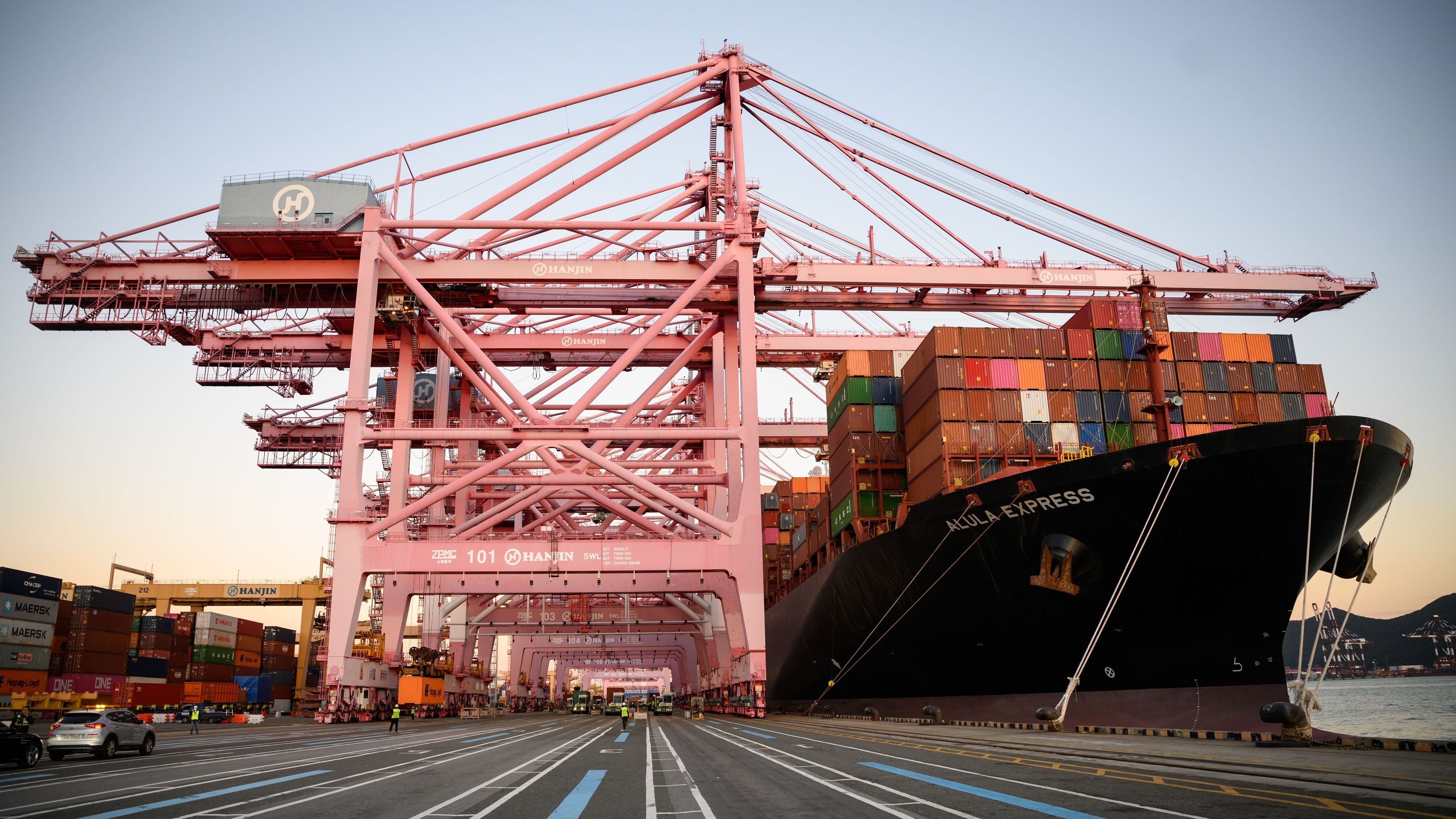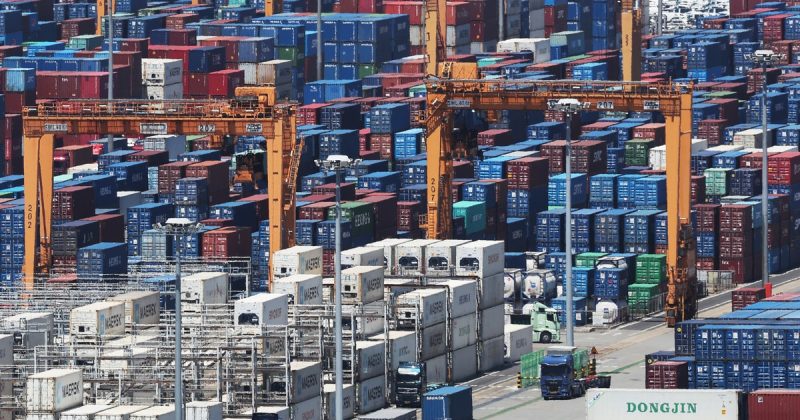
Memory supercycle brings $40,000 income milestone closer Containers sit stacked at a port terminal in Incheon, June 1. (Newsis) Riding a wave of AI-driven semiconductor demand, South Korea's economy grew 1.8 percent in the January-March period, as booming chip exports powered one of the strongest expansions in recent years, central bank data showed Tuesday.The country's real gross domestic product expanded 1.8 percent from the previous quarter, 0.1 percentage point higher than the Bank of Korea's preliminary estimate released in April.The stronger-than-expected growth was largely fueled by the semiconductor industry, with surging artificial intelligence-related demand driving chip exports and investment and reinforcing the economy's growth momentum.Exports, a major pillar of GDP, climbed 5.9 percent on shipments of information technology products, particularly chips, while manufacturing output and facility investment advanced 3.9 percent and 6.6 percent, respectively."A 0.1 percentage-point upward revision in first-quarter real GDP adds about 0.1 percentage point to the annual growth estimate," Kim Hwa-yong, director of the production, expenditure and income division at the BOK, said at a press conference.The comment suggests that the central bank's latest 2.6 percent growth forecast for this year, revised up from 2 percent in February, could be nudged closer to 2.7 percent if current conditions persist."We expect to reassess the yearly outlook in August under these updated conditions," Kim said.The 1.8 percent expansion was the strongest quarterly performance since the third quarter of 2020.The economy looked even stronger in nominal terms. Nominal GDP, which measures economic output at current market prices, surged 10.5 percent from the previous quarter, marking the sharpest rise in 50 years since 1976.The steep increase was driven by soaring export prices as booming demand for semiconductors pushed up both shipment volumes and chip prices."The stronger nominal GDP growth has been driven not by domestic inflation, but by an improvement in the earnings of Korean exporters," Kim said, adding that it differs from past episodes of cost-driven inflation.The data also showed the country's real gross national income, the total income earned by a nation's people and businesses, reached 647 trillion won last year, marking a 9.2 percent increase from a year before.The increase far outpaced real GDP growth, reflecting strong net factor income from abroad amid higher semiconductor prices.With per capita GNI rising 0.3 percent from a year earlier to $36,963 last year, the $40,000 threshold remains within reach. The won-dollar exchange rate remains the key variable, however, as a weaker won reduces per capita GNI when converted into dollar terms.Korea's per capita GNI first surpassed $30,000 in 2014 and rose steadily to reach a record high of $37,898 in 2021. It then fell back to the $35,000 range in 2022 as the Korean won depreciated sharply, and has remained in the $36,000 range for three consecutive years from 2023 through 2025."If the current growth continues, per capita income could approach the level this year. In March, we projected 2028 as the target year, but the possibility of reaching it sooner has clearly increased," Kim said."The timeline for reaching $40,000 is moving faster than previously expected," he said, adding the attainment of the milestone would hinge on corporate earnings and the won's valuation against the greenback.
AI chip boom fuels Korea's fastest growth in 5 years
Riding a wave of AI-driven semiconductor demand, South Korea's economy grew 1.8 percent in the January-March period, as booming chip exports powered one of the
526 words~2 min read