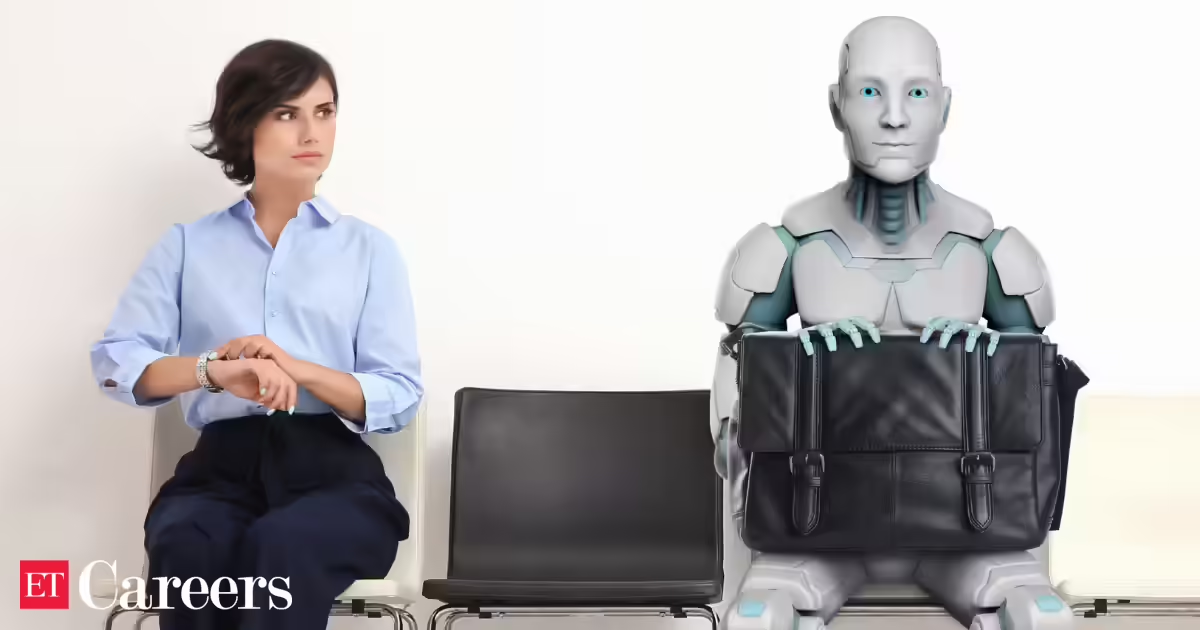
This time last year, The Irish Times wrote that “it’s a great time to be a graduate in Ireland.” However, with social media giant Meta laying off 20 per cent of its Irish workforce last month, amid a general sense of uncertainty around artificial intelligence (AI) and fears of a global slowdown due to war and conflict, we’d hesitate to say the same this year.But it’s not all bad news.The numbers suggest graduate recruitment is holding steady, but behind that stability employers are hiring more cautiously, more selectively and with a sharper eye on skills than ever before.We consulted widely with a range of employment experts about the picture in 2026. What emerges from their insights – as well as the relatively limited data on the current hiring picture – is not blindly optimistic but, reassuringly, nobody thinks it is dire either.Gavin Connell is head of careers at the University of Limerick, which publishes the Early Careers Employer Survey, one of the most detailed annual snapshots of the Irish early careers market.Connell says that around 88 per cent of the 269 employers surveyed for this year’s Early Careers Employer Publication expect graduate vacancies to either remain stable or increase. “What has changed is not necessarily the number of opportunities, but the level of caution and selectivity in hiring,” he says.Libby Kelly is chief executive of Brightwater Group, a recruitment specialist. “Overall, in 2026 we are seeing a strong but disciplined recruitment market,” she says. “There continues to be low unemployment, with a healthy demand for specialist talent and equally a resilient graduate market. However, there remains some caution amongst employers as they seek to assess the potential impact of AI on hiring parameters.”Unemployment stands at 4.7 per cent, which is widely considered to be “full employment”. But Clodagh Kerr, work integrated learning lead in the UCC office for the vice-president of learning, points out that youth unemployment is significantly higher, at around 14 per cent. And, she says, the graduate cohort is competing in a market where employer caution, increased application volumes and the growing use of automated screening have raised the bar for entry. That said, not all recruiters are using AI, she adds, and many are particularly wary of using it for interviewing and assessing candidates.“The market is more cautious and selective compared to the post-pandemic surge,” she says. “Employers are hiring with tighter headcounts, more targeted requirements and longer recruitment cycles.”The chill winds blow strongest in technology. Recent figures obtained by the Business Post show that the number of 15-to-29-years-olds working in the tech sector fell from 36,000 at the start of 2023 to 25,000 by the end of 2025. Meanwhile, a report from the Department of Finance noted a 30 per cent decline in youth ICT (information and communications technology) employment over that period, describing the trend as “consistent with international evidence which suggests that AI adoption is having its most pronounced impacts on entry-level and junior employees in highly digitised sectors”.“AI has not replaced graduate entry-level jobs,” says Doone O’Doherty, chief people officer at PwC, a professional services firm employing more than 3,000 people across offices in Dublin, Cork and Galway. “If anything, it is making them more exciting than ever.” Doone says AI is removing repetitive tasks from graduates’ plates, freeing them for higher-value work from day one. “That means greater efficiency, faster learning and the chance to get involved in meaningful projects far earlier in their careers than ever before.”At Brightwater, Kelly invokes Jevon’s Paradox – the economic principle that greater efficiency tends to generate more demand, not less. “Technology such as AI or automation will in fact make work faster and cheaper, so it won’t necessarily reduce jobs, but in fact create more work and therefore more hiring,” says Kelly.“There will be more jobs, more industries, an increase in productivity, and this will in turn generate fresh employment demand.”Dr Karina Doorley, research area coordinator at the Economic and Social Research Council (ESRI) for the tax, welfare and pensions team, is a co-author of a recent report on AI and income inequality. She takes a different view. “When it comes to AI, no matter what scenario you look at, widespread adoption results in average income losses for households, because the employment loss outweighs the wage gain.“This also results in an increase in income inequality in Ireland because you have this mix of job losses, which increase the number of households with zero income, and wage increases for those who keep their jobs. So you have this increased polariation in the income distribution.”For now, she says, the most visible effect is a slowdown in entry-level hiring, rather than large-scale lay-offs.Beyond technology, the picture is more encouraging. Brightwater’s Kelly identifies strong graduate demand in AI and digital transformation, engineering (civil, mechanical, electrical, renewable energy, manufacturing, semiconductors, data centres), healthcare and life sciences, financial services, and professional services and consulting.UCC’s Kerr points to growth in bioinformatics, environmental science, ecology, finance, marine biology, sustainable energy and construction. The National Skills Bulletin 2025, she notes, continues to flag software developer roles as experiencing shortages (despite widespread predictions of AI disruption) and highlights acute demand for cybersecurity specialists, information systems analysts, and data scientists. Engineers, in particular, enjoy strong prospects at home and abroad.Although there are points of disagreement, everyone interviewed for this piece agrees on one thing: the most valuable thing a graduate can bring to the 2026 labour market is not a specific set of technical skills, but the capacity to learn, adapt and think.“The most resilient worker now is the worker who can learn and who has the ability to learn new things,” says the ESRI’s Doorley. “The days of the single career focused on a particular area are gone. We’re in a labour market now that requires change and growth and lifelong learning.”PwC’s O’Doherty says technical skills get you through the door. “But it’s transversal skills such as communication, collaboration, critical thinking and resilience that will set you apart and help you thrive in the long run.”For graduates wondering how to stand out in a noisier and more competitive market, UL’s Connell emphasises starting early. “Focus less on applying for hundreds of jobs and more on building evidence of employability through placements, volunteering, projects, networking, LinkedIn engagement and tailored applications.”For all of this, the ESRI’s Doorley is cautiously optimistic about the longer term. “If you look at all of the technological revolutions throughout history, there’s always been job destruction, but there has also always been job creation. Something like 60 per cent of jobs that exist today did not exist in 1940.”The challenge with AI, she says, is that it is differently disruptive from previous waves of technology: rather than displacing lower-skilled workers, it primarily threatens high-skilled, cognitive roles.“It’s going to displace high-skilled workers, and that’s very different,” she says.
What sort of workforce are graduates entering, and what do they need to know?
AI means the employment environment is changing, but there are indications of resilience in the graduate jobs market
1,135 words~5 min read