Support CleanTechnica's work through a Substack subscription or on Stripe.
Scaling back the EU’s electric car targets makes the transition to renewables far more expensive to achieve.
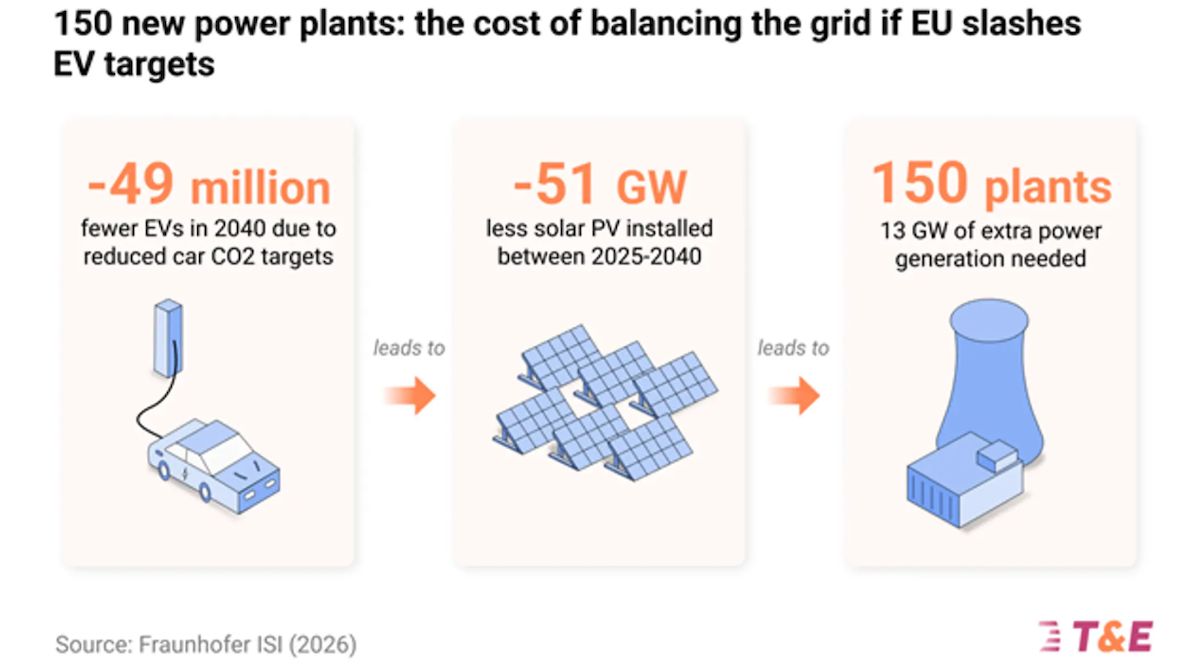
Europe’s electricity system could be one of the biggest victims of plans to scale back electric vehicle targets. By providing ‘batteries on wheels’, EVs are set to fundamentally rewire the math of the electricity sector. But fewer electric cars would mean less storage capacity for the grid to absorb excess wind and solar energy and feed back at times of peak electricity demand. To make up the difference, EU countries would have to provide new power generation equivalent to building 150 extra power plants, a new study finds.¹
In the study for T&E, Fraunhofer ISI assessed the diminished potential of vehicle-to-grid (V2G) technology in the EU if EU targets are weakened. V2G is a technology which allows EVs to push power back into the grid when there is a shortfall. But car industry lobby ACEA has demanded the EU scale back its car CO2 targets, which would result in 49 million fewer EVs on European roads in 2040. The EU Parliament’s lead MEP on the targets has proposed weakening them even further.
Fewer EVs would result in large amounts of excess energy being wasted and reduce the additional deployment of new solar PV by more than a third, the study finds. There would be 37% less new solar PV (-51 GW) installed in the EU between 2025-2040 if EU car CO2 targets are weakened as the car lobby ACEA industry demands.